Showing posts with label Berkeley. Show all posts

Tuesday, January 7, 2020

Let There Be Peace

I hoped when Posters for Peace was published in 2015 by the Penn State University Press some of the anonymous artists of the posters would come forward. One artist, Jay Belloli, was known to me at the time of publication. Then another of the artists, Phil Allen, identified himself. Now another of the artists, Robin Repp has come forward.

With her permission I enclose Ms. Repp's letter to me about the creation of the posters. The plate numbers to which Ms. Repp refers are from Thomas W. Benson, Posters for Peace: Visual Rhetoric and Civic Action (Pennsylvania State University Press, 2015).

Here are the posters to which Ms. Repp refers, with plate numbers from the published book.

Robin Repp. Let There Be Peace and Let It Begin With Me. Plate 28.


Robin Repp. Did We Really Come in Peace for All Mankind? Plate 47.


Robin Repp and Michael [?]. It's Only the Beginning. Plate 27.


December 19, 2019

Hello Mr. Benson,

Thank you for your recent letter.  Yes, it was me who wrote the review on Amazon of your book, Posters for Peace. l really enjoyed reading your book.

Plate 28 and 47 are two of mine. Also, plate 27 I collaborated with a friend, Michael whose last name, I don't remember. It was May 1970, when I made my posters at home with photo silk screen techniques, printing on large paper, 26x40 and 17x22 that I purchased at a local store(Ponderosa?) on Page Street. I bought my screens at California Process Supply in Berkeley.  All of my posters were not part of the workshop that printed on that smaller, old computer paper. I made another poster that is not in the book, "The Cruel War is Raging", included in the Guardian article listed below.

I did bring my screens into the classroom when everyone started printing posters in large quantities. Lincoln Cushing, who lives in Berkeley has researched political posters extensively. You may know him? (http://www.docspopuli.org/articles/Bancroft/1970folio/1970folio.html and http://www.docspopuli.org/articles/Bancroft/1970workshop.html)

The Guardian, London, interviewed me a couple of years ago when there were 2 shows in London, one at the Stapero Modern and another exhibition at The Victoria and Albert Museum which included several of my posters.
and

That would be great if you can make the proper attributions. If I can connect with the other artists, that would be wonderful.  The 50 anniversary exhibition idea would definitely be of interest. Since the original show was in the Berkeley Art Museum, organized by Hershel Chipp, seems like that would be the perfect place, or Worth Ryder Gallery.

Thank you for reaching out to me. I look forward to hearing more in the future.

Best regards,
Robin Repp


 Artist 
OCCCA

https://www.saatchiart.com/robinrepp

Wednesday, January 27, 2016

STOP! Which Came First?

Stop Sign with Santorum bumper sticker. Near a Wegmans supermarket, State College, Pennsylvania, January 2016.

"Stop War" poster, silk screen, Berkeley, California, c. May 1970, from Thomas W. Benson Political Protest Collection, Special Collections, Penn State University Libraries and Thomas W. Benson, Posters for Peace: Visual Rhetoric and Civic Action (University Park: Penn State University Press, 2015).


When is the last time you saw a STOP sign decorated with an addition that constituted it as a political slogan? The "Stop War" poster shown above was part of the peace movement at the University of California, Berkeley, in May 1970, after the Cambodia invasion and the shootings at Kent State. Did the poster prompt others to add words to STOP signs, or was the poster artist inspired by a practice that was already ongoing? I can't remember, though it seems to me I saw STOP WAR on public STOP signs around the country at about that time, and perhaps before.

The STOP SANTORUM sign in the photograph above refers to and is a relic of the presidential primary campaign of 2012, and it was still there this week when I took the photograph -- January 2016.

It seems to me that the tone of these STOP WAR alterations was at the time somewhat transgressive, suggesting not only an appeal to peace but an act of resistance by defacing what is, after all, government property and a sign of government's regulative power. As the years have gone by, that cluster of rhetorical suggestions seems to me to have dimmed somewhat, with the worldwide spread of graffiti. Altering a STOP sign is still illegal, and so still formally an act of resistance or at least of exclamatory, even imperative, appeal, but the power has been diluted by use and context. STOP sign defacements are no longer the property of the Left, though probably most of such uses are anti-establishment in context and appeal. One has often seen, for example, Ron Paul, and now Rand Paul defacement of traffic signs. Are we all anti-establishment now?

See also http://nyti.ms/1Lrhss3 "Why Can't the GOP Stop Trump?" March 3, 2016.


Thursday, January 14, 2016

Choice names Posters for Peace among Editors' Top Community College Resources

Choice has named Posters for Peace as among "Editors' Top 75 Community College Resources" for November 2015.

http://www.amazon.com/Posters-Peace-Visual-Rhetoric-Action/dp/0271065877/ref=sr_1_1?s=books&ie=UTF8&qid=1452790930&sr=1-1&keywords=benson+posters+for+peace
"Within the wider academic community, the number of two-year colleges is growing nationwide, and Choice is poised to help the libraries on these campuses, where much of the work revolves around three main challenges: how to help students learn; how to improve academic and program performance; and how to promote innovation."

Tuesday, November 3, 2015

No Nixon Agnew War -- artist identified as Karl Kasten

"No Nixon Agnew War." Poster, silk screen. Artist: Karl Kasten. From the Thomas W. Benson Political Protest Collection, Penn State University libraries. 


The artist has been identified as Karl Kasten, a professor of art practice at Berkeley in 1970. Source: note to the author from Phil Allen, received November 3, 2015 (see next note on blog). The poster is Plate 20 in Thomas W. Benson, Posters for Peace: Visual Rhetoric and Civic Action (University Park: Pennsylvania State University Press, 2015).


Run This One Up Your Flagpole, Dick -- artist comes forward

"Run this one up Your Flagpole, Dick!" Poster, silk screen, Berkeley, California, c. May 1970. Artist: Phil Allen. The poster is in the Thomas W. Benson Political Protest Collection at the Pennsylvania State University libraries.


Since the publication of Posters for Peace: Visual Rhetoric and Civic Action (University Park: Penn State University Press, 2015) I have been hoping that some of the unknown artists who designed and screened these posters would come across the book and get in touch with me to reveal something more about the origins, organization, and aftermath of the posters, which were produced at the University of California, Berkeley, in the weeks after the U. S. invasion of Cambodia and the killings at Kent State University and Jackson State College.

Just yesterday, one of the artists, Phil Allen, came forward to identify himself as the artist of the poster "Run this on up Your Flagpole, Dick!"  Here is his note (reproduced here with permission):

-----
Dear Prof. Benson,..

I'm glad I thumbed through the copy of Posters for Peace newly displayed at my local city library, as two of the depicted posters --screened at UC-Berkeley in the Spring of 1970--hold more-than-routine attention.

I designed/screened the one shown in Plate 18. It gave me a chance to exercise my newly-recovered (childhood) interest in flags, and include 'clever' language and an Oliphant-like caricature of Mr. Nixon. The registration number '4973' was shared by other artists, as required by some quasi-authority in charge of the liberated classroom in Kroeber Hall. The slanted line and triangle is my stylized monogram. Vexillarily, I've since gone on design and research flags. If there is an authority on the football penalty flag, I am he.

Plate 20 was the work of one of my art-practice professors, Karl Kasten. It has a level of quality missing in most of the others we cranked out. Nice of him to include one of the lesser grim personalities of the era.

Plates 27, 31, and 53 have always been particularly effective for me. 27 and 53 were to me something of a personal invitation to wrestle with inner beliefs and outward commitment, and 31 is possibly the most enduring single image of all our creations. I still see it around.

Many folks hereabouts had quite a time of it recently, as last autumn the 50th anniversary of the Free Speech Movement was celebrated with many gatherings, albeit with fewer notables due to death. I found myself unable to get involved in '64, still being in high school at the time, and full of adult envy. I decided to be a grump about it last year until I realized that my time came during that highly-charged, far less remembered Spring of 1970: Cambodia's invasion and 4-5 more killings at Kent/Jackson, and locally...Peoples' Park (1 more death); many energized youth who got progressives elected to state and national office, and those posters. When 2020 comes around, I'll be ready.

phil allen, Cal '71 (Art)
-----------
If this posting reaches anyone who was one of the artists, or who knows one of the artists, I hope you will come forward so that we can continue to add more fully to the historical account. Please consider sharing this on Facebook and other social media, so that it might eventually reach some of the other artists.

See also Amerika Is Devouring Its Children

Saturday, May 16, 2015

People's Park

photo: Mural at Haste Street and Telegraph Avenue, Berkeley, California. Detail showing the killing of James Rector by Alameda County Sheriff's Deputies on May 15, 1969. Photo by Tom Benson, February 2013 (copyright).


On May 15, 1969, students at the University of California, Berkeley, and local citizens, demonstrated against California Governor Ronald Reagan's arbitrary fencing off of an unused field near the university that had become known as People's Park.

Oakland police, state police, and, Alameda County sheriff's deputies, many of them Vietnam Veterans, were called on to quell the demonstrations and were issued live ammunition. The deputies were apparently armed with shotguns, loaded with buckshot.

James Rector, a graduate student, was with a group of friends watching the events from a rooftop when deputies opened fire. Rector was killed. Another bystander was blinded.


Monday, May 11, 2015

God Bless the Establishment

On May 11, 1970, New York construction workers again attacked students who were demonstrating against the war. A front page picture shows workers holding up a huge printed sign bearing the words

WE SUPPORT NIXON AND AGNEW
GOD BLESS THE ESTABLISHMENT

In Augusta, Georgia, state troopers and the National Guard confronted a riot. Four African Americans were shot and killed.


poster: from poster workshop at University of California, Berkeley, May 1970. Thomas W. Benson Political Protest Collection, Penn State University.


see:

Bigart, Homer. “Thousands Assail Lindsay In 2d Protest by Workers: Thousands Assail Lindsay at City Hall.” New York Times. May 12, 1970.
“4 Dead, Guard Called In Augusta Disorder: 3 DIE, GUARD SENT TO AUGUSTA, GA.” New York Times. May 12, 1970.

Thursday, May 7, 2015

Amerika Is Devouring Its Children

Jay Belloli, "Amerika Is Devouring Its Children," poster, Berkeley, California, c. May 1970. This image from the Thomas W. Benson Political Protest collection at Penn State.


Francisco de Goya, "Saturn Devouring His Son," oil, 1819-1823; original in the Prado, Madrid; this image public domain from Wikipedia.

See also Thomas W. Benson, Posters for Peace: Visual Rhetoric and Civic Action (University Park: Penn State University Press, 2015).

Most of the student- and faculty-made antiwar posters circulated from the Berkeley campus in May 1970 were anonymous. Some time later, Jay Belloli revealed his authorship of "Amerika Is Devouring Its Children." Belloli had been an undergraduate art history major at Stanford who in 1970 was an art history graduate student at Berkeley. See his recent YouTube account of his work.


Sunday, April 19, 2015

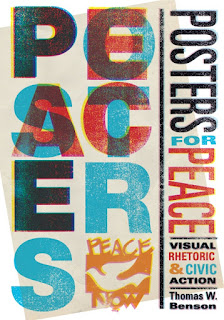
Posters for Peace


Thomas W. Benson, Posters for Peace: Visual Rhetoric and Civic Action. University Park: Penn State University Press, 2015.

from the publisher:
“With Posters for Peace: Visual Rhetoric and Civic Action, Thomas Benson generously shares an archival treasure trove with readers. By itself that might be enough, but Benson doesn't stop there. He offers a thoughtful and sophisticated rhetorical analysis of the posters that reads them in historical context, elaborates the visual traditions from which they drew their representations, and considers how viewers of the era might have responded to them. In doing so, he makes a compelling case for the posters' rhetorical importance, both then and now. The book skillfully models the practice of visual rhetorical history for students and scholars alike.”
“Thomas Benson has rediscovered and shared a treasure of poster art, along with some history, brilliantly told.”
“Long before there was a subdiscipline called ‘visual rhetoric,’ Thomas Benson was probing the rhetorical dimensions of visual images. His books on the films of Frederick Wiseman and on political documentaries set the standard for rhetorically informed criticism of documentary film. Now Benson has turned his attention to the political protest posters that appeared in Berkeley, California, throughout the tumultuous year of 1970. Benson was a visiting assistant professor at UC–Berkeley during the 1969–70 academic year, where he witnessed firsthand the distribution and placement of many of the posters he examines in this book. He places the posters in their political, cultural, social, and rhetorical contexts, and he engages in a close reading that uncovers the layers of meaning and significance that were clear to the creators at the time of production but which now, almost forty-five years later, are often lost in the mists of time. This is a masterful work of recovery that reminds us anew of that time when the whole world was watching.”
“Thomas W. Benson's Posters for Peace examines numerous political posters that circulated in Berkeley, California, in 1970 during intense controversies over the Vietnam War and racism. Benson’s critical approach features close examination of the posters in combination with creative comparisons in order to explore their visual rhetoric in the national scene. To develop his central argument, he traces earlier sources of consequence pertaining to posters as a rhetorical medium with an international history. Benson's book offers his readers a wealth of previously unstudied primary materials, which are featured and catalogued in the course of his careful history and criticism of the protest rhetoric.”
By the spring of 1970, Americans were frustrated by continuing war in Vietnam and turmoil in the inner cities. Students on American college campuses opposed the war in growing numbers and joined with other citizens in ever-larger public demonstrations against the war. Some politicians—including Ronald Reagan, Spiro Agnew, and Richard Nixon—exploited the situation to cultivate anger against students. At the University of California at Berkeley, student leaders devoted themselves, along with many sympathetic faculty, to studying the war and working for peace. A group of art students designed, produced, and freely distributed thousands of antiwar posters. Posters for Peace tells the story of those posters, bringing to life their rhetorical iconography and restoring them to their place in the history of poster art and political street art. The posters are vivid, simple, direct, ironic, and often graphically beautiful. Thomas Benson shows that the student posters from Berkeley appealed to core patriotic values and to the legitimacy of democratic deliberation in a democracy—even in a time of war.

Saturday, December 6, 2014

Quirky Berkeley

A recent New York Times article describes a blog called Quirky Berkeley. It's worth a look.

http://nyti.ms/1z5bm7J

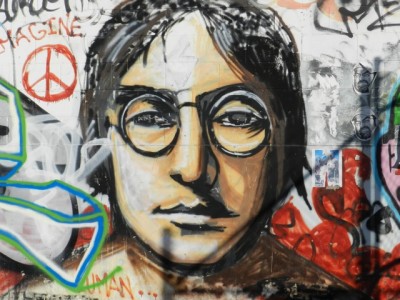
John Lennon mural, from Quirky Berkeley -  © 2014 by Quirky Berkeley

Railroad tracks, south of Addison


Wednesday, March 14, 2012

Political Poster Collection now of Flickr


The Political Poster collection that I donated to Penn State is now available on Flickr -- which permits comments. I am hoping that this will elicit some participants, and perhaps some of the artists, to recall the era. The collection is here.

Monday, November 21, 2011

Peace Now

Political protest art focus of University Libraries exhibit

Friday, November 11, 2011

An exhibit featuring political protest art from the Thomas W. Benson Collection, will be on display from Nov. 18 to Feb. 1, 2012, in the Diversity Studies Room, 203 Pattee Library, Penn State University. The collection captures the intensely political climate and emerging student engagement with war, patriotism and anti-imperialism in the late 1960s and early 1970s. The exhibit is open during standard library hours. Call 814-865-3063 to confirm times.

Benson will give a gallery talk at 4 p.m. on Tuesday, Nov. 29, in the Foster Auditorium, 102 Paterno Library and also on MediaSite Live at www.libraries.psu.edu/mtss. No login required.

The Benson Political Protest Poster Collection began in August 1969, when Thomas W. Benson, then on the faculty of SUNY Buffalo, arrived as visiting professor to spend the year in the Department of Rhetoric at the University of California, Berkeley. Political activity on campus was common though a fairly quiet presence, but the climate on the Berkeley campus changed dramatically in 1969 when the public learned of the 1968 My Lai Massacre, a murder of more than 350 innocent victims by U.S. troops. This massacre, combined with then Governor Ronald Reagan’s anti-University campaign and fiscal cuts, along with President Nixon’s April 1970 Cambodian invasion, fueled emotional demonstrations and strikes by faculty and students.

Benson noted, “The university became a sort of teach-in about the war.” Student design artists and activists banded together and created the Berkeley Political Poster Workshop that designed, printed, and distributed hundreds of political protest posters in support of the anti-war movement.

The Eberly Family Special Collections Library acquired the political protest posters in 2009 as a gift from Benson, the Edwin Erle Sparks Professor of Rhetoric, Communication Arts and Sciences, Penn State College of the Liberal Arts, and the editor of the series in Rhetoric and Communication for the University of South Carolina Press.

To view the full online Thomas W. Benson Political Protest Digital Collection, go to http://www.libraries.psu.edu/psul/digital/benson.html online.

Library announcement is here.

Police Attack at UC Berkeley


Police at the University of California, Berkeley, attacked students with billy clubs as part of the response to the Occupy movement there. The video above is borrowed from You Tube and from a story about the attacks in the Huffington Post.

See also Robert Hass, "Poet-Bashing Police," New York Times, 19 November 2011.

Monday, September 5, 2011

Political Poster Collection


A collection of political posters -- most of them from Berkeley in May 1970 -- is now online at the Penn State Libraries. I collected the posters at the time, and donated them to Penn State a couple of years ago, where they have been under development as a special collection, thanks to James Quigel, Head of Historical Collections and Labor Archives in the Special Collections Library, and the staff of the Libraries. Ellysa Cahoy at the Libraries has also been important to its development, and tells me the collection will soon be mounted on Flickr, as the Library's first-ever interactive on-line exhibit.

Thomas W. Benson Political Protest collection