Showing posts with label peace. Show all posts

Tuesday, January 7, 2020

Let There Be Peace

I hoped when Posters for Peace was published in 2015 by the Penn State University Press some of the anonymous artists of the posters would come forward. One artist, Jay Belloli, was known to me at the time of publication. Then another of the artists, Phil Allen, identified himself. Now another of the artists, Robin Repp has come forward.

With her permission I enclose Ms. Repp's letter to me about the creation of the posters. The plate numbers to which Ms. Repp refers are from Thomas W. Benson, Posters for Peace: Visual Rhetoric and Civic Action (Pennsylvania State University Press, 2015).

Here are the posters to which Ms. Repp refers, with plate numbers from the published book.

Robin Repp. Let There Be Peace and Let It Begin With Me. Plate 28.


Robin Repp. Did We Really Come in Peace for All Mankind? Plate 47.


Robin Repp and Michael [?]. It's Only the Beginning. Plate 27.


December 19, 2019

Hello Mr. Benson,

Thank you for your recent letter.  Yes, it was me who wrote the review on Amazon of your book, Posters for Peace. l really enjoyed reading your book.

Plate 28 and 47 are two of mine. Also, plate 27 I collaborated with a friend, Michael whose last name, I don't remember. It was May 1970, when I made my posters at home with photo silk screen techniques, printing on large paper, 26x40 and 17x22 that I purchased at a local store(Ponderosa?) on Page Street. I bought my screens at California Process Supply in Berkeley.  All of my posters were not part of the workshop that printed on that smaller, old computer paper. I made another poster that is not in the book, "The Cruel War is Raging", included in the Guardian article listed below.

I did bring my screens into the classroom when everyone started printing posters in large quantities. Lincoln Cushing, who lives in Berkeley has researched political posters extensively. You may know him? (http://www.docspopuli.org/articles/Bancroft/1970folio/1970folio.html and http://www.docspopuli.org/articles/Bancroft/1970workshop.html)

The Guardian, London, interviewed me a couple of years ago when there were 2 shows in London, one at the Stapero Modern and another exhibition at The Victoria and Albert Museum which included several of my posters.
and

That would be great if you can make the proper attributions. If I can connect with the other artists, that would be wonderful.  The 50 anniversary exhibition idea would definitely be of interest. Since the original show was in the Berkeley Art Museum, organized by Hershel Chipp, seems like that would be the perfect place, or Worth Ryder Gallery.

Thank you for reaching out to me. I look forward to hearing more in the future.

Best regards,
Robin Repp


 Artist 
OCCCA

https://www.saatchiart.com/robinrepp

Wednesday, January 27, 2016

STOP! Which Came First?

Stop Sign with Santorum bumper sticker. Near a Wegmans supermarket, State College, Pennsylvania, January 2016.

"Stop War" poster, silk screen, Berkeley, California, c. May 1970, from Thomas W. Benson Political Protest Collection, Special Collections, Penn State University Libraries and Thomas W. Benson, Posters for Peace: Visual Rhetoric and Civic Action (University Park: Penn State University Press, 2015).


When is the last time you saw a STOP sign decorated with an addition that constituted it as a political slogan? The "Stop War" poster shown above was part of the peace movement at the University of California, Berkeley, in May 1970, after the Cambodia invasion and the shootings at Kent State. Did the poster prompt others to add words to STOP signs, or was the poster artist inspired by a practice that was already ongoing? I can't remember, though it seems to me I saw STOP WAR on public STOP signs around the country at about that time, and perhaps before.

The STOP SANTORUM sign in the photograph above refers to and is a relic of the presidential primary campaign of 2012, and it was still there this week when I took the photograph -- January 2016.

It seems to me that the tone of these STOP WAR alterations was at the time somewhat transgressive, suggesting not only an appeal to peace but an act of resistance by defacing what is, after all, government property and a sign of government's regulative power. As the years have gone by, that cluster of rhetorical suggestions seems to me to have dimmed somewhat, with the worldwide spread of graffiti. Altering a STOP sign is still illegal, and so still formally an act of resistance or at least of exclamatory, even imperative, appeal, but the power has been diluted by use and context. STOP sign defacements are no longer the property of the Left, though probably most of such uses are anti-establishment in context and appeal. One has often seen, for example, Ron Paul, and now Rand Paul defacement of traffic signs. Are we all anti-establishment now?

See also http://nyti.ms/1Lrhss3 "Why Can't the GOP Stop Trump?" March 3, 2016.


Thursday, January 14, 2016

Choice names Posters for Peace among Editors' Top Community College Resources

Choice has named Posters for Peace as among "Editors' Top 75 Community College Resources" for November 2015.

http://www.amazon.com/Posters-Peace-Visual-Rhetoric-Action/dp/0271065877/ref=sr_1_1?s=books&ie=UTF8&qid=1452790930&sr=1-1&keywords=benson+posters+for+peace
"Within the wider academic community, the number of two-year colleges is growing nationwide, and Choice is poised to help the libraries on these campuses, where much of the work revolves around three main challenges: how to help students learn; how to improve academic and program performance; and how to promote innovation."

Wednesday, November 18, 2015

Rescuing Refugees

Ralph M. Faust in 1945, as principal of Oswego High School, Oswego, New York

Saturday, June 20, 2015 was World Refugee Day. I was invited, thanks to the good offices of Nola Heidlebaugh, to accept on behalf of my late uncle Ralph the Ralph M. Faust Humanitarian Award--awarded to Ralph M. Faust, who was principal of Oswego High School in Oswego, New York (1939-1964). In 1944, President Franklin Roosevelt authorized the establishment of a refugee shelter at Fort Ontario, in Oswego, New York, which is now the Safe Haven Museum and Education Center. The Ralph M. Faust Humanitarian Award was presented for the first time this year and is expected to be an annual award. In 1944, 983 refugees, mostly Jewish, were brought to the center from Italy, to which they had fled from all over Europe to escape Nazi persecution. When they arrived in Oswego, Ralph M. Faust played a leading role in welcoming them to the community and arranged for 40 of them to attend Oswego High School. He is remembered as a hero by many of the refugees, who were eventually allowed to immigrate and apply for citizenship. They left the camp in January 1946. The photograph shows Ralph Faust in 1945, from the Oswego High School yearbook. See also the short video about the refugees -- https://youtu.be/I1eptVZhoCk

Monday, November 16, 2015

Peace for Paris

 Peace for Paris. Designed by Jean Jullien.

Some links on the story of this design, which is circulating rapidly after the recent attacks in Paris--

"French Artist Tells How He Created 'Symbol of Peace for Paris.'" Time.

Fast Co. Design


Sunday, April 19, 2015

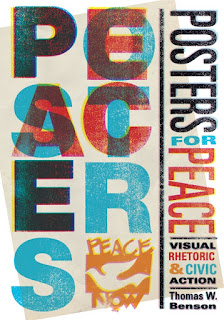
Posters for Peace


Thomas W. Benson, Posters for Peace: Visual Rhetoric and Civic Action. University Park: Penn State University Press, 2015.

from the publisher:
“With Posters for Peace: Visual Rhetoric and Civic Action, Thomas Benson generously shares an archival treasure trove with readers. By itself that might be enough, but Benson doesn't stop there. He offers a thoughtful and sophisticated rhetorical analysis of the posters that reads them in historical context, elaborates the visual traditions from which they drew their representations, and considers how viewers of the era might have responded to them. In doing so, he makes a compelling case for the posters' rhetorical importance, both then and now. The book skillfully models the practice of visual rhetorical history for students and scholars alike.”
“Thomas Benson has rediscovered and shared a treasure of poster art, along with some history, brilliantly told.”
“Long before there was a subdiscipline called ‘visual rhetoric,’ Thomas Benson was probing the rhetorical dimensions of visual images. His books on the films of Frederick Wiseman and on political documentaries set the standard for rhetorically informed criticism of documentary film. Now Benson has turned his attention to the political protest posters that appeared in Berkeley, California, throughout the tumultuous year of 1970. Benson was a visiting assistant professor at UC–Berkeley during the 1969–70 academic year, where he witnessed firsthand the distribution and placement of many of the posters he examines in this book. He places the posters in their political, cultural, social, and rhetorical contexts, and he engages in a close reading that uncovers the layers of meaning and significance that were clear to the creators at the time of production but which now, almost forty-five years later, are often lost in the mists of time. This is a masterful work of recovery that reminds us anew of that time when the whole world was watching.”
“Thomas W. Benson's Posters for Peace examines numerous political posters that circulated in Berkeley, California, in 1970 during intense controversies over the Vietnam War and racism. Benson’s critical approach features close examination of the posters in combination with creative comparisons in order to explore their visual rhetoric in the national scene. To develop his central argument, he traces earlier sources of consequence pertaining to posters as a rhetorical medium with an international history. Benson's book offers his readers a wealth of previously unstudied primary materials, which are featured and catalogued in the course of his careful history and criticism of the protest rhetoric.”
By the spring of 1970, Americans were frustrated by continuing war in Vietnam and turmoil in the inner cities. Students on American college campuses opposed the war in growing numbers and joined with other citizens in ever-larger public demonstrations against the war. Some politicians—including Ronald Reagan, Spiro Agnew, and Richard Nixon—exploited the situation to cultivate anger against students. At the University of California at Berkeley, student leaders devoted themselves, along with many sympathetic faculty, to studying the war and working for peace. A group of art students designed, produced, and freely distributed thousands of antiwar posters. Posters for Peace tells the story of those posters, bringing to life their rhetorical iconography and restoring them to their place in the history of poster art and political street art. The posters are vivid, simple, direct, ironic, and often graphically beautiful. Thomas Benson shows that the student posters from Berkeley appealed to core patriotic values and to the legitimacy of democratic deliberation in a democracy—even in a time of war.

Saturday, December 6, 2014

Quirky Berkeley

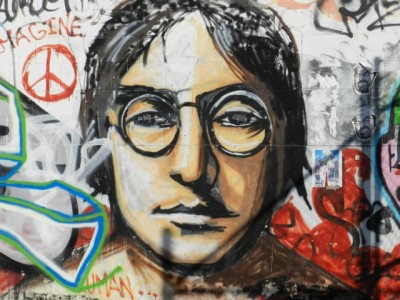
A recent New York Times article describes a blog called Quirky Berkeley. It's worth a look.

http://nyti.ms/1z5bm7J

John Lennon mural, from Quirky Berkeley -  © 2014 by Quirky Berkeley

Railroad tracks, south of Addison


Saturday, December 18, 2010

peace / war


Google ngrams for peace / war in its database of texts in English, from 1650.

Friday, November 21, 2008

FDR at Gettysburg on video

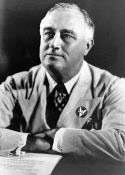
FDR throws out the first ball, Washington, D.C. 24 April 1934
FDR Library, Hyde Park, New York

During his presidency, FDR gave two speeches at Gettysburg, in 1934 and 1938. I've been remembering them this week, since November 19 is the anniversary of Abraham Lincoln's Gettysburg Address.

YouTube has video transfers of some newsreels made on the occasion of FDR's speech at Gettysburg on July 4, 1938, the 75th anniversary of the battle. Reading the speeches now, it is possible to see how, all those years after the end of the Civil War, Roosevelt is still working to re-unite the country. The veterans on that occasion, old men who returned for their last reunion, seemed willing to shake hands and meet as friends. All these years later, 80 years after Roosevelt's 1938 speech at the dedication of a peace memorial on the Gettysburg battlefield, the first comments on the YouTube posting of Roosevelt's speech wave the banner of the lost cause bitter-enders, still not ready for peace.


For more on FDR's 1934 and 1938 Gettysburg speeches, see -- Thomas W. Benson, "FDR at Gettysburg: The New Deal and the Rhetoric of Presidential Leadership," The Rhetoric of Presidential Leadership, ed. Leroy Dorsey (College Station: Texas A&M University Press, 2002), 145-183.


Tuesday, April 22, 2008

Eyes Wide Open

"Eyes Wide Open" is "An Exhibition of the Human Cost of the Iraq War," created by the American Friends Service Committee. The exhibit has appeared in a number of cities since 2004 and is the subject of a documentary film. The rhetoric of the American Friends is unusual in its combination of frankness in opposition to the war and its steady sense of the human dignity of all involved. The AFSC goes beyond advocacy to engage in service to survivors and victims.

The boots seem to invite contemplation. They are laid out as graves might be, with a name for each pair. Their appeal to shared, humane reflection in the open exhibit space calls to mind the AIDS Quilt. The quilt suggested the effort of its many lovingly made panels and the individuality of imagination and experience, as well as the now useless comfort that a quilt might bring to an ailing person. The quilt seems to say, over and over, "it's to late for him, for her, but not too late for the living." Some of this is suggested in the Eyes Wide Open project, but the boots have a different pattern of associations. The boots acknowledge the boots-on-the-ground military commitment of the dead, echoing funerary practices such as the empty boots in the stirrup of a dead officer. The boots suggest the imposed, manufactured, military-issue regularity of the soldier; the grounded, individual fact of the each pair of boots, with its stains and patterns of wear; and the absence of the owner, an absence suggesting both repose and utter violence.