“To those who say this civil rights program is an infringement on states’ rights,” he thundered from the convention podium, “I say this: The time has arrived in America for the Democratic Party to get out of the shadow of states’ rights and to walk forthrightly into the bright sunshine of human rights.”qtd in Rick Perlstein, "America's Forgotten Liberal," New York Times, 27 May 2011.
Friday, May 27, 2011
Hubert Humphrey at 100
Hubert Humphrey at the Democratic National Convention, 1948:


Monday, May 16, 2011
Speaking Hermeneutically

John Arthos, Speaking Hermeneutically: Understanding in the Conduct of a Life (Columbia: University of South Carolina Press, 2011), series in Rhetoric / Communication.
from the publisher:
John Arthos discovers and promotes an organic reciprocity between rhetoric as a humanist practice and hermeneutics as a theoretical comportment. Although these two traditions have a long and rewarding collaboration, it is only now that we begin to realize their potential for radically remaking the way we think and speak as social animals. Arthos marries the performative competencies of rhetorical practice with the circularity of hermeneutic understanding in a way that redefines the syntax of a humanist education in the twenty-first century. As a counter to the linear, technical rationalism that permeates common culture and educational praxis, Speaking Hermeneutically shows how a hermeneutically inflected rhetoric can lead to refashioning habits of thought and speech, the constitution of personal identity, the conventions of social engagement, and the deliberative practices that form the basis of public institutions. Arthos adapts the hermeneutics of Martin Heidegger, Hans-Georg Gadamer, and Paul Ricoeur to a series of classic rhetorical texts and landmark political moments, modeling the revitalized interchange of traditions in a way that will be accessible to scholars and students in both fields of inquiry.
John Arthos is an associate professor in the Department of Communication and the John and Christine Warner Chair at Denison University in Granville, Ohio. He is also the author of The Inner Word in Gadamer's Hermeneutics.
Friday, May 6, 2011
Roots of new media

Sheila C. Murphy, How Television Invented New Media (Rutgers University Press, 2011).
from the publisher:
Television is a global industry, a medium of representation, an architectural component of space, and a nearly universal frame of reference for viewers. Yet it is also an abstraction and an often misunderstood science whose critical influence on the development, history, and diffusion of new media has been both minimized and overlooked. How Television Invented New Media adjusts the picture of television culturally while providing a corrective history of new media studies itself.
Personal computers, video game systems, even iPods and the Internet built upon and borrowed from television to become viable forms. The earliest personal computers, disguised as video games using TV sets as monitors, provided a case study for television's key role in the emergence of digital interactive devices. Sheila C. Murphy analyzes how specific technologies emerge and how representations, from South Park to Dr. Horrible's Sing-Along-Blog, mine the history of television just as they converge with new methods of the making and circulation of images. Past and failed attempts to link television to computers and the Web also indicate how services like Hulu or Netflix On-Demand can give rise to a new era for entertainment and program viewing online. In these concrete ways, television's role in new and emerging media is solidified and finally recognized.
Wednesday, May 4, 2011
In the Land of Cotton

Karen L. Cox, Dreaming of Dixie: How the South Was Created in American Popular Culture (Chapel Hill: University of North Carolina Press, 2011).
from the publisher:
From the late nineteenth century through World War II, popular culture portrayed the American South as a region ensconced in its antebellum past, draped in moonlight and magnolias, and represented by such southern icons as the mammy, the belle, the chivalrous planter, white-columned mansions, and even bolls of cotton.
In Dreaming of Dixie, Karen Cox shows that the chief purveyors of this constructed nostalgia for the Old South were outsiders of the region, especially advertising agencies, musicians, publishers, radio personalities, writers, and filmmakers playing to consumers' anxiety about modernity by marketing the South as a region still dedicated to America's pastoral traditions. Cox examines how southerners themselves embraced the imaginary romance of the region's past, particularly in the tourist trade as southern states and cities sought to capitalize on popular perceptions by showcasing their Old South heritage. Only when television emerged as the most influential medium of popular culture did views of the South begin to change, as news coverage of the civil rights movement brought images of violence, protest, and conflict in the South into people's living rooms. Until then, Cox argues, most Americans remained content with their romantic vision of Dixie.
Monday, April 18, 2011
Republicans and the Social Compact
Is the Republican Party trying to repeal the New Deal? An editorial in today's New York Times:
"The New Republican Landscape," New York Times, 18 April 2011.
Six months after voters sent Republicans in large numbers to Congress and many statehouses, it is possible to see the full landscape of destruction that their policies would cause — much of which has already begun. If it was not clear before, it is obvious now that the party is fully engaged in a project to dismantle the foundations of the New Deal and the Great Society, and to liberate business and the rich from the inconveniences of oversight and taxes.
"The New Republican Landscape," New York Times, 18 April 2011.
Sunday, April 17, 2011
Fracking PA
Governor Tom Corbett wants Pennsylvania to be the Texas of the next oil and gas boom, based on the exploitation of the natural gas in the Marcellus Shale formation under Pennsylvania. He has said he will veto any attempt to tax the industry, which is alleged to be responsible for toxifying underground water reserves, and for breaking up roads all over Pennsylvania. He is also attempting to evade environmental regulations that might identify and prevent damage to the environment.
Now a new Congressional study on the environmental dangers of fracking -- the hydraulic fracturing system used to extract gas from underground shale.
Ian Urbina, "Chemicals Were Injected into Wells, Report Says," New York Times, 17 April 2011.
Now a new Congressional study on the environmental dangers of fracking -- the hydraulic fracturing system used to extract gas from underground shale.
WASHINGTON — Oil and gas companies injected hundreds of millions of gallons of hazardous or carcinogenic chemicals into wells in more than 13 states from 2005 to 2009, according to an investigation by Congressional Democrats.
Ian Urbina, "Chemicals Were Injected into Wells, Report Says," New York Times, 17 April 2011.
Monday, April 11, 2011
Digital Griots
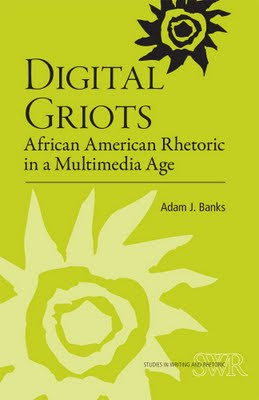 Adam J. Banks, Digital Griots: African American Rhetoric in a Multimedia Age (Carbondale: Southern Illinois University Press, 2011).
Saturday, April 9, 2011
LionSearch

New search function unlocks Libraries' resources
The University Libraries will test a powerful new search function on March 21 that will allow users to find all library resources -- books, articles, newspapers, databases and more -- from a single search box. Called LionSearch, the new service is designed to mimic open Web search methods. Entering a search term in LionSearch will return, nearly instantaneously, a list of relevant physical and digital materials from the Libraries’ collections. LionSearch can be accessed from the Libraries’ homepage, www.libraries.psu.edu, and will debut initially in beta mode. Students, faculty and other users are encouraged to test the functionality of the service and leave feedback.
Penn State is one of a handful of universities around the world pioneering this service for their library collections. This simple and fast way of retrieving information will enhance the research process for students and unlock the wealth of resources available at Penn State.
"New search function unlocks Libraries' resources"
Friday, April 8, 2011
Net Neutrality -- Once There Was an Internet
The House of Representatives has voted to end Net Neutrality --
Edward Wyatt, "House Votes against 'Net Neutrality,'" New York Times, 8 April 2011.
WASHINGTON — The House of Representatives approved a measure on Friday that would prohibit the Federal Communications Commission from regulating how Internet service providers manage their broadband networks, potentially overturning a central initiative of the F.C.C. chairman, Julius Genachowski. . . .
Edward Wyatt, "House Votes against 'Net Neutrality,'" New York Times, 8 April 2011.
Wednesday, April 6, 2011
Of the 1%, by the 1%, for the 1% Society: vanityfair.com
Joseph Stiglitz, "Of the 1%, by the 1%, for the 1%," Vanity Fair, May 2011
Of the 1%, by the 1%, for the 1% Society: vanityfair.com
. . . a modern economy requires “collective action”—it needs government to invest in infrastructure, education, and technology. The United States and the world have benefited greatly from government-sponsored research that led to the Internet, to advances in public health, and so on. But America has long suffered from an under-investment in infrastructure (look at the condition of our highways and bridges, our railroads and airports), in basic research, and in education at all levels. Further cutbacks in these areas lie ahead. . . . <more>
Of the 1%, by the 1%, for the 1% Society: vanityfair.com
Sunday, April 3, 2011
Academic Research and State Propaganda in Britain
D. D. Guttenplan reports in the New York Times on how British research funding for humanist scholars is being used to force them into doing the political work of the current government.
"Two historians have accused the British government of pressuring researchers to study Prime Minister David Cameron's 'Big Society' or lose their funding."D. D. Guttenplan, "Academic Freedom, With Strings Attached?" New York Times, 3 April 2011.
Saturday, April 2, 2011
The Memory Purge in Maine

Peter Catapano on the memory purge in Maine:
Last weekend, on the order of Maine’s governor, Paul LePage, a 36-foot-wide, 11-panel mural, pictured in part below, was removed from the lobby of the state’s Department of Labor building in Augusta. The mural, which depicts scenes from Maine’s labor history, was completed with a $60,000 federal arts grant. (The artist, Judy Taylor, has expressed her dismay at the removal, but should probably send a thank-you note to the governor for the exposure.) LePage, who has been in office for about two months, claimed he removed the mural because of complaints from “some business owners” that it was too pro-union. (A spokesperson for the governor said it was “not in keeping with the department’s pro-business goals.”) . . . [more]
Peter Catapano, "The Mural Vanishes," New York Times, 1 April 2011.
image from Reuters, via New York Times
see also "Buddhas of Bamiyan," Wikipedia
Wednesday, March 30, 2011
The Cost of Freedom (of Information): In Defense of William Cronon - Inside Higher Ed
Barbara Fister at Inside Higher Ed on the Wisconsin Republican e-mail search:
The Cost of Freedom (of Information): In Defense of William Cronon - Inside Higher EdI am a huge fan of open government and of the Freedom of Information Act. The right of the people to request information from public officials is an important tool for journalism, research, and activism. That’s why, as I read responses to a political group’s request for e-mail correspondence from a state employee, my knee does not begin to jerk convulsively. I don’t think, “e-mail!? That’s outrageous! how dare you invade an individual’s privacy?” Not only do I know better than to think a work account is in any respect private or personal, but I remember how outraged I felt when I learned that top officials of the Bush White House used unofficial e-mail accounts to avoid their official correspondence being part of the record. (And I must say I am impressed that there’s a Wikipedia article on this very topic.)
All that said, I am appalled that officials of the Republican Party in Wisconsin have decided to use a public records law to peer into a University of Wisconsin history professor’s e-mail to see if he’s said anything they consider inappropriate and to find out if he can be attacked for violating the university’s policies. (An aside: as a born-and-bred Sconnie who spent my childhood hanging around the UW campus and playing tag in the basement hallways of the capital building, I am baffled and dismayed by recent events and wonder how it can possibly have happened in my home state; as a connoisseur of headlines, “Wisconsin Gets Weirder” is a keeper.) . . .
Tuesday, March 29, 2011
The Intimidation Spreads
E-mail trolling linked to freedom of information requests is apparently becoming a method of intimidation for some Republicans.
Evan McMorris-Santoro, "Conservative Think Tank Seeks Michigan Seeks Michigan Profs' Emails about Wisconsin Union Battle . . . and Maddow," Talking Points Memo, 29 March 2011.
A free enterprise think tank in Michigan -- backed by some of the biggest names in national conservative donor circles -- has made a broad public records request to at least three in-state universities with departments that specialize in the study of labor relations, seeking all their emails regarding the union battle in Wisconsin, Gov. Scott Walker (R-WI) and MSNBC's Rachel Maddow, TPM has learned. . . . [more]
Evan McMorris-Santoro, "Conservative Think Tank Seeks Michigan Seeks Michigan Profs' Emails about Wisconsin Union Battle . . . and Maddow," Talking Points Memo, 29 March 2011.
Monday, March 28, 2011
Academic Freedom in Wisconsin
Editorial in the New York Times, today:
"A Shabby Crusade in Wisconsin," editorial, New York Times, 28 March 2011.
The latest technique used by conservatives to silence liberal academics is to demand copies of e-mails and other documents. Attorney General Kenneth Cuccinelli of Virginia tried it last year with a climate-change scientist, and now the Wisconsin Republican Party is doing it to a distinguished historian who dared to criticize the state’s new union-busting law. These demands not only abuse academic freedom, but make the instigators look like petty and medieval inquisitors. . . .
"A Shabby Crusade in Wisconsin," editorial, New York Times, 28 March 2011.
Is This the New McCarthyism?
Paul Krugman in the New York Times:
Paul Krugman, "William Cronon and the American Thought Police," New York Times, 28 March 2011.
The hard right — which these days is more or less synonymous with the Republican Party — has a modus operandi when it comes to scholars expressing views it dislikes: never mind the substance, go for the smear. And that demand for copies of e-mails is obviously motivated by no more than a hope that it will provide something, anything, that can be used to subject Mr. Cronon to the usual treatment. . . .
Paul Krugman, "William Cronon and the American Thought Police," New York Times, 28 March 2011.
Wisconsin's Republican Progressives
Professor William Cronon in the New York Times:
NOW that a Wisconsin judge has temporarily blocked a state law that would strip public employee unions of most collective bargaining rights, it’s worth stepping back to place these events in larger historical context.
Republicans in Wisconsin are seeking to reverse civic traditions that for more than a century have been among the most celebrated achievements not just of their state, but of their own party as well. . . .
William Cronon, "Wisconsin's Radical Break," New York Times, 22 March 2011.
It did not take long for Wisconsin Republicans to launch a McCarthyite attack on Professor Cronon.
Saturday, March 26, 2011
Bob Herbert, "Losing Our Way"
Bob Herbert's last New York Times column:
Bob Herbert, "Losing Our Way," New York Times, 26 March 2011.
Limitless greed, unrestrained corporate power and a ferocious addiction to foreign oil have led us to an era of perpetual war and economic decline. Young people today are staring at a future in which they will be less well off than their elders, a reversal of fortune that should send a shudder through everyone. . . .
Bob Herbert, "Losing Our Way," New York Times, 26 March 2011.
Friday, March 25, 2011
Where the Action Is - Inside Higher Ed
Russ Olwell, "Where the Action Is," Inside Higher Ed, 25 March 2011.
Where the Action Is - Inside Higher Ed
When asked what they want to do when they grow up, few little kids answer, "I want to teach at a regional public university." They want to be astronauts, fighter pilots, spies or generals (OK, those were my choices at that age). In Ph.D. programs, graduate students are encouraged to seek work and accept positions at the kind of research institutions where they do their doctoral work, whether they are wealthy private institutions or top flagship public institutions. The only step off the research track imaginable is the private liberal arts college, where selective admissions and small classes promise an ideal teaching setting.
Where the Action Is - Inside Higher Ed
Subscribe to:
Comments (Atom)




 Posts
Posts

