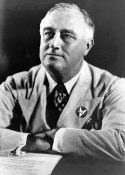
Saturday, June 20, 2015 was World Refugee Day. I was invited, thanks to the good offices of Nola Heidlebaugh, to accept on behalf of my late uncle Ralph the Ralph M. Faust Humanitarian Award--awarded to Ralph M. Faust, who was principal of Oswego High School in Oswego, New York (1939-1964). In 1944, President Franklin Roosevelt authorized the establishment of a refugee shelter at Fort Ontario, in Oswego, New York, which is now the Safe Haven Museum and Education Center. The Ralph M. Faust Humanitarian Award was presented for the first time this year and is expected to be an annual award. In 1944, 983 refugees, mostly Jewish, were brought to the center from Italy, to which they had fled from all over Europe to escape Nazi persecution. When they arrived in Oswego, Ralph M. Faust played a leading role in welcoming them to the community and arranged for 40 of them to attend Oswego High School. He is remembered as a hero by many of the refugees, who were eventually allowed to immigrate and apply for citizenship. They left the camp in January 1946. The photograph shows Ralph Faust in 1945, from the Oswego High School yearbook. See also the short video about the refugees -- https://youtu.be/I1eptVZhoCk
Wednesday, November 18, 2015
Rescuing Refugees
Saturday, June 20, 2015 was World Refugee Day. I was invited, thanks to the good offices of Nola Heidlebaugh, to accept on behalf of my late uncle Ralph the Ralph M. Faust Humanitarian Award--awarded to Ralph M. Faust, who was principal of Oswego High School in Oswego, New York (1939-1964). In 1944, President Franklin Roosevelt authorized the establishment of a refugee shelter at Fort Ontario, in Oswego, New York, which is now the Safe Haven Museum and Education Center. The Ralph M. Faust Humanitarian Award was presented for the first time this year and is expected to be an annual award. In 1944, 983 refugees, mostly Jewish, were brought to the center from Italy, to which they had fled from all over Europe to escape Nazi persecution. When they arrived in Oswego, Ralph M. Faust played a leading role in welcoming them to the community and arranged for 40 of them to attend Oswego High School. He is remembered as a hero by many of the refugees, who were eventually allowed to immigrate and apply for citizenship. They left the camp in January 1946. The photograph shows Ralph Faust in 1945, from the Oswego High School yearbook. See also the short video about the refugees -- https://youtu.be/I1eptVZhoCk
Wednesday, November 11, 2009
President Obama at Ford Hood - Echoes of Eloquence
Is there an echo of John Steinbeck's Grapes of Wrath, from the speech near the end of the novel when the son says goodbye to his mother? --
"Whenever they's a fight so hungry people can eat, I'll be there. Whenever they's a cop beatin' up a guy, I'll be there... I'll be in the way guys yell when they're mad an'-I'll be in the way kids laugh when they're hungry an' they know supper's ready. An' when our folks eat the stuff they raise an' live in the houses they build-why, I'll be there."
- John Steinbeck, The Grapes of Wrath, Chapter 28
Here is the president's echo. President Barack Obama, “Remarks by the President at Memorial Service at Fort Hood,” Fort Hood - III Corps, Fort Hood, Texas. 10 November 2008:
But here is what you must also know: Your loved ones endure through the life of our nation. Their memory will be honored in the places they lived and by the people they touched. Their life's work is our security, and the freedom that we all too often take for granted. Every evening that the sun sets on a tranquil town; every dawn that a flag is unfurled; every moment that an American enjoys life, liberty and the pursuit of happiness -- that is their legacy.
And there were echoes of Lincoln at Gettysburg and Franklin Delano Roosevelt's War Message of December 8, 1941:
We are a nation that endures because of the courage of those who defend it. We saw that valor in those who braved bullets here at Fort Hood, just as surely as we see it in those who signed up knowing that they would serve in harm’s way.
We are a nation of laws whose commitment to justice is so enduring that we would treat a gunman and give him due process, just as surely as we will see that he pays for his crimes. We're a nation that guarantees the freedom to worship as one chooses. And instead of claiming God for our side, we remember Lincoln’s words, and always pray to be on the side of God. We're a nation that is dedicated to the proposition that all men and women are created equal. We live that truth within our military, and see it in the varied backgrounds of those we lay to rest today. We defend that truth at home and abroad, and we know that Americans will always be found on the side of liberty and equality. That's who we are as a people.
Thursday, March 5, 2009
FDR on Social Security
We live in different times, and yet it is remarkable how close the themes of FDR and his opponents are to the debates going on today, in policy and politics.
Here are some excerpts from his message to Congress of June 8, 1934, when he had been in office for fifteen months, introducing the idea of social security insurance:
Franklin Delano Roosevelt, "Message to Congress Reviewing the Broad Objectives and Accomplishments of the Administration," June 8, 1934.
You and I, as the responsible directors of these policies and actions, may, with good reason, look to the future with confidence, just as we may look to the past fifteen months with reasonable satisfaction.
On the side of relief we have extended material aid to millions of our fellow citizens.
On the side of recovery we have helped to lift agriculture and industry from a condition of utter Prostration.
But, in addition to these immediate tasks of relief and of recovery we have properly, necessarily and with overwhelming approval determined to safeguard these tasks by rebuilding many of the structures of our economic life and reorganizing it in order to prevent a recurrence of collapse.
It is childish to speak of recovery first and reconstruction afterward. In the very nature of the processes of recovery we must avoid the destructive influences of the past. We have shown the world that democracy has within it the elements necessary to its own salvation. . . .
Among our objectives I place the security of the men, women and children of the Nation first.
This security for the individual and for the family concerns itself primarily with three factors. People want decent homes to live in; they want to locate them where they can engage in productive work; and they want some safeguard against misfortunes which cannot be wholly eliminated in this man-made world of ours. . . .
These three great objectives the security of the home, the security of livelihood, and the security of social insurance--are, it seems to me, a minimum of the promise that we can offer to the American people. They constitute a right which belongs to every individual and every family willing to work. They are the essential fulfillment of measures already taken toward relief, recovery and reconstruction.
FDR's Statements on Social Security at www.socialsecurity.gov
More documents on FDR speeches and papers at the American Presidency Project and the Franklin D. Roosevelt Presidential Library and Museum
Friday, November 21, 2008
FDR at Gettysburg on video
FDR throws out the first ball, Washington, D.C. 24 April 1934FDR Library, Hyde Park, New York
During his presidency, FDR gave two speeches at Gettysburg, in 1934 and 1938. I've been remembering them this week, since November 19 is the anniversary of Abraham Lincoln's Gettysburg Address.
YouTube has video transfers of some newsreels made on the occasion of FDR's speech at Gettysburg on July 4, 1938, the 75th anniversary of the battle. Reading the speeches now, it is possible to see how, all those years after the end of the Civil War, Roosevelt is still working to re-unite the country. The veterans on that occasion, old men who returned for their last reunion, seemed willing to shake hands and meet as friends. All these years later, 80 years after Roosevelt's 1938 speech at the dedication of a peace memorial on the Gettysburg battlefield, the first comments on the YouTube posting of Roosevelt's speech wave the banner of the lost cause bitter-enders, still not ready for peace.
For more on FDR's 1934 and 1938 Gettysburg speeches, see -- Thomas W. Benson, "FDR at Gettysburg: The New Deal and the Rhetoric of Presidential Leadership," The Rhetoric of Presidential Leadership, ed. Leroy Dorsey (College Station: Texas A&M University Press, 2002), 145-183.
Monday, November 10, 2008
Paul Krugman -- Think Big
Paul Krugman, "Franklin Delano Obama," New York Times, 10 November 2008.