Showing posts with label rhetorical presidency. Show all posts

Sunday, September 12, 2010

Dog Bites Back

Frank Rich, writing in the New York Times, calls (as so many have since January 2009) for President Obama to fight back, harder and in public rhetoric, against the conservative opposition and big business. This longing for presidential rhetoric seems to be a recurrent feature of our national life.

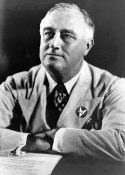
Rich even recommends FDR's 1936 Madison Square Garden speech excoriating his opposition -- a speech that my students always find a shocker. Here is a key passage from Franklin Roosevelt's speech, near the end of his first term:

For nearly four years you have had an Administration which instead of twirling its thumbs has rolled up its sleeves. We will keep our sleeves rolled up.

We had to struggle with the old enemies of peace—business and financial monopoly, speculation, reckless banking, class antagonism, sectionalism, war profiteering.

They had begun to consider the Government of the United States as a mere appendage to their own affairs. We know now that Government by organized money is just as dangerous as Government by organized mob.

Never before in all our history have these forces been so united against one candidate as they stand today. They are unanimous in their hate for me—and I welcome their hatred.

I should like to have it said of my first Administration that in it the forces of selfishness and of lust for power met their match. I should like to have it said of my second Administration that in it these forces met their master.


Frank Rich, "Time for This Big Dog to Bite Back," New York Times, 12 September 2010.

Does big business try to run (or to stop) the government? Where to start? Have a look at Eric Lipton, "A G.O.P. Leader Tightly Bound to Lobbyists," New York Times, 11 September 2010. "As Democrats try to cast John A. Boehner of Ohio, the House minority leader, as the face of the Republican Party, his ties to lobbyists are under attack. . . ."

Wednesday, August 12, 2009

White House Health Care Campaign

The Obama administration is using public communication in what appear to me to be some novel ways -- for a president.

In his general approach to health care reform, President Obama set out broad principles that he hoped would form the Congressional agenda, rather than sending a bill prepared in advance by the administration. Whether this was a largely tactical attempt to separate this round of health care from the failed Clinton plan is not clear. In some ways the President's approach seemed to hark back to the Constitutional system depicted by Jeffrey Tulis as preceding what he called The Rhetorical Presidency, in which, Tulis claimed, presidents spoke over the heads of Congress and thus short-circuited the process of Congressional deliberation.

On the other hand, the Obama White House has been using various organizing and communication tactics that bring to the White House a new level of direct citizen appeals. See, for example, the "Health Insurance Reform Reality Check" site at the White House. The site comes complete with links to post to email and Facebook and to connect to the White House Facebook and Twitter services. Whatever our views of the importance of health care reform -- I'm all for it -- this is a peculiar development and in some ways a worrying one.

Tuesday, December 2, 2008

The Anti-Intellectual Presidency

John McWhorter reviews The Anti-Intellectual Presidency: The Decline of Presidential Rhetoric from George Washington to George W. Bush, by Elvin T. Lim (Oxford University Press, 2008) --

Lim pays some lip service to larger trends but focuses on a narrower analysis, carefully posing that the increasing anti-intellectualism in presidential rhetoric resulted from a “tyranny of small decisions” effected by speechwriters and presidents taking their cue from the linguistic tone of the administrations preceding them. This analysis, however, can explain only so much. Truman may well have despaired of equaling Franklin Roosevelt’s eloquence and instead emphasized his own flinty straight-talking persona, while Lyndon Johnson was linguistically insecure and simply did not seek eloquence at all. This kind of analysis, however, fails to explain why in the nineteenth century even a plain-spoken ex-general such as Ulysses S. Grant pitched his official statements at the grand level, while a plain-spoken ex-general such as Dwight Eisenhower did not—or why Richard Nixon’s oratory was even more conversational than Lyndon Johnson’s.

The overarching explanation is the cultural context of an American culture that embraced informality in the 1920s and kept at it ever since. Clinton, for example, was not simply possessed with an animus toward flowery speech, and he certainly did not consciously decide to sound less formal than his notoriously inarticulate predecessor, George H.W. Bush. He was, instead, someone who had smoked pot in dormitories while listening to the kind of music that the parents in Bye Bye Birdie reviled—and that was the source of his rhetoric.


The review: John McWhorter, "A Rhetorical Question," First Things (October 2008).

The book: Elvin T. Lim, The Anti-Intellectual Presidency: The Decline of Presidential Rhetoric from George Washington to George W. Bush, (Oxford University Press, 2008).

More reviews: Scott McLemee, Inside Higher Ed; David Broder, Washington Post;