
Friday, October 9, 2009


Thursday, October 8, 2009
Berlusconi at Risk?
From the New York Times:
Rachel Donadio, "Despite Charges, Berlusconi Vows to 'Forge Ahead,'"New York Times, 8 October 2009.
The BBC News story is here.
ROME — A day after Italy’s highest court overturned a law granting him immunity from prosecution while in office, Prime Minister Silvio Berlusconi on Thursday called corruption charges against him “absurd” and said his government would “forge ahead calmly.”This saga has been going on for a long while. When corruption charges were brought against Sylvio Berlusconi soon after he first took office years ago, he simply instructed the parliament to pass a law declaring him immune. Matters move slowly, and back and forth, in the Italian courts, so this newest development may come to nothing.
Rachel Donadio, "Despite Charges, Berlusconi Vows to 'Forge Ahead,'"New York Times, 8 October 2009.
The BBC News story is here.
Tuesday, September 29, 2009
Shorenstein Center Webcast on Health Care Reform
Live Webcast: Briefing on Health Care Reform
Wednesday, September 30, 2009
8:30 a.m. – 11:45 a.m.
Watch the live webcast:
http://www.hks.harvard.edu/
8:30 a.m. – 10:00 a.m.
News Coverage of Health Reform—Metanarratives and the Missing Narratives
David Broder, The Washington Post
Linda Douglass, White House Office of Health Reform, U. S. Department of Health and Human Services
Dr. Timothy Johnson, ABC News
Moderated by Alex S. Jones, Joan Shorenstein Center
10:15 a.m. – 11:45 a.m.
Health Reform: Public Opinion, Polling, Ad Campaigns and Grassroots Mobilization
Robert Blendon, Harvard University
Theda Skocpol, Harvard University
Kathleen Hall Jamieson, University of Pennsylvania
Moderated by Alex S. Jones, Joan Shorenstein Center
Newseum, Washington, D. C.
To receive an RSS feed for the Shorenstein Center’s calendar of events, click here.
Wednesday, September 23, 2009
Saturday, September 19, 2009
Congressional Apology
Professor Joanne B. Freeman has written a useful reminder of the complex rhetorical history of Congressional insult and apology for the New York Times. She offers some observations useful for rhetorical scholars and citizens. She writes:
Joanne B. Freeman, "Joe Wilson's War," New York Times, 18 September 2009.
Congress has a long and storied culture of apology, to go along with its long and storied culture of insult — and . . . the two traditions are inextricably bound together. . . .
By publicly apologizing to his colleagues, a congressman not only paid obeisance to the dignity and order of the House or Senate, but he also upheld the civility of Congressional proceedings as a whole. This sentiment was perhaps explained best by Senator Louis McLane, a Jacksonian from Delaware, in an 1828 debate over the vice president’s right to call men to order. Written parliamentary rules were useful, he said, but the Senate’s tradition of “liberal comity” was “more efficient than any written rule.” What would preserve the Senate was “the great moral influence of the power of the body for its own preservation.” For this reason, the Congressional culture of insult was necessarily accompanied by one of apology. Whether it exists today remains an open question.
Joanne B. Freeman, "Joe Wilson's War," New York Times, 18 September 2009.
Friday, September 18, 2009
Critical Media Studies
 Brian L. Ott and Robert L. Mack, Critical Media Studies: An Introduction (Malden, MA: Wiley-Blackwell, 2009)
A More Perfect Union

The Speech: Race and Barack Obama's "A More Perfect Union" edited by T. Denean Sharpley-Whiting (Bloomsbury; 261 pages; $18).
Wednesday, September 16, 2009
A Question of Decorum: Congress Disapproves
Here is the opening of the Congressional debate on a resolution expressing disapproval of the behavior of Joe Wilson (Republican, South Carolina), who interrupted the president's speech to a joint session of Congress last Wednesday:
The full debate may be read in the Congressional Record. On the search page, type "Joe Wilson" and look for September 15, 2009, among the search results. This will take you to the text or pdf versions of the debate.
RAISING A QUESTION OF THE PRIVILEGES OF THE HOUSE
Mr. HOYER. Mr. Speaker, I rise to a question of the privileges of the House.
The SPEAKER pro tempore. The Clerk will report the resolution.
The Clerk read as follows:H. RES. 744
Whereas on September 9, 2009, during the joint session of Congress convened pursuant to House Concurrent Resolution 179, the President of the United States, speaking at the invitation of the House and Senate, had his remarks interrupted by the Representative from South Carolina, Mr. Wilson; and Whereas the conduct of the Representative from South Carolina was a breach of decorum and degraded the proceedings of the joint session, to the discredit of the House:
Now, therefore, be it Resolved, That the House of Representatives disapproves of the behavior of the Representative from South Carolina, Mr. Wilson, during the joint session of Congress held on September 9, 2009.
The full debate may be read in the Congressional Record. On the search page, type "Joe Wilson" and look for September 15, 2009, among the search results. This will take you to the text or pdf versions of the debate.
Tuesday, September 15, 2009
I want my country back

Linda Campbell of the Fort Worth Star Telegram has written a variation on the "I want my country back" commonplace.
I want my country back.The one where a message of personal responsibility and the value of a good education is celebrated, not denigrated with suspicion and hostility. . . .
Linda Campbell, "Can We Please Act Like the United States?" Fort Worth Star Telegram, 9 September 2009.
Even Campbell would probably admit -- as a rhetorical critic must -- that the United States has often entertained furies of uncivil rhetoric. The current rage at President Obama on the part of a right wing lunatic fringe carries the occasional national carnival of partisan hysteria to shocking lengths, even among some otherwise presumably responsible adults.
Sunday, September 13, 2009
Text - President Obama's address on health care, September 9, 2009
Here is the White House release of the full text of President Obama's speech on health care to a joint session of Congress on September 9, 2009. The White House version retains the Joe Wilson "You Lie!" interruption, along with indications of interruptions for applause. Full video follows in the next post.
-------
-------
THE WHITE HOUSE
Office of the Press Secretary
_________________________________________________________________________
For Immediate Release September 9, 2009
REMARKS BY THE PRESIDENT
TO A JOINT SESSION OF CONGRESS
ON HEALTH CARE
U.S. Capitol
Washington, D.C.
8:16 P.M. EDT
THE PRESIDENT: Madam Speaker, Vice President Biden, members of Congress, and the American people:
When I spoke here last winter, this nation was facing the worst economic crisis since the Great Depression. We were losing an average of 700,000 jobs per month. Credit was frozen. And our financial system was on the verge of collapse.
As any American who is still looking for work or a way to pay their bills will tell you, we are by no means out of the woods. A full and vibrant recovery is still many months away. And I will not let up until those Americans who seek jobs can find them -- (applause) -- until those businesses that seek capital and credit can thrive; until all responsible homeowners can stay in their homes. That is our ultimate goal. But thanks to the bold and decisive action we've taken since January, I can stand here with confidence and say that we have pulled this economy back from the brink. (Applause.)
I want to thank the members of this body for your efforts and your support in these last several months, and especially those who've taken the difficult votes that have put us on a path to recovery. I also want to thank the American people for their patience and resolve during this trying time for our nation.
But we did not come here just to clean up crises. We came here to build a future. (Applause.) So tonight, I return to speak to all of you about an issue that is central to that future -- and that is the issue of health care.
I am not the first President to take up this cause, but I am determined to be the last. (Applause.) It has now been nearly a century since Theodore Roosevelt first called for health care reform. And ever since, nearly every President and Congress, whether Democrat or Republican, has attempted to meet this challenge in some way. A bill for comprehensive health reform was first introduced by John Dingell Sr. in 1943. Sixty-five years later, his son continues to introduce that same bill at the beginning of each session. (Applause.)
Our collective failure to meet this challenge -- year after year, decade after decade -- has led us to the breaking point. Everyone understands the extraordinary hardships that are placed on the uninsured, who live every day just one accident or illness away from bankruptcy. These are not primarily people on welfare. These are middle-class Americans. Some can't get insurance on the job. Others are self-employed, and can't afford it, since buying insurance on your own costs you three times as much as the coverage you get from your employer. Many other Americans who are willing and able to pay are still denied insurance due to previous illnesses or conditions that insurance companies decide are too risky or too expensive to cover.
We are the only democracy -- the only advanced democracy on Earth -- the only wealthy nation -- that allows such hardship for millions of its people. There are now more than 30 million American citizens who cannot get coverage. In just a two-year period, one in every three Americans goes without health care coverage at some point. And every day, 14,000 Americans lose their coverage. In other words, it can happen to anyone.
But the problem that plagues the health care system is not just a problem for the uninsured. Those who do have insurance have never had less security and stability than they do today. More and more Americans worry that if you move, lose your job, or change your job, you'll lose your health insurance too. More and more Americans pay their premiums, only to discover that their insurance company has dropped their coverage when they get sick, or won't pay the full cost of care. It happens every day.
One man from Illinois lost his coverage in the middle of chemotherapy because his insurer found that he hadn't reported gallstones that he didn't even know about. They delayed his treatment, and he died because of it. Another woman from Texas was about to get a double mastectomy when her insurance company canceled her policy because she forgot to declare a case of acne. By the time she had her insurance reinstated, her breast cancer had more than doubled in size. That is heart-breaking, it is wrong, and no one should be treated that way in the United States of America. (Applause.)
Then there's the problem of rising cost. We spend one and a half times more per person on health care than any other country, but we aren't any healthier for it. This is one of the reasons that insurance premiums have gone up three times faster than wages. It's why so many employers -- especially small businesses -- are forcing their employees to pay more for insurance, or are dropping their coverage entirely. It's why so many aspiring entrepreneurs cannot afford to open a business in the first place, and why American businesses that compete internationally -- like our automakers -- are at a huge disadvantage. And it's why those of us with health insurance are also paying a hidden and growing tax for those without it -- about $1,000 per year that pays for somebody else's emergency room and charitable care.
Finally, our health care system is placing an unsustainable burden on taxpayers. When health care costs grow at the rate they have, it puts greater pressure on programs like Medicare and Medicaid. If we do nothing to slow these skyrocketing costs, we will eventually be spending more on Medicare and Medicaid than every other government program combined. Put simply, our health care problem is our deficit problem. Nothing else even comes close. Nothing else. (Applause.)
Now, these are the facts. Nobody disputes them. We know we must reform this system. The question is how.
There are those on the left who believe that the only way to fix the system is through a single-payer system like Canada's -- (applause) -- where we would severely restrict the private insurance market and have the government provide coverage for everybody. On the right, there are those who argue that we should end employer-based systems and leave individuals to buy health insurance on their own.
I've said -- I have to say that there are arguments to be made for both these approaches. But either one would represent a radical shift that would disrupt the health care most people currently have. Since health care represents one-sixth of our economy, I believe it makes more sense to build on what works and fix what doesn't, rather than try to build an entirely new system from scratch. (Applause.) And that is precisely what those of you in Congress have tried to do over the past several months.
During that time, we've seen Washington at its best and at its worst.
We've seen many in this chamber work tirelessly for the better part of this year to offer thoughtful ideas about how to achieve reform. Of the five committees asked to develop bills, four have completed their work, and the Senate Finance Committee announced today that it will move forward next week. That has never happened before. Our overall efforts have been supported by an unprecedented coalition of doctors and nurses; hospitals, seniors' groups, and even drug companies -- many of whom opposed reform in the past. And there is agreement in this chamber on about 80 percent of what needs to be done, putting us closer to the goal of reform than we have ever been.
But what we've also seen in these last months is the same partisan spectacle that only hardens the disdain many Americans have towards their own government. Instead of honest debate, we've seen scare tactics. Some have dug into unyielding ideological camps that offer no hope of compromise. Too many have used this as an opportunity to score short-term political points, even if it robs the country of our opportunity to solve a long-term challenge. And out of this blizzard of charges and counter-charges, confusion has reigned.
Well, the time for bickering is over. The time for games has passed. (Applause.) Now is the season for action. Now is when we must bring the best ideas of both parties together, and show the American people that we can still do what we were sent here to do. Now is the time to deliver on health care. Now is the time to deliver on health care.
The plan I'm announcing tonight would meet three basic goals. It will provide more security and stability to those who have health insurance. It will provide insurance for those who don't. And it will slow the growth of health care costs for our families, our businesses, and our government. (Applause.) It's a plan that asks everyone to take responsibility for meeting this challenge -- not just government, not just insurance companies, but everybody including employers and individuals. And it's a plan that incorporates ideas from senators and congressmen, from Democrats and Republicans -- and yes, from some of my opponents in both the primary and general election.
Here are the details that every American needs to know about this plan. First, if you are among the hundreds of millions of Americans who already have health insurance through your job, or Medicare, or Medicaid, or the VA, nothing in this plan will require you or your employer to change the coverage or the doctor you have. (Applause.) Let me repeat this: Nothing in our plan requires you to change what you have.
What this plan will do is make the insurance you have work better for you. Under this plan, it will be against the law for insurance companies to deny you coverage because of a preexisting condition. (Applause.) As soon as I sign this bill, it will be against the law for insurance companies to drop your coverage when you get sick or water it down when you need it the most. (Applause.) They will no longer be able to place some arbitrary cap on the amount of coverage you can receive in a given year or in a lifetime. (Applause.) We will place a limit on how much you can be charged for out-of-pocket expenses, because in the United States of America, no one should go broke because they get sick. (Applause.) And insurance companies will be required to cover, with no extra charge, routine checkups and preventive care, like mammograms and colonoscopies -- (applause) -- because there's no reason we shouldn't be catching diseases like breast cancer and colon cancer before they get worse. That makes sense, it saves money, and it saves lives. (Applause.)
Now, that's what Americans who have health insurance can expect from this plan -- more security and more stability.
Now, if you're one of the tens of millions of Americans who don't currently have health insurance, the second part of this plan will finally offer you quality, affordable choices. (Applause.) If you lose your job or you change your job, you'll be able to get coverage. If you strike out on your own and start a small business, you'll be able to get coverage. We'll do this by creating a new insurance exchange -- a marketplace where individuals and small businesses will be able to shop for health insurance at competitive prices. Insurance companies will have an incentive to participate in this exchange because it lets them compete for millions of new customers. As one big group, these customers will have greater leverage to bargain with the insurance companies for better prices and quality coverage. This is how large companies and government employees get affordable insurance. It's how everyone in this Congress gets affordable insurance. And it's time to give every American the same opportunity that we give ourselves. (Applause.)
Now, for those individuals and small businesses who still can't afford the lower-priced insurance available in the exchange, we'll provide tax credits, the size of which will be based on your need. And all insurance companies that want access to this new marketplace will have to abide by the consumer protections I already mentioned. This exchange will take effect in four years, which will give us time to do it right. In the meantime, for those Americans who can't get insurance today because they have preexisting medical conditions, we will immediately offer low-cost coverage that will protect you against financial ruin if you become seriously ill. (Applause.) This was a good idea when Senator John McCain proposed it in the campaign, it's a good idea now, and we should all embrace it. (Applause.)
Now, even if we provide these affordable options, there may be those -- especially the young and the healthy -- who still want to take the risk and go without coverage. There may still be companies that refuse to do right by their workers by giving them coverage. The problem is, such irresponsible behavior costs all the rest of us money. If there are affordable options and people still don't sign up for health insurance, it means we pay for these people's expensive emergency room visits. If some businesses don't provide workers health care, it forces the rest of us to pick up the tab when their workers get sick, and gives those businesses an unfair advantage over their competitors. And unless everybody does their part, many of the insurance reforms we seek -- especially requiring insurance companies to cover preexisting conditions -- just can't be achieved.
And that's why under my plan, individuals will be required to carry basic health insurance -- just as most states require you to carry auto insurance. (Applause.) Likewise -- likewise, businesses will be required to either offer their workers health care, or chip in to help cover the cost of their workers. There will be a hardship waiver for those individuals who still can't afford coverage, and 95 percent of all small businesses, because of their size and narrow profit margin, would be exempt from these requirements. (Applause.) But we can't have large businesses and individuals who can afford coverage game the system by avoiding responsibility to themselves or their employees. Improving our health care system only works if everybody does their part.
And while there remain some significant details to be ironed out, I believe -- (laughter) -- I believe a broad consensus exists for the aspects of the plan I just outlined: consumer protections for those with insurance, an exchange that allows individuals and small businesses to purchase affordable coverage, and a requirement that people who can afford insurance get insurance.
And I have no doubt that these reforms would greatly benefit Americans from all walks of life, as well as the economy as a whole. Still, given all the misinformation that's been spread over the past few months, I realize -- (applause) -- I realize that many Americans have grown nervous about reform. So tonight I want to address some of the key controversies that are still out there.
Some of people's concerns have grown out of bogus claims spread by those whose only agenda is to kill reform at any cost. The best example is the claim made not just by radio and cable talk show hosts, but by prominent politicians, that we plan to set up panels of bureaucrats with the power to kill off senior citizens. Now, such a charge would be laughable if it weren't so cynical and irresponsible. It is a lie, plain and simple. (Applause.)
There are also those who claim that our reform efforts would insure illegal immigrants. This, too, is false. The reforms -- the reforms I'm proposing would not apply to those who are here illegally.
AUDIENCE MEMBER: You lie! (Boos.)
THE PRESIDENT: It's not true. And one more misunderstanding I want to clear up -- under our plan, no federal dollars will be used to fund abortions, and federal conscience laws will remain in place. (Applause.)
Now, my health care proposal has also been attacked by some who oppose reform as a "government takeover" of the entire health care system. As proof, critics point to a provision in our plan that allows the uninsured and small businesses to choose a publicly sponsored insurance option, administered by the government just like Medicaid or Medicare. (Applause.)
So let me set the record straight here. My guiding principle is, and always has been, that consumers do better when there is choice and competition. That's how the market works. (Applause.) Unfortunately, in 34 states, 75 percent of the insurance market is controlled by five or fewer companies. In Alabama, almost 90 percent is controlled by just one company. And without competition, the price of insurance goes up and quality goes down. And it makes it easier for insurance companies to treat their customers badly -- by cherry-picking the healthiest individuals and trying to drop the sickest, by overcharging small businesses who have no leverage, and by jacking up rates.
Insurance executives don't do this because they're bad people; they do it because it's profitable. As one former insurance executive testified before Congress, insurance companies are not only encouraged to find reasons to drop the seriously ill, they are rewarded for it. All of this is in service of meeting what this former executive called "Wall Street's relentless profit expectations."
Now, I have no interest in putting insurance companies out of business. They provide a legitimate service, and employ a lot of our friends and neighbors. I just want to hold them accountable. (Applause.) And the insurance reforms that I've already mentioned would do just that. But an additional step we can take to keep insurance companies honest is by making a not-for-profit public option available in the insurance exchange. (Applause.) Now, let me be clear. Let me be clear. It would only be an option for those who don't have insurance. No one would be forced to choose it, and it would not impact those of you who already have insurance. In fact, based on Congressional Budget Office estimates, we believe that less than 5 percent of Americans would sign up.
Despite all this, the insurance companies and their allies don't like this idea. They argue that these private companies can't fairly compete with the government. And they'd be right if taxpayers were subsidizing this public insurance option. But they won't be. I've insisted that like any private insurance company, the public insurance option would have to be self-sufficient and rely on the premiums it collects. But by avoiding some of the overhead that gets eaten up at private companies by profits and excessive administrative costs and executive salaries, it could provide a good deal for consumers, and would also keep pressure on private insurers to keep their policies affordable and treat their customers better, the same way public colleges and universities provide additional choice and competition to students without in any way inhibiting a vibrant system of private colleges and universities. (Applause.)
Now, it is -- it's worth noting that a strong majority of Americans still favor a public insurance option of the sort I've proposed tonight. But its impact shouldn't be exaggerated -- by the left or the right or the media. It is only one part of my plan, and shouldn't be used as a handy excuse for the usual Washington ideological battles. To my progressive friends, I would remind you that for decades, the driving idea behind reform has been to end insurance company abuses and make coverage available for those without it. (Applause.) The public option -- the public option is only a means to that end -- and we should remain open to other ideas that accomplish our ultimate goal. And to my Republican friends, I say that rather than making wild claims about a government takeover of health care, we should work together to address any legitimate concerns you may have. (Applause.)
For example -- for example, some have suggested that the public option go into effect only in those markets where insurance companies are not providing affordable policies. Others have proposed a co-op or another non-profit entity to administer the plan. These are all constructive ideas worth exploring. But I will not back down on the basic principle that if Americans can't find affordable coverage, we will provide you with a choice. (Applause.) And I will make sure that no government bureaucrat or insurance company bureaucrat gets between you and the care that you need. (Applause.)
Finally, let me discuss an issue that is a great concern to me, to members of this chamber, and to the public -- and that's how we pay for this plan.
And here's what you need to know. First, I will not sign a plan that adds one dime to our deficits -- either now or in the future. (Applause.) I will not sign it if it adds one dime to the deficit, now or in the future, period. And to prove that I'm serious, there will be a provision in this plan that requires us to come forward with more spending cuts if the savings we promised don't materialize. (Applause.) Now, part of the reason I faced a trillion-dollar deficit when I walked in the door of the White House is because too many initiatives over the last decade were not paid for -- from the Iraq war to tax breaks for the wealthy. (Applause.) I will not make that same mistake with health care.
Second, we've estimated that most of this plan can be paid for by finding savings within the existing health care system, a system that is currently full of waste and abuse. Right now, too much of the hard-earned savings and tax dollars we spend on health care don't make us any healthier. That's not my judgment -- it's the judgment of medical professionals across this country. And this is also true when it comes to Medicare and Medicaid.
In fact, I want to speak directly to seniors for a moment, because Medicare is another issue that's been subjected to demagoguery and distortion during the course of this debate.
More than four decades ago, this nation stood up for the principle that after a lifetime of hard work, our seniors should not be left to struggle with a pile of medical bills in their later years. That's how Medicare was born. And it remains a sacred trust that must be passed down from one generation to the next. (Applause.) And that is why not a dollar of the Medicare trust fund will be used to pay for this plan. (Applause.)
The only thing this plan would eliminate is the hundreds of billions of dollars in waste and fraud, as well as unwarranted subsidies in Medicare that go to insurance companies -- subsidies that do everything to pad their profits but don't improve the care of seniors. And we will also create an independent commission of doctors and medical experts charged with identifying more waste in the years ahead. (Applause.)
Now, these steps will ensure that you -- America's seniors -- get the benefits you've been promised. They will ensure that Medicare is there for future generations. And we can use some of the savings to fill the gap in coverage that forces too many seniors to pay thousands of dollars a year out of their own pockets for prescription drugs. (Applause.) That's what this plan will do for you. So don't pay attention to those scary stories about how your benefits will be cut, especially since some of the same folks who are spreading these tall tales have fought against Medicare in the past and just this year supported a budget that would essentially have turned Medicare into a privatized voucher program. That will not happen on my watch. I will protect Medicare. (Applause.)
Now, because Medicare is such a big part of the health care system, making the program more efficient can help usher in changes in the way we deliver health care that can reduce costs for everybody. We have long known that some places -- like the Intermountain Healthcare in Utah or the Geisinger Health System in rural Pennsylvania -- offer high-quality care at costs below average. So the commission can help encourage the adoption of these common-sense best practices by doctors and medical professionals throughout the system -- everything from reducing hospital infection rates to encouraging better coordination between teams of doctors.
Reducing the waste and inefficiency in Medicare and Medicaid will pay for most of this plan. (Applause.) Now, much of the rest would be paid for with revenues from the very same drug and insurance companies that stand to benefit from tens of millions of new customers. And this reform will charge insurance companies a fee for their most expensive policies, which will encourage them to provide greater value for the money -- an idea which has the support of Democratic and Republican experts. And according to these same experts, this modest change could help hold down the cost of health care for all of us in the long run.
Now, finally, many in this chamber -- particularly on the Republican side of the aisle -- have long insisted that reforming our medical malpractice laws can help bring down the cost of health care. (Applause.) Now -- there you go. There you go. Now, I don't believe malpractice reform is a silver bullet, but I've talked to enough doctors to know that defensive medicine may be contributing to unnecessary costs. (Applause.) So I'm proposing that we move forward on a range of ideas about how to put patient safety first and let doctors focus on practicing medicine. (Applause.) I know that the Bush administration considered authorizing demonstration projects in individual states to test these ideas. I think it's a good idea, and I'm directing my Secretary of Health and Human Services to move forward on this initiative today. (Applause.)
Now, add it all up, and the plan I'm proposing will cost around $900 billion over 10 years -- less than we have spent on the Iraq and Afghanistan wars, and less than the tax cuts for the wealthiest few Americans that Congress passed at the beginning of the previous administration. (Applause.) Now, most of these costs will be paid for with money already being spent -- but spent badly -- in the existing health care system. The plan will not add to our deficit. The middle class will realize greater security, not higher taxes. And if we are able to slow the growth of health care costs by just one-tenth of 1 percent each year -- one-tenth of 1 percent -- it will actually reduce the deficit by $4 trillion over the long term.
Now, this is the plan I'm proposing. It's a plan that incorporates ideas from many of the people in this room tonight -- Democrats and Republicans. And I will continue to seek common ground in the weeks ahead. If you come to me with a serious set of proposals, I will be there to listen. My door is always open.
But know this: I will not waste time with those who have made the calculation that it's better politics to kill this plan than to improve it. (Applause.) I won't stand by while the special interests use the same old tactics to keep things exactly the way they are. If you misrepresent what's in this plan, we will call you out. (Applause.) And I will not -- and I will not accept the status quo as a solution. Not this time. Not now.
Everyone in this room knows what will happen if we do nothing. Our deficit will grow. More families will go bankrupt. More businesses will close. More Americans will lose their coverage when they are sick and need it the most. And more will die as a result. We know these things to be true.
That is why we cannot fail. Because there are too many Americans counting on us to succeed -- the ones who suffer silently, and the ones who shared their stories with us at town halls, in e-mails, and in letters.
I received one of those letters a few days ago. It was from our beloved friend and colleague, Ted Kennedy. He had written it back in May, shortly after he was told that his illness was terminal. He asked that it be delivered upon his death.
In it, he spoke about what a happy time his last months were, thanks to the love and support of family and friends, his wife, Vicki, his amazing children, who are all here tonight. And he expressed confidence that this would be the year that health care reform -- "that great unfinished business of our society," he called it -- would finally pass. He repeated the truth that health care is decisive for our future prosperity, but he also reminded me that "it concerns more than material things." "What we face," he wrote, "is above all a moral issue; at stake are not just the details of policy, but fundamental principles of social justice and the character of our country."
I've thought about that phrase quite a bit in recent days -- the character of our country. One of the unique and wonderful things about America has always been our self-reliance, our rugged individualism, our fierce defense of freedom and our healthy skepticism of government. And figuring out the appropriate size and role of government has always been a source of rigorous and, yes, sometimes angry debate. That's our history.
For some of Ted Kennedy's critics, his brand of liberalism represented an affront to American liberty. In their minds, his passion for universal health care was nothing more than a passion for big government.
But those of us who knew Teddy and worked with him here -- people of both parties -- know that what drove him was something more. His friend Orrin Hatch -- he knows that. They worked together to provide children with health insurance. His friend John McCain knows that. They worked together on a Patient's Bill of Rights. His friend Chuck Grassley knows that. They worked together to provide health care to children with disabilities.
On issues like these, Ted Kennedy's passion was born not of some rigid ideology, but of his own experience. It was the experience of having two children stricken with cancer. He never forgot the sheer terror and helplessness that any parent feels when a child is badly sick. And he was able to imagine what it must be like for those without insurance, what it would be like to have to say to a wife or a child or an aging parent, there is something that could make you better, but I just can't afford it.
That large-heartedness -- that concern and regard for the plight of others -- is not a partisan feeling. It's not a Republican or a Democratic feeling. It, too, is part of the American character -- our ability to stand in other people's shoes; a recognition that we are all in this together, and when fortune turns against one of us, others are there to lend a helping hand; a belief that in this country, hard work and responsibility should be rewarded by some measure of security and fair play; and an acknowledgment that sometimes government has to step in to help deliver on that promise.
This has always been the history of our progress. In 1935, when over half of our seniors could not support themselves and millions had seen their savings wiped away, there were those who argued that Social Security would lead to socialism, but the men and women of Congress stood fast, and we are all the better for it. In 1965, when some argued that Medicare represented a government takeover of health care, members of Congress -- Democrats and Republicans -- did not back down. They joined together so that all of us could enter our golden years with some basic peace of mind.
You see, our predecessors understood that government could not, and should not, solve every problem. They understood that there are instances when the gains in security from government action are not worth the added constraints on our freedom. But they also understood that the danger of too much government is matched by the perils of too little; that without the leavening hand of wise policy, markets can crash, monopolies can stifle competition, the vulnerable can be exploited. And they knew that when any government measure, no matter how carefully crafted or beneficial, is subject to scorn; when any efforts to help people in need are attacked as un-American; when facts and reason are thrown overboard and only timidity passes for wisdom, and we can no longer even engage in a civil conversation with each other over the things that truly matter -- that at that point we don't merely lose our capacity to solve big challenges. We lose something essential about ourselves.
That was true then. It remains true today. I understand how difficult this health care debate has been. I know that many in this country are deeply skeptical that government is looking out for them. I understand that the politically safe move would be to kick the can further down the road -- to defer reform one more year, or one more election, or one more term.
But that is not what the moment calls for. That's not what we came here to do. We did not come to fear the future. We came here to shape it. I still believe we can act even when it's hard. (Applause.) I still believe -- I still believe that we can act when it's hard. I still believe we can replace acrimony with civility, and gridlock with progress. I still believe we can do great things, and that here and now we will meet history's test.
Because that's who we are. That is our calling. That is our character. Thank you, God bless you, and may God bless the United States of America. (Applause.)
END 9:03 P.M. EDT
President Barack Obama, Address to Congress on Health Care
President Barack Obama
Address to Congress on Health Care
September 9, 2009
Graham Spanier - Penn State University - 2009 State of the University Address
2009 State of the University Address
Penn State University
Graham B. Spanier
September 11, 2009
September 11, 2009
Friday, September 11, 2009
Say It Isn't So, Joe Wilson
Congressman Joe Wilson of South Carolina is the person who shouted "You lie!" during President Barack Obama's address to a joint session of Congress on Wednesday evening. Wilson violated the rules of the House of Representatives, of which he is a member, on a variety of counts that are respected even in the most heated Congressional debates -- no direct address, except to the Chair, and after being recognized; no characterization of another speaker in the body as lying. Oh, and don't heckle the speaker. Treat the President, the judiciary, members of the "other body," and colleagues with respect and courtesy.
Wilson's heckling is rightly regarded as beyond the pale, and his apology came only after the Republican leadership, seeing how idiotic this made them look, insisted to him that he apologize--which he did in a message to the president's chief of staff. The president, typically, forgave him. Wilson continued to excuse and justify his act to the press--insisting that he spoke spontaneously (the righteous reaction of a virtuous patriot!), and, after all, he tells the press, although President Obama was technically correct that the health care bills so far passed prohibit enrollment by illegal aliens, Wilson thinks the preventive resources are not sufficiently harsh.
Such justifications bring discredit upon Wilson and his cause--are in fact a declaration of the bullying resentments of a displaced and disgraced minority groaning at its own impotence--declaring that impotence by its tantrums. At least that's the way I read the most likely rhetorical response to Wilson's actions. True believers, of course, will think otherwise, asking the rest of us to regard their shouting as a sign of deep sincerity. Perhaps it is. Is it the rule that they would like us all to live by?
Wilson appears to be hearing about this from his constituents--at least he was until the outpouring apparently overwhelmed his Congressional web site. Here's how it looks at the moment:
Wilson's heckling is rightly regarded as beyond the pale, and his apology came only after the Republican leadership, seeing how idiotic this made them look, insisted to him that he apologize--which he did in a message to the president's chief of staff. The president, typically, forgave him. Wilson continued to excuse and justify his act to the press--insisting that he spoke spontaneously (the righteous reaction of a virtuous patriot!), and, after all, he tells the press, although President Obama was technically correct that the health care bills so far passed prohibit enrollment by illegal aliens, Wilson thinks the preventive resources are not sufficiently harsh.
Such justifications bring discredit upon Wilson and his cause--are in fact a declaration of the bullying resentments of a displaced and disgraced minority groaning at its own impotence--declaring that impotence by its tantrums. At least that's the way I read the most likely rhetorical response to Wilson's actions. True believers, of course, will think otherwise, asking the rest of us to regard their shouting as a sign of deep sincerity. Perhaps it is. Is it the rule that they would like us all to live by?
Wilson appears to be hearing about this from his constituents--at least he was until the outpouring apparently overwhelmed his Congressional web site. Here's how it looks at the moment:

Joe Wilson
Due to exceptionally high traffic, this site is temporarily unavailable.
Please come back shortly.
Thursday, September 3, 2009
Obama and Reform Leadership
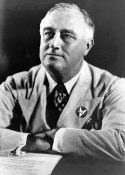
Jean Edward Smith, author of a recent biography of FDR, writes in the Times today with a reminder to President Obama about reform leadership in a divided country:
Jean Edward Smith, "Roosevelt: The Great Divider," New York Times, 2 September 2009.
see also Jean Edward Smith, FDR (New York: Random House, 2007). See Jonathan Yardley's review in the Washington Post.
PRESIDENT OBAMA’S apparent readiness to backtrack on the public insurance option in his health care package is not just a concession to his political opponents — this fixation on securing bipartisan support for health care reform suggests that the Democratic Party has forgotten how to govern and the White House has forgotten how to lead.
This was not true of Franklin Roosevelt and the Democratic Congresses that enacted the New Deal. With the exception of the Emergency Banking Act of 1933 (which gave the president authority to close the nation’s banks and which passed the House of Representatives unanimously), the principal legislative innovations of the 1930s were enacted over the vigorous opposition of a deeply entrenched minority. Majority rule, as Roosevelt saw it, did not require his opponents’ permission. . . .
Jean Edward Smith, "Roosevelt: The Great Divider," New York Times, 2 September 2009.
see also Jean Edward Smith, FDR (New York: Random House, 2007). See Jonathan Yardley's review in the Washington Post.
Wednesday, September 2, 2009
The Biggest Business
We are all tourists, and we all live in tourist destinations. By some estimates, tourism is the largest business in the world.
According to Wolfram|Alpha, the United States received 23.89 million visitors in 2007. These visitors generated 30.01 million hotel nights of business.

Wolfram|Alpha reports that Italy had 70.27 million visitors -- that's in one year. The population of Italy is 58.9 million people.
Do you know Wolfram | Alpha? It is a tremendously interesting knowledge web site, truly addictive.
According to Wolfram|Alpha, the United States received 23.89 million visitors in 2007. These visitors generated 30.01 million hotel nights of business.
Wolfram|Alpha reports that Italy had 70.27 million visitors -- that's in one year. The population of Italy is 58.9 million people.
Do you know Wolfram | Alpha? It is a tremendously interesting knowledge web site, truly addictive.
Monday, August 31, 2009
Have You Insulted a Friend Today?
Have you insulted a friend today? There's still time!
This item appeared in today's Penn State Newswire, our online in-house newsletter:
How did this one get past the IRB committee? A playful person could have a lot of fun with this.
This item appeared in today's Penn State Newswire, our online in-house newsletter:
9. Researchers seek 'least playful' adults to participate in survey
Xiangyou (Sharon) Shen, a doctoral student in the Department of Recreation, is seeking participants for an online survey regarding "adult playfulness." Think of the least playful person you know, excluding yourself, and have them take the eight to 10 minute survey at
http://www.surveymonkey.com/s.aspx?sm= online. TheLJKvBJeZDnFqNgyAMhu6Eg_3d_3d
password for the survey is 'lg'. For more information, contact Shen via e-mail at sshen@psu.edu.
How did this one get past the IRB committee? A playful person could have a lot of fun with this.
The Rhetoric of Capital Punishment
A New York Times editorial today tells the story of yet another Texas execution, and argues:
There are and always will be moral and scientific arguments showing that capital punishment cannot be imposed justly.
For many years it has also seemed to me as a student of rhetoric that capital punishment is incompatible with what we know about the human capacity to make public judgments, which are inevitably the result of, among other things, rhetorical processes. Our capacity to discover what happened in the past is always based on probability, which can be approached only through processes of argument by flawed human beings using systems of persuasion that cannot attain justified certainty. The ultimate extinction of capital punishment simply cannot be justified in light of our limited capacity to know and to communicate what happened and why, and to sort out the moral weight of human action.
People should have no illusions about the brutal injustice of the death penalty after all of the exonerations in recent years from DNA evidence, but the case of Cameron Todd Willingham is still shocking.
Mr. Willingham was executed for setting a fire that killed his 2-year-old daughter and 1-year-old twins, but a fire expert hired by the State of Texas has issued a report casting enormous doubt on whether the fire was arson at all. The Willingham investigation, which is continuing, is further evidence that the criminal justice system is far too flawed to justify imposing a death penalty.
There are and always will be moral and scientific arguments showing that capital punishment cannot be imposed justly.
For many years it has also seemed to me as a student of rhetoric that capital punishment is incompatible with what we know about the human capacity to make public judgments, which are inevitably the result of, among other things, rhetorical processes. Our capacity to discover what happened in the past is always based on probability, which can be approached only through processes of argument by flawed human beings using systems of persuasion that cannot attain justified certainty. The ultimate extinction of capital punishment simply cannot be justified in light of our limited capacity to know and to communicate what happened and why, and to sort out the moral weight of human action.
Thursday, August 27, 2009
No Pictures, Please: Studying Visual Rhetoric

The Yale University Press removed all the images from a new scholarly book, The Cartoons That Shook the World, by Jytte Klausen. The Press announced, when its action was revealed in a New York Times article, that it had taken the step to forestall possibly violent reactions to any attempt to publish images of the Prophet Muhammad. Cary Nelson, president of the American Association of University Professors quickly issued a statement condemning the Press action as a threat to academic freedom.
Jennifer Howard, "Hot Type: Yale U. Press's Attempt to Avoid Risks Has Risks of Its Own," Chronicle of Higher Education, 26 August 2009.
Wednesday, August 26, 2009

Tuesday, August 25, 2009
Stanley Fish: Rating ACTA, Teaching Writing
At the New York Times, Stanley Fish has weighed in on the ACTA college rankings. As often happens with his columns, the readers' comments are as interesting as his initial argument. I find myelf agreeing that though it is possible to abuse a group of composition students by luring them into right-thinking about politics, it is also possible to teach composition by going beyond grammar and style -- giving students useful models, engaging them in analysis of rhetorical method, and helping them to see that to write is often to talk about the world outside of the self.
Stanley Fish, "What Should Colleges Teach?" The New York Times, 24August 2009.
Stanley Fish, "What Should Colleges Teach?" The New York Times, 24August 2009.
Faculty Value Civic Engagement and Diversity
The Higher Education Research Institute at UCLA describes changing views of American college and university teachers:
Compared to just three years ago, a significantly greater number of today's college teachers consider civic engagement and appreciation of racial and ethnic diversity important educational goals for undergraduates, according to a UCLA report on teaching faculty at the nation's colleges and universities.
The majority of college faculty (55.5 percent) nationwide now consider it "very important" or "essential" to "instill in students a commitment to community service," an increase of 19.1 percentage points since the survey was last conducted in 2004–05, and 75.2 percent indicate that they work to "enhance students' knowledge of and appreciation for other racial/ethnic groups," a gain of 17.6 percentage points over three years.
The report, "The American College Teacher: National Norms for the 2007–08 HERI Faculty Survey," is issued by the Cooperative Institutional Research Program (CIRP) at the Higher Education Research Institute (HERI) at UCLA, which puts out the national faculty report triennially. . . .
Saturday, August 22, 2009
College Ratings and the Culture Wars
It is college rating season again. This year the American Council of Trustees and Alumni, a conservative education advocacy group that pressures for the "traditional" curriculum, has created a web site rating colleges and universities.
But watch out.
Not only are the criteria and ratings rather tendentious -- so far as I can tell they are often simply inaccurate. When I learned of the project I visited the site and looked up the rating for the university where I teach -- Penn State University.
ACTA gives Penn State a "D," alleging that we do not require English composition as a graduation requirement -- which is not accurate. They give Penn State only one "yes" rating, for requiring foreign languages. But in fact study of a foreign language is required only for the BA degree -- not for the BS degree. In addition, Penn State requires that students take a writing-intensive course in their major. The Penn State undergraduate degree requirements--admittedly they can be somewhat confusing--are here.
Between the political agenda and the apparently sloppy research, the ACTA ratings don't seem to hold up.
Cornell University is rated "F" -- on the allegation, among others, that they do not offer a required composition course taught by the English department. The first year writing program at Cornell is of long standing and has been a considerable success, taught by instructors not only in English Literature but also in Philosophy, History, Art History, and other disciplines. Cornell in fact requires two first-year writing seminars. The Cornell first year writing program is described at the Cornell site for the John S. Knight Institute for Writing in the Disciplines. The Cornell model may not be for everyone, but it is hard to argue that it is casual or irresponsible.
There is also the question of why so many colleges that attract elite students choose to act in ways that earn them an "F" in the ACTA ratings. Perhaps a simple set of required courses is not the golden key to a great college education.
ACTA is not rating undergraduate education but awarding grades based on an arbitrary and tendentious set of criteria -- inaccurately applied.
For a fascinating essay on the history of English studies, do have a look at William Riley Parker, "Where Do English Departments Come From?" Association of Departments of English Bulletin 11 (1967): 8-17. The essay is reprinted in an immensely useful new anthology, The Norton Book of Composition Studies, ed. Susan Miller (New York: W. W. Norton, 2009), 3-16.
But watch out.
Not only are the criteria and ratings rather tendentious -- so far as I can tell they are often simply inaccurate. When I learned of the project I visited the site and looked up the rating for the university where I teach -- Penn State University.
ACTA gives Penn State a "D," alleging that we do not require English composition as a graduation requirement -- which is not accurate. They give Penn State only one "yes" rating, for requiring foreign languages. But in fact study of a foreign language is required only for the BA degree -- not for the BS degree. In addition, Penn State requires that students take a writing-intensive course in their major. The Penn State undergraduate degree requirements--admittedly they can be somewhat confusing--are here.
Between the political agenda and the apparently sloppy research, the ACTA ratings don't seem to hold up.
Cornell University is rated "F" -- on the allegation, among others, that they do not offer a required composition course taught by the English department. The first year writing program at Cornell is of long standing and has been a considerable success, taught by instructors not only in English Literature but also in Philosophy, History, Art History, and other disciplines. Cornell in fact requires two first-year writing seminars. The Cornell first year writing program is described at the Cornell site for the John S. Knight Institute for Writing in the Disciplines. The Cornell model may not be for everyone, but it is hard to argue that it is casual or irresponsible.
There is also the question of why so many colleges that attract elite students choose to act in ways that earn them an "F" in the ACTA ratings. Perhaps a simple set of required courses is not the golden key to a great college education.
ACTA is not rating undergraduate education but awarding grades based on an arbitrary and tendentious set of criteria -- inaccurately applied.
For a fascinating essay on the history of English studies, do have a look at William Riley Parker, "Where Do English Departments Come From?" Association of Departments of English Bulletin 11 (1967): 8-17. The essay is reprinted in an immensely useful new anthology, The Norton Book of Composition Studies, ed. Susan Miller (New York: W. W. Norton, 2009), 3-16.
Sunday, August 16, 2009
Senator Arlen Specter Town Hall Meeting on Health Care at Penn State
Senator Arlen Specter held a town hall meeting on health care at Penn State's conference center hotel on August 12. The video here, presented by the Penn State student newspaper, the Daily Collegian, is from that meeting. An accompanying story is here.
By all reports, Specter has been handling the angry shouters who have come to his town halls this month, as they have come to those of other Democratic members of Congress, with considerable skill and fortitude. He insists that the protesters have a right to be heard, and he moves close to them as they ask their questions, rather than shrinking away, as we would all be tempted to do, or himself rising in anger, as we might also be tempted to do.
Wednesday, August 12, 2009
White House Health Care Campaign
The Obama administration is using public communication in what appear to me to be some novel ways -- for a president.
In his general approach to health care reform, President Obama set out broad principles that he hoped would form the Congressional agenda, rather than sending a bill prepared in advance by the administration. Whether this was a largely tactical attempt to separate this round of health care from the failed Clinton plan is not clear. In some ways the President's approach seemed to hark back to the Constitutional system depicted by Jeffrey Tulis as preceding what he called The Rhetorical Presidency, in which, Tulis claimed, presidents spoke over the heads of Congress and thus short-circuited the process of Congressional deliberation.
On the other hand, the Obama White House has been using various organizing and communication tactics that bring to the White House a new level of direct citizen appeals. See, for example, the "Health Insurance Reform Reality Check" site at the White House. The site comes complete with links to post to email and Facebook and to connect to the White House Facebook and Twitter services. Whatever our views of the importance of health care reform -- I'm all for it -- this is a peculiar development and in some ways a worrying one.
In his general approach to health care reform, President Obama set out broad principles that he hoped would form the Congressional agenda, rather than sending a bill prepared in advance by the administration. Whether this was a largely tactical attempt to separate this round of health care from the failed Clinton plan is not clear. In some ways the President's approach seemed to hark back to the Constitutional system depicted by Jeffrey Tulis as preceding what he called The Rhetorical Presidency, in which, Tulis claimed, presidents spoke over the heads of Congress and thus short-circuited the process of Congressional deliberation.
On the other hand, the Obama White House has been using various organizing and communication tactics that bring to the White House a new level of direct citizen appeals. See, for example, the "Health Insurance Reform Reality Check" site at the White House. The site comes complete with links to post to email and Facebook and to connect to the White House Facebook and Twitter services. Whatever our views of the importance of health care reform -- I'm all for it -- this is a peculiar development and in some ways a worrying one.
MoveOn.org on Health Care
MoveOn.org has posted a set of talking points on what it calls the "Top Five Health Care Reform Lies--and How to Fight Back."
The site keeps the list brief and pointed, and seems clearly designed to be forwarded, and to serve as ammunition in conversation and debate.
Meanwhile Senator Arlen Specter is in town today for another health care town hall -- early reports indicate that it, too, was interrupted by shouters.
The site keeps the list brief and pointed, and seems clearly designed to be forwarded, and to serve as ammunition in conversation and debate.
Meanwhile Senator Arlen Specter is in town today for another health care town hall -- early reports indicate that it, too, was interrupted by shouters.
Tuesday, August 11, 2009
Health Care Scare Tactics
The Lehrer News Hour on PBS broadcast a useful analysis last night of where those charges about "government run health care" and "euthanasia" were coming from.
It's an interesting question of public communication how this sort of sensible analysis could find its way into the hysterical atmosphere created by the angry mobs that have disrupted town hall meetings. And of course, that is their point.
JUDY WOODRUFF: I want to deal with this charge that's out there. Gail Wilensky, to you first, this so-called euthanasia charge, that there's something in this proposal that will have somebody from the government go visit people and say, "You must decide right now how you're going to die." What's the truth of that?GAIL WILENSKY, Project HOPE: That is just not true. . . . This is not a right characterization.
What has been proposed is that, if someone wants to get counseling on hospice care, hospice care itself is, of course, a covered Medicare benefit. They would be able to have the physician or other practitioner paid for the counseling.
The idea is for people to be able to make known how they would like to be treated in the event of a terminal illness. We have advance directives now. It was actually first raised when I was running the Medicare program. If you go in to the hospital or a nursing home, you are supposed to be asked whether you have an advance directive and, if so, have it noted. . . .
It's an interesting question of public communication how this sort of sensible analysis could find its way into the hysterical atmosphere created by the angry mobs that have disrupted town hall meetings. And of course, that is their point.
Saturday, August 8, 2009
Health Care Reform - UMich Research Guide
The University of Michigan Library has posted a useful web page with links to informational resources the health care debate (some of them restricted to University of Michigan library patrons, but most public access).
Political Party or Mob?
"The bitter divisions over an overhaul of the health care system have exploded at town-hall-style meetings over the last few days as members of Congress have been shouted down, hanged in effigy and taunted by crowds. In several cities, noisy demonstrations have led to fistfights, arrests and hospitalizations. . . ."
Ian Urbina, "Health Debate Turns Hostile at Town Hall Meetings," New York Times, 8 August 2009.
Many related stories may be found at the same site, including a timeline on attempts to reform American health care, starting with Teddy Roosevelt's promise to initiate universal national health care -- in 1912.
Wednesday, July 29, 2009
With Faith in the Works of Words

Erik Doxtader, With Faith in the Works of Words: The Beginnings of Reconciliation in South Africa, 1985–1995 (East Lansing: Michigan State University Press, 2009).
From the publisher's description:
With Faith in the Works of Words is the first book to look behind the Truth and Reconciliation Commission (TRC) and examine reconciliation's larger and fundamental role in the transition from apartheid to nonracial democracy. In doing so, it finds that there have been many beginnings of reconciliation in South Africa. Based on documents that have received little public attention, including controversial texts from the religious community and fascinating transcripts from South Africa's constitutional negotiations, the book reveals how reconciliation was used to energize the struggle against apartheid and the ways in which it underwrote the negotiated revolution, including the development of a constitution whose very promise was pegged to the willingness of South Africans to pursue the work of "reconciliation and reconstruction." Faith in the Works of Words challenges many common assumptions about the discourse and dynamics of reconciliation in South Africa. An important history of reconciliation’s rhetorical power, this book shows how reconciliation shaped the process of South African nation-building long before the TRC took to the stage and captured the world's imagination.
"This is simply the best available record and analysis of the debate leading to the adoption of the South African TRC and its implementation. No one interested in the South African transition from apartheid to the beginning of democracy can afford not to read it." – Charles Villa-Vicencio
Sunday, July 12, 2009
Rose Macaulay, Picnic: July 1917
Rose Macaulay
Picnic
July 1917
We lay and ate sweet hurt-berries
In the bracken of Hurt Wood.
Like a quire of singers singing low
The dark pines stood.
Behind us climbed the Surrey hills,
Wild, wild in greenery;
At our feet the downs of Sussex broke
To an unseen sea.
And life was bound in a still ring,
Drowsy, and quiet, and sweet . . .
When heavily up the south-east wind
The great guns beat.
We did not wince, we did not weep,
We did not curse or pray;
We drowsily heard, and someone said,
'They sound clear today'.
We did not shake with pity and pain,
Or sicken and blanch white.
We said, 'If the wind's from over there
There'll be rain tonight'.
*
Once pity we knew, and rage we knew,
And pain we knew, too well,
As we stared and peered dizzily
Through the gates of hell.
But now hell's gates are an old tale
Remote the anguish seems;
The guns are muffled and far away,
Dreams within dreams.
And far and far are Flanders mud,
And the pain of Picardy;
And the blood that runs there runs beyond
The wide waste sea.
We are shut about by guarding walls:
(We have built them lest we run
Mad from dreaming of naked fear
And of the black things done.)
We are ringed all round by guarding walls:
So high, they shut the view.
Not all the guns that shatter the world
Can quite break through.
*
Oh, guns of France, oh, guns of France,
Be still, you crash in vain . . .
Heavily up the south wind throb
Dull dreams of pain, . . .
Be still, be still, south wind, lest your
Blowing should bring the rain . . .
We'll lie very quiet on Hurt Hill,
And sleep once again.
Oh, we'll lie quite still, nor listen nor look ,
While the earth's bounds reel and shake,
Lest, battered too long, our walls and we
Should break . . . should break . . .
Wednesday, July 8, 2009

Judson Welliver
Trevor Parry-Giles of the University of Maryland published a picture of Judson Welliver, who was Warren Harding's speechwriter and whose name is used for the society of former White House speechwriters, founded by William Safire.
Trevor published the picture, found by one of his students, on his blog, Rhetoric Matters, back in May-- and Judson Welliver's niece came across it in a Google search. She left a comment and apparently a correspondence has begun. It's big news for scholars of presidential speechwriting that Trevor may soon be able to tell us all more about the famous and elusive Judson Welliver.
Trevor published the picture, found by one of his students, on his blog, Rhetoric Matters, back in May-- and Judson Welliver's niece came across it in a Google search. She left a comment and apparently a correspondence has begun. It's big news for scholars of presidential speechwriting that Trevor may soon be able to tell us all more about the famous and elusive Judson Welliver.
Saturday, July 4, 2009
4th of July, State College


In recent weeks, it has been reported with sadness that because of the financial crisis, corporate sponsorship of the local fireworks show, reportedly the biggest such private 4th of July fireworks show in the United States, will be smaller this year.
Shown here are two photographs from the Farm Security Administration collection at the Library of Congress. The photographs are both by Edwin Rosskam, and were taken in State College, Pennsylvania on July 4, 1941. Rain during the day had threatened the annual 4th of July fireman's carnival downtown.
The first photograph shows an evening bingo game in progress on a main street. The second shows a group of small boys with cap pistols in a doorway earlier on the same day.
Happy 4th of July.
Sarah Palin: Devotion and Resignation

Alaska Governor Sarah Palin's resignation speech is really very peculiar. The New York Times reprints the full text of the speech here. It is worth a read.
My guess is that those who were most enthusiastic for Sarah Palin during the recent presidential campaign will find a way to be enthusiastic about the resignation speech and the prospects for a Palin presidential campaign in 2012.
But the peculiarities of the speech do little to put aside the doubts of many Americans -- including Independents and Republicans -- that Palin is a lightweight, non-serious politician and would be a disaster in the White House.
A strange time for governors.
Gail Collins in the Times quotes a typical passage from the speech: “And a problem in our country today is apathy,” she said on Friday as she announced that she would resign as governor of Alaska at the end of the month. “It would be apathetic to just hunker down and ‘go with the flow.’ Nah, only dead fish ‘go with the flow.’ No. Productive, fulfilled people determine where to put their efforts, choosing to wisely utilize precious time ... to BUILD UP.” Collins then comments: "Basically, the point was that Palin is quitting as governor because she’s not a quitter."Gail Collins, "Sarah's Straight Talk," New York Times, 4 July 2009.
Governor Palin's speech is peculiar in so many ways. It is fairly long, and it rambles, and in rambling it offers contradictory logics about matters that never had to be raised in the first place. It is hard for a rhetorical critic not to notice that no self-evident situational exigence, strongly visible to her public, was in circulation before the speech, and so part of her rhetorical task would be to offer a convincing depiction of the situation that called forth her resignation. This she really did not do, thus creating an immediate stampede on the part of commentators in the news about her possible motives -- the most likely of which, in their view, is that Palin is planning to run for president and has just further damaged her chances.
Or that there is some further scandal about to burst forth, following a long trail of ethics investigations into the behavior of Governor Palin and her cabinet and family.
Or that the motivation was temperamental and psychological -- that Palin is basically either (1) a committed family person and Christian who has higher priorities; or (2) that she is a flake and a lightweight. There is plenty of evidence for both of these competing views, the choice perhaps depending on one's degree of political sympathy for Palin.
This resignation might be illuminated, at least rhetorically, by recalling Albert O. Hirschman's Exit, Voice, and Loyalty: Responses to Decline in Firms, Organizations and States (Cambridge: Harvard University Press, 1970). Hirschman's fascinating little book considers the varieties of individual response to a failing organization -- one can simply leave (or leave under protest); one can stay and try to give voice to arguments and appeals that might bring about change (or leave while giving voice to such arguments and appeals). Hirschman shows how one can act loyally, creating surprising and productive relations between voice and exit. Thinking of Palin's exit in Hirschman's terms invites us to consider other recent actions by leading Republicans dealing with the widespread perception of the Republican Party as a failing operation--consider Arlen Specter, for example, and the chant of Rush Limbaugh and others that Republicans who don't follow the line should get out. Palin and Specter are exiting in very different directions, but perhaps Hirschman's perspective helps us to see their similarities.
See also:
Todd Purdum, "It Came from Wasilla," Vanity Fair, August 2009.
Maureen Dowd, "Now, Sarah's Folly," New York Times, 5 July 2009.
Video of the speech is here.
The photograph of Governor Palin is from her governor's web page.
Moving Bodies
 Debra Hawhee's new book has just been published:
Debra Hawhee, Moving Bodies: Kenneth Burke at the Edges of Language (Columbia: University of South Carolina Press, 2009).
From the publisher:
Kenneth Burke may be best known for his theories of dramatism and of language as symbolic action, but few know him as one of the twentieth century's foremost theorists of the relationship between language and bodies. Moving Bodies presents him as a major transdisciplinary theorist of the body. Debra Hawhee focuses on Burke's studies from the 1930s, 40s, and 50s while illustrating that his interest in reading the body as a central force of communication began early in his career and continued to inform his work over more than six decades.
Burke examined the human body as a participant in thought rather than as the mind's binary Cartesian opposite, grappling with notions of physical form as a corporeal intellect, the mental and biological interwoven within one life. By exploring his extensive writings on the subject alongside revealing considerations of his life and his scholarship, Hawhee maps his recurring invocation of a variety of perspectives in order to theorize bodies and communication, including music, mysticism, endocrinology, evolution, speech-gesture theory, and speech-act theory, as well as his personal experiences with pain and illness. Hawhee shows that Burke's goal was to advance understanding of the body's relationship to identity, to the creation of meaning, and to the circulation of language.
Her study brings to the fore one of Burke's most important and understudied contributions to language theory, and she establishes Burke as a pioneer in a field where investigations into affect, movement, and sense perception broaden understanding of physical ways of knowing.
Debra Hawhee is an associate professor of English at Penn State University. She is the author of Bodily Arts: Rhetoric and Athletics in Ancient Greece and coauthor of Ancient Rhetorics for Contemporary Students.
Subscribe to:
Posts (Atom)




 Posts
Posts

