Friday, May 8, 2015

The Hard Hat Riot

On May 8, 1970, high school and college students assembled near Wall Street in New York City to mourn the Kent State shootings of four days before. Near the intersection of Wall Street and Broad Street the mourners were attacked by a large body of construction workers who had been assembled by Peter J. Brennan, head of the Construction and Building Trades Union, AFL. The workers charged the students, under the eye of mostly passive New York police. Students were assaulted with hard hats, rebar, and steel toed boots.

Mayor John Lindsay of New York had ordered City Hall flags flown at half-mast to mourn the Kent State students. The hard hats invaded City Hall and raised the flags.

photo: Hard Hats on the Cabinet Table, White House. May 26, 1970. Nixon Library / Wikipedia


Part of the point of the "Hard Hat Riots," which were more like an organized assault than a riot, was to demonstrate that labor -- the common American citizen -- supported President Nixon and the war in Vietnam. In fact, workers were divided on the war. The AFL-CIO took a strongly anti-communist position in support of the war, whereas many leaders and many in the rank and file opposed the war.

Brennan was rewarded after the 1972 election by being appointed Secretary of Labor, a post he retained in the Ford administration.

This event became part of the staging of the narrative, which by now is quite familiar, of the decent hard-working American versus the malingering and disloyal cultural and intellectual elite. It is the same theme as that of the "silent majority" appealed to in Nixon's Vietnam speech of November 1969.

See also:

Wikipedia, "Hard Hat Riots."

Thomas W. Benson, Posters for Peace: Visual Rhetoric and Civic Action (University Park: Penn State University Press, 2015).

Thursday, May 7, 2015

Amerika Is Devouring Its Children

Jay Belloli, "Amerika Is Devouring Its Children," poster, Berkeley, California, c. May 1970. This image from the Thomas W. Benson Political Protest collection at Penn State.


Francisco de Goya, "Saturn Devouring His Son," oil, 1819-1823; original in the Prado, Madrid; this image public domain from Wikipedia.

See also Thomas W. Benson, Posters for Peace: Visual Rhetoric and Civic Action (University Park: Penn State University Press, 2015).

Most of the student- and faculty-made antiwar posters circulated from the Berkeley campus in May 1970 were anonymous. Some time later, Jay Belloli revealed his authorship of "Amerika Is Devouring Its Children." Belloli had been an undergraduate art history major at Stanford who in 1970 was an art history graduate student at Berkeley. See his recent YouTube account of his work.


Wednesday, May 6, 2015

All His Parents' Love and Devotion


President Nixon's decision to invade Cambodia, announced on April 30, 1970, sparked immediate and widespread opposition across the country and in Congress. Students at many campuses engaged in demonstrations opposing the widening of the war.

On May 4, 1970, National Guard troops opened fire on distant students on the campus of Kent State University. Four students were killed; nine more were wounded. The poster shown here, from the Thomas W. Benson Political Protest Collection at Penn State uses a photograph taken by a student photojournalist that day as part of a poster appealing for citizen action for peace.

Thursday, April 30, 2015

Incursion or Invasion? Cambodia, 1970.

On April 30, 1970, Richard M. Nixon, in a televised speech from the White House, announced a Cambodian "incursion," sparking widespread protest among citizens, students, and political leaders.


Obergefell v. Hodges

Here is a link to the oral arguments (audio and pdf transcript) of Obergefell v. Hodges -- the same sex marriage case argued on April 28, 2015: http://www.supremecourt.gov/oral_arguments/audio/…/14-556-q1 See also the SCOTUS Blog on the case at http://www.scotusblog.com/case-f…/cases/obergefell-v-hodges/

This is fascinating argument. These links contain both the oral arguments and the various petitions and briefs, as well as related commentary.

Sunday, April 19, 2015

Posters for Peace


Thomas W. Benson, Posters for Peace: Visual Rhetoric and Civic Action. University Park: Penn State University Press, 2015.

from the publisher:
“With Posters for Peace: Visual Rhetoric and Civic Action, Thomas Benson generously shares an archival treasure trove with readers. By itself that might be enough, but Benson doesn't stop there. He offers a thoughtful and sophisticated rhetorical analysis of the posters that reads them in historical context, elaborates the visual traditions from which they drew their representations, and considers how viewers of the era might have responded to them. In doing so, he makes a compelling case for the posters' rhetorical importance, both then and now. The book skillfully models the practice of visual rhetorical history for students and scholars alike.”
“Thomas Benson has rediscovered and shared a treasure of poster art, along with some history, brilliantly told.”
“Long before there was a subdiscipline called ‘visual rhetoric,’ Thomas Benson was probing the rhetorical dimensions of visual images. His books on the films of Frederick Wiseman and on political documentaries set the standard for rhetorically informed criticism of documentary film. Now Benson has turned his attention to the political protest posters that appeared in Berkeley, California, throughout the tumultuous year of 1970. Benson was a visiting assistant professor at UC–Berkeley during the 1969–70 academic year, where he witnessed firsthand the distribution and placement of many of the posters he examines in this book. He places the posters in their political, cultural, social, and rhetorical contexts, and he engages in a close reading that uncovers the layers of meaning and significance that were clear to the creators at the time of production but which now, almost forty-five years later, are often lost in the mists of time. This is a masterful work of recovery that reminds us anew of that time when the whole world was watching.”
“Thomas W. Benson's Posters for Peace examines numerous political posters that circulated in Berkeley, California, in 1970 during intense controversies over the Vietnam War and racism. Benson’s critical approach features close examination of the posters in combination with creative comparisons in order to explore their visual rhetoric in the national scene. To develop his central argument, he traces earlier sources of consequence pertaining to posters as a rhetorical medium with an international history. Benson's book offers his readers a wealth of previously unstudied primary materials, which are featured and catalogued in the course of his careful history and criticism of the protest rhetoric.”
By the spring of 1970, Americans were frustrated by continuing war in Vietnam and turmoil in the inner cities. Students on American college campuses opposed the war in growing numbers and joined with other citizens in ever-larger public demonstrations against the war. Some politicians—including Ronald Reagan, Spiro Agnew, and Richard Nixon—exploited the situation to cultivate anger against students. At the University of California at Berkeley, student leaders devoted themselves, along with many sympathetic faculty, to studying the war and working for peace. A group of art students designed, produced, and freely distributed thousands of antiwar posters. Posters for Peace tells the story of those posters, bringing to life their rhetorical iconography and restoring them to their place in the history of poster art and political street art. The posters are vivid, simple, direct, ironic, and often graphically beautiful. Thomas Benson shows that the student posters from Berkeley appealed to core patriotic values and to the legitimacy of democratic deliberation in a democracy—even in a time of war.

Sunday, March 29, 2015

Someone Else


"Though our own culture has made a significant shift over to the sovereignty of visual signs and a rhetoric of images as against that of words and speeches, we are nevertheless extremely sensitive to questions of rhetoric and persuasion broadly conceived. Perhaps exploring the ancient problematic in some detail--that is, what did they talk about? when? why? and what went unsaid?--will allow for a revisitation of our own discursive regime and insight into its family tree. Our own cynicism about rhetoric as 'mere rhetoric' and obsession with hypocrisy and manipulation bespeaks an investment, albeit a largely negative one, in the potency of rhetoric. We still cling to the idea that words have power even if the skilled at speaking are no longer assumed to be good men. We worry that essences and appearances have been sundered, and that, ironically, rhetoric really is all too efficacious; while we personally remain unfooled, someone else out there actually has or is likely to fall for all of this."

Erik Gunderson, "Introduction," The Cambridge Companion to Ancient Rhetoric," ed. Erik Gunderson (Cambridge: Cambridge University Press, 2009), 21-22.

Saturday, December 6, 2014

Quirky Berkeley

A recent New York Times article describes a blog called Quirky Berkeley. It's worth a look.

http://nyti.ms/1z5bm7J

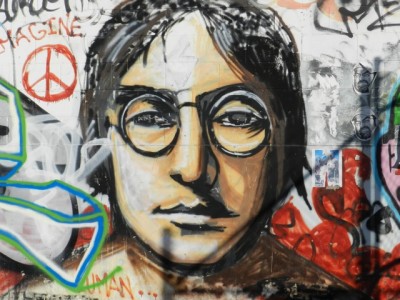
John Lennon mural, from Quirky Berkeley -  © 2014 by Quirky Berkeley

Railroad tracks, south of Addison


Friday, August 15, 2014

Deja Vu: A Look Back at Some of the Tirades Against Social Security and Medicare | BillMoyers.com

Bill Moyers on opposition to Social Security, then to Medicare, and now with echoes in the Republican opposition to the Affordable Care Act (Obamacare).

Deja Vu: A Look Back at Some of the Tirades Against Social Security and Medicare | BillMoyers.com

see also:


http://youtu.be/fRdLpem-AAs

Tuesday, August 5, 2014

Too thin to plow, too thick to drink

Shortly after we moved from Buffalo, New York, where we had lived for most of the 1960s, Lake Erie was famously called "too thick to drink, too thin to plow." In the 1970s, the lake was vastly improved by government action, but we are slipping again, as the Toledo drinking water story shows.

Here's a comment I sent on the New York Times story on the recent algae bloom in Lake Erie.

"One small measure that would help -- a ban on residential use or application of pesticides and fertilizers. Lawns are wonderful, but they would grow just fine without sprinklers, fertilizer, herbicides, or pesticides if we followed the practices of a generation or two ago. To improve the lawn, add a handful of clover seeds in the spring or fall to fix nitrogen that helps sustain the grass. Mow regularly but not too often. We are ruining our shared environment to outdo our neighbors for perfect lawns."
 What's on your lawn?

Monday, May 26, 2014

New York Times on state university administrator salaries

"Confronted with punishing state budget cuts, the public colleges and universities that educate more than 70 percent of this country’s students have raised tuition, shrunk course offerings and hired miserably paid, part-time instructors who now form what amounts to a new underclass in the academic hierarchy. At the same time, some of those colleges and universities are spending much too freely on their top administrators. . . . 

"The “worst overall offenders,” the study said, were Ohio State, Penn State, the University of Minnesota, the University of Michigan and the University of Delaware. . . ."

"Fat-Cat Administrators at the Top 25," New York Times, May 26, 2014.

Europe's Jobs

"The truth is that European-style welfare states have proved more resilient, more successful at job creation, than is allowed for in America’s prevailing economic philosophy. . . ."

Paul Krugman, "Europe's Secret Success," New York Times, May 26, 2014.

Saturday, May 24, 2014

Amazon - How Does a Monopoly Behave?


"This week, as part of a contract dispute with the publisher Hachette, we’re seeing Amazon behaving at its worst. The company’s willingness to nakedly flex its anticompetitive muscle gives new cause for concern to anyone who cares about books — authors, publishers, but mainly customers. . . ."

Farhad Manjoo, "Amazon's Tactics Confirm Its Critics' Worst Suspicions," New York Times, May 23, 2014.

Wednesday, May 21, 2014

University Presses Under Fire | The Nation

University Presses Under Fire | The Nation


"The Missouri case starkly illustrates a dual reality about the world of
university press publishing—many university presses exist on the edge,
and a large number of people want them to survive and flourish. . . ."

Screens in class?

"People flipping through electronic pages often retain less of what they read than on printed ones, studies suggest. . . ." 

This past semester, I experimented with permitting my undergraduate students, against my usual practice, to bring the class readings--intended for shared close reading during intensive seminar-like discussion--on their laptops, tablets, or even phones. It seemed clear to me that this had a very bad effect on class discussion--people just got distracted looking at their screens and lost touch with each other and the thread of the class. And now this study--apparently they just did not read as closely on screen as they would on paper. Perhaps technology can solve or transcend this problem that it seems to have created--or, for some uses, perhaps we really do read and mark up on paper, and talk face to face without the distraction of screens and connectivity.

But surely this must depend on the sort of classes I teach, since I am lucky to teach fairly small groups and to teach by discussion of assigned texts. 

See Anne Eisenberg, "Tackling the Limits of Touch Screens," New York Times (May 17, 2014).

May Is for Mowing, Too


Russell Lee, Worker Mowing Grass at the Agua Fria Migratory Labor Camp, Arizona. May 1940. FSA-OWI photography collection, Library of Congress. http://www.loc.gov/pictures/item/fsa1998000719/PP/

Iris Barry and the Art of Film


Robert Sitton, Lady in the Dark: Iris Barry and the Art of Film (New York: Columbia University Press, 2014).

from the publisher:

"Iris Barry (1895–1969) was a pivotal modern figure and one of the first intellectuals to treat film as an art form, appreciating its far-reaching, transformative power. Although she had the bearing of an aristocrat, she was the self-educated daughter of a brass founder and a palm-reader from the Isle of Man. An aspiring poet, Barry attracted the attention of Ezra Pound and joined a demimonde of Bloomsbury figures, including Ford Maddox Ford, T. S. Eliot, Arthur Waley, Edith Sitwell, and William Butler Yeats. She fell in love with Pound’s eccentric fellow Vorticist, Wyndham Lewis, and had two children by him.

"In London, Barry pursued a career as a novelist, biographer, and critic of motion pictures. In America, she joined the modernist Askew Salon, where she met Alfred Barr, director of the new Museum of Modern Art. There she founded the museum’s film department and became its first curator, assuring film’s critical legitimacy. She convinced powerful Hollywood figures to submit their work for exhibition, creating a new respect for film and prompting the founding of the International Federation of Film Archives.

"Barry continued to augment MoMA’s film library until World War II, when she joined the Office of Strategic Services to develop pro-American films with Orson Welles, Walt Disney, John Huston, and Frank Capra. Yet despite her patriotic efforts, Barry’s “foreignness” and association with such filmmakers as Luis Buñuel made her the target of an anticommunist witch hunt. She eventually left for France and died in obscurity. Drawing on letters, memorabilia, and other documentary sources, Robert Sitton reconstructs Barry's phenomenal life and work while recasting the political involvement of artistic institutions in the twentieth century."

Tuesday, May 20, 2014

How Did We Get Into This Mess?: Hyperscribal Society

How Did We Get Into This Mess?: Hyperscribal Society: From http://mimiandeunice.com/2011/01/05/killer-of-scribes/ A week or so ago, on Twitter, Virginia Heffernan introduced me to the word &...

Monday, May 19, 2014

What Administrators Cost University Students?

New York Times: Are our students  borrowing money so that public universities can pay higher salaries to administrators?

 http://nyti.ms/1gXnxrL

"At the 25 public universities with the highest-paid presidents, both student debt and the use of part-time adjunct faculty grew far faster than at the average state university from 2005 to 2012, according to a new study by the Institute for Policy Studies, a left-leaning Washington research group.. . ."

Saturday, April 26, 2014

Sunday, April 6, 2014


Arthur Rothstein, "Fruit tramps from California who have come to the Yakima Valley for apple thinning. Yakima, Washington." July 1936. FSA-OWI Collection, Library of Congress. 

Old Age in Pennsylvania, 1936


Dorothea Lange, "Old Age" near Washington, Pennsylvania. July 1936. FSA-OWI collection, Library of Congress.
http://www.loc.gov/pictures/collection/fsa/item/fsa1998021755/PP/

Sunday, March 2, 2014

Eugene E. White

Our colleague Gene White has died.  Here is the obituary from the Centre Daily Times.

Eugene Edmond White Eugene Edmond White, Ph.D., 94, passed away on February 6, 2014, in Ocala, Fla. Author of more than 40 professional articles and books on Puritan rhetoric and the history and criticism of American public address, Dr. White retired from Penn State University in 1986 as an emeritus professor. He is survived by his wife of 70 years, Roberta F. White; son, Eugene R. White and daughter-in-law, Carolyn M. White; and five grandchildren: Alexander X. Wilkens, Jennifer L. White, David E. White, Mark-Jason White, and Jessica S. White. Known as "Hoho" by his grandchildren, he will be missed most for his love and wonderful sense of humor. Memorial services will be held at Roberts Funeral Home, 19939 E. Pennsylvania Ave., Dunnellon, FL 34432 on Saturday, February 22, 2014, at 10 a.m. In lieu of flowers, the family suggests donations be made to Hospice of Marion County, Fla.

Published in Centre Daily Times on Feb. 13, 2014

Saturday, December 28, 2013

Herman Cohen

Herman Cohen December 29, 1924 December 22, 2013 Herman Cohen, 88, of State College, died Sunday, December 22, 2013, at Nazareth Hospital, Philadelphia. Born December 29, 1924, in Superior, Nebraska, he was the son of the late Morris and Dora Shvartsman Cohen. In 1947, he married Marlee Hollander who survives in State College. He is also survived by two children, Bob Cohen and his wife, Regina, of Medford, NJ, Matthew Cohen, of Santa Clarita, CA; a brother, Edward Cohen and his wife, Phyllis, of Ocala, FL; and four grandchildren, Bobby, Sara, Kristina and Jennifer Cohen. He was preceded in death by two brothers, Abraham and Casey Cohen. He was a 1942 graduate of Rock Island (IL) High School. He graduated with Bachelor's, Master's and Ph.D. degrees in Speech Communication from the University of Iowa. During WWII Herman served in the United States Army in the European and Asian Theatre. He was a Professor of Speech Communications at the University of Oregon, the University of Massachusetts and the Pennsylvania State University. He retired with Professor Emeritus status from Penn State College of Liberal Arts and was formerly head of the Speech Communication Department at Penn State. He was active in the Speech Communication Association and served as president of this organization in 1975. Herman published extensively on the history of rhetorical theory in American and European books and journals. He lectured and gave presentations in Germany, Switzerland, Italy and Finland. He published various books, including The History of Speech Communication: The Emergence of a Discipline, 1914-1945, which won the Everett Lee Hunt award. Herman enjoyed traveling, politics, reading and sports. He especially enjoyed traveling through Europe with his wife, keeping tabs on any upcoming elections and following Penn State Athletics. Visitation will be 1:00 to 2:00 p.m., Friday, December 27, 2013, at Koch Funeral Home, 2401 S. Atherton St., State College. Memorial service will follow at 2:00 p.m., Friday, December 27, 2013, at the funeral home with Jackie Hook, Life-Cycle Celebrant, officiating. Memorial contributions may be made to the American Lung Association at 810 River Avenue, Suite 140, Pittsburgh, PA 15212. Arrangements are under the care of Koch Funeral Home, State College. Online condolences and signing of the guest book may be entered at www.kochfuneralhome.com.

Centre Daily Times
December 25, 2013


Friday, April 19, 2013

Gentle Thursday, Penn State, 1974


Penn State University
April 1974

photos by Tom Benson (image at top is color adjusted)

Sunday, February 24, 2013

The Hawk for Peace

Alexander Calder, The Hawk for Peace (1968). Painted Steel. University of California Art Museum. Gift of the Artist.

Friday, February 8, 2013

Blizzard - 1940


Marion Post Wolcott. Railroad station during blizzard. North Adams, Massachusetts. March 1940.

Farm Security Administration - Office of War Information Photograph Collection (Library of Congress) LC-USF34- 053319-D More information about the FSA/OWI Collection is available at http://hdl.loc.gov/loc.pnp/pp.fsaowi

Sunday, January 27, 2013

What Killed Filibuster Reform?


 From The American Prospect:

Scott Lemieux, "What Killed Filibuster Reform?" American Prospect.
Senate Majority Leader Harry Reid and Senator McConnell reached an agreement yesterday that will be called "filibuster reform" by some reports. But as The Washington Post's Ezra Klein summarizes it, "The deal is this: The filibuster will not be reformed." There were some minor changes in the deal that will streamline the confirmation process for nominees to federal district courts (although not appeals courts), but overall the deal is a fizzle for supporters of filibuster reform. . . .

What Killed Filibuster Reform?

I admit that filibuster reform is something I have mixed feelings about, since the ability to "extend debate" protects the rights of the minority in the debate. But there must come a point at which the majority can move on with its work, and the filibuster has been abused. 

Selling Guns to Children -- It's Good Business

From the New York Times:
Threatened by declining participation in shooting sports, gun makers and sellers have poured millions of dollars into a campaign to get firearms into the hands of more, and younger, children.

Sunday, November 18, 2012

Thanksgiving 1942


Marjory Collins, "Neffsville, Pennsylvania. Saying grace before carving the turkey at Thanksgiving dinner in the home of Earle Landis." November 1942. FSA-OWI photographs, Library of Congress. 

http://hdl.loc.gov/loc.pnp/fsa.8d10749

Saturday, November 17, 2012

Veterans Day


John Vachon. War Veteran Selling Pencils. Omaha, Nebraska. November 1938.

FSA-OWI Collection. Library of Congress. LC-USF33- 001276-M5. fsa 8a03797
http://hdl.loc.gov/loc.pnp/fsa.8a03797

Wednesday, November 14, 2012

A Victory Over Suppression? by Elizabeth Drew | NYRblog


"Despite their considerable efforts the Republicans were not able to buy or steal the election after all. Their defeat was of almost Biblical nature. The people, Democratic supporters of the president, whose votes they had plotted, schemed, and maneuvered—unto nearly the very last minute—to deny rose up and said they wouldn’t have it. If they had to stand in line well into the night to cast their vote they did it. The lines were the symbol of the 2012 election—at once awe-inspiring and enraging. . . ."

A Victory Over Suppression? by Elizabeth Drew | NYRblog | The New York Review of Books

Professors of Persuasion

Running for president? Call a professor. From the New York Times:

      This election season the Obama campaign won a reputation for drawing on the tools of social science. The book “The Victory Lab,” by Sasha Issenberg, and news reports have portrayed an operation that ran its own experiment and, among other efforts, consulted with the Analyst Institute, a Washington voter research group established in 2007 by union officials and their allies to help Democratic candidates.
      Less well known is that the Obama campaign also had a panel of unpaid academic advisers. The group — which calls itself the “consortium of behavioral scientists,” or COBS — provided ideas on how to counter false rumors, like one that President Obama is a Muslim. It suggested how to characterize the Republican opponent, Mitt Romney, in advertisements. It also delivered research-based advice on how to mobilize voters. . . .

Benedict Carey, "Academic 'Dream Team' Helped Obama's Efforts," New York Times, 12 November 2012.

Monday, November 12, 2012

Prisoners of Conscience


Gerard A. Hauser, Prisoners of Conscience: Moral Vernaculars of Political Agency. (Columbia, SC: University of South Carolina Press, 2012).

from the publisher:

Prisoners of Conscience continues the work begun by Gerard A. Hauser in Vernacular Voices: The Rhetoric of Publics and Public Spheres, winner of the National Communication Association's Hochmuth Nichols Award. In his new book, Hauser examines the discourse of political prisoners, specifically the discourse of prisoners of conscience, as a form of rhetoric in which the vernacular is the main source of available appeals and the foundation for political agency.


Hauser explores how modes of resistance employed by these prisoners constitute what he deems a "thick moral vernacular" rhetoric of human rights. Hauser's work considers in part how these prisoners convert universal commitments to human dignity, agency, and voice into the moral vernacular of the society and culture to which their rhetoric is addressed.


Hauser grounds his study through a series of case studies, each centered on a different rhetorical mechanism brought to bear in the act of resistance.Through a transnational rhetorical analysis of resistance within political prisons, Hauser brings to bear his skills as a rhetorical theorist and critic to illuminate the rhetorical power of resistance as tied to core questions in contemporary humanistic scholarship and public concern.

Friday, November 9, 2012

Sam Becker

From the website of the Department of Communication, University of Iowa:

Distinguished Professor Emeritus of Communication Studies Samuel L. "Sam" Becker died on Thursday, November 8, 2012, at the age of 89. Professor Becker, a UI alumnus, was a beloved figure for the University of Iowa, the College of Liberal Arts & Sciences, the Department of Communication Studies, and the countless students, faculty colleagues, staff members, and community members who were touched by his more than 70 years of scholarship, mentorship, and friendship at the UI. Our College extends its deepest condolences to Sam's family. . . .

 Sam Becker was one of the great leaders in the discipline of Communication.

photo--from the University of Iowa, Department of Communication web site.

Tuesday, November 6, 2012

Stealing the Vote

When I voted this morning in State College, PA, the voters ahead of me in line were simply handing their driver's licenses to the check-in woman behind the table as they approached. I didn't do that, but said, "Good morning." The woman said, "May I see your ID?"

I found myself saying, "I understand the Court has ruled that you can ask, but has also ruled that I don't need to show it." "Well, that is correct," she said. "But you will have to next time." "Unless the Court rules against the Voter ID bill again," I found myself saying. All this was very polite, but I'll admit I felt a certain chill from the ladies behind the table--ladies I'd seen and thanked every election for the past 40 or so years at our local polling place. So, I was asked to spell my name, and then asked, as were all the others, to sign my name on the page next to where my name appears in the registry of voters. And then I voted.

See also

Elizabeth Drew, "Voting Wrongs," New York Review of Books, NYR Blogs, 21 September 2012.

Monday, November 5, 2012

Speechwriting

Nice piece by Robert Lehrman in today's New York Times -- on political speechwriting.

Much of what lures speechwriters is the prospect of reaching so many people about ideas we think so important — as Peggy Noonan did for Mr. Bush in 1989 (“thousand points of light”) ; Bob Shrum did for Edward M. Kennedy in 1980 (“the dream shall never die”); and Matt Scully did for Sarah Palin in 2008 (“If character is the measure in this election …”).

I have passed no bill, stopped no war, created no policy that would bring health insurance to a single person. But if we expect to see such results solely from our work, that dooms many to disappointment. There’s plenty to celebrate about being part of the team. . . .


Robert Lehrman, "The Political Speechwriter's Life," New York Times, 5 November 2012.

Wednesday, October 10, 2012

African Yearbook of Rhetoric

The African Yearbook of Rhetoric is now available online:


Welcome to the African Yearbook of Rhetoric
 
The African Yearbook of Rhetoric (ISSN: 2220-2188) is a multi-lingual, peer-reviewed scholarly journal devoted to the development of rhetoric studies on, and in Africa. Some special issues are released under the imprint of The Elephant and the Obelisk.

From October 2012 the Yearbook is freely accessible on this site.

The copyright to all materials is held by AfricaRhetoric Publishing and downloads made for public usage must be acknowledged.

All correspondence to: africarhetoric@rhetoricafrica.org
 
South African painter Toni Bico (www.tonibico.com) is contributing original cover illustrations. (Book Covers)

List of Volumes
 
Vol. 1, Gender Rhetoric: North-South, September 2010.
Vol. 2, 1, Rhetorics of justice in post-societies, July 2011.
Vol. 2, 2 Under the Baobab. To Honour Stuart Saunders on his Eightieth Birthday, under the imprint of The Elephant and the Obelisk, August 2011.
Vol. 2, 3, The Great Liberation Speeches of Africa, December 2011.
Vol. 3, 1, Surveillance/Rhetorics, March 2012.
Vol. 3, 2, New Beginnings: Argentina and South Africa, June 2012.
Vol. 3, 3, Diplomatic Rhetoric in the South, November 2012.
Vol. 4, 1, Rhetoric of Statecraft in Africa, March 2013.

Thursday, October 4, 2012

The Debate


              photo: npr


What a disappointing debate, and I'm still trying to sort it out. By now, almost 24 hours after the first presidential debate on October 3, 2012, the press has told us all that Mitt Romney was dominant, energetic, upbeat, prepared, aggressive.

Looking at this as a rhetorical critic, I can see the way the Romney-wins! scenario comes together for the press and for many viewers. Looking at it as a citizen (of course with political perspectives of my own) I see the story very differently.

I didn't see it that way, though I found the event as a whole depressing. President Obama and Jim Lehrer both, for seemingly different reasons, deferred to a Mitt Romney who interrupted, who filibustered, and who would not be either responsive to or guided by the moderator.

Jim Lehrer -- it seems to me that as theater the obvious reading was that Jim Lehrer was too diffident, too deferential to Mitt Romney, and perhaps too old to exert the force necessary to reign in the candidate. My own reading is different, but I don't think it will be the dominant reading -- I think Jim Lehrer, one of the great TV journalists, was genuinely hoping to get the candidates talking and to stay out of their way.

Barack Obama -- again, from the point of view of theater, especially in the morning after, the interpretation is that President Obama lacked energy (must have wished he weren't there), and seemed unprepared. I think otherwise, but again I recognize that my understanding is shaped by my preferences and hopes. I thought President Obama was stunned to find Mitt Romney simply lying, taking positions very different from those he has been advocating for the past year, and that he chose not to call him on it directly. After all, if the president calls someone a liar, especially in the middle of a debate, that's an even bigger decorum violation than Mitt Romney's lies and aggressiveness.

Mitt Romney -- the press seems to agree that he had the fighting spirit, and that's been ruled the winning combination the morning after. But I saw Romney as refusing to stick to agreed upon time limits, and simply filibustering. At one crucial point, as I saw it, Romney in effect challenged the president to call him a liar, when he said that he would cut taxes and do so in a way that would not decrease revenue. But that's either a lie (when compared to his earlier campaign numbers, such as they are) or it is magical thinking -- that is, that if we drastically lower taxes, the economy will boom and revenues will go up on their own even with lower rates. We've heard that one before. Here it comes again. Romney also presented a new persona at the debate; gone (for the moment) was the "severely conservative" Romney of the primary debates; last night we saw a man imitating a center-right-wing pragmatist with a whole new set of talking points. As a citizen, this, for me, reinforces the sense that though Romney argues as if from deep inner conviction, he does not seem to carry his principles from one tactical situation to another. As a rhetorical maneuver last night, I can see how it worked its appeal.

Thursday, September 13, 2012

Supreme Court and McCarthy


  Robert M. Lichtman. The Supreme Court and McCarthy-Era Repression: One Hundred Decisions (Urbana, IL: University of Illinois Press, 2012).

from the publisher:

In this volume, attorney Robert M. Lichtman provides a comprehensive history of the U.S. Supreme Court's decisions in "Communist" cases during the McCarthy era. Lichtman shows the Court's vulnerability to public criticism and attacks by the elected branches during periods of political repression. The book describes every Communist-related decision of the era (none is omitted), placing them in the context of political events and revealing the range and intrusiveness of McCarthy-era repression.
In Fred Vinson's term as chief justice (1946–53), the Court largely rubber-stamped government action against accused Communists and "subversives." After Earl Warren replaced Vinson as chief justice in 1953, however, the Court began to rule against the government in "Communist" cases, choosing the narrowest of grounds but nonetheless outraging public opinion and provoking fierce attacks from the press and Congress. Legislation to curb the Court flooded Congress and seemed certain to be enacted. The Court's situation was aggravated by its 1954 school-desegregation decision, Brown v. Board of Education, which led to an anti-Court alliance between southern Democrats and anti-Communists in both parties. Although Lyndon Johnson's remarkable talents as Senate majority leader saved the Court from highly punitive legislation, the attacks caused the Court to retreat, with Felix Frankfurter leading a five-justice majority that decided major constitutional issues for the government and effectively nullified earlier decisions. Only after August 1962, when Frankfurter retired and was replaced by Arthur Goldberg, did the Court again begin to vindicate individual rights in "Communist" cases--its McCarthy era was over.
Demonstrating keen insight into the Supreme Court's inner workings and making extensive use of the justices' papers, Lichtman examines the dynamics of the Court's changes in direction and the relationships and rivalries among its justices, including such towering figures as Hugo Black, Felix Frankfurter, Earl Warren, William O. Douglas, and William J. Brennan, Jr. The Supreme Court and McCarthy-Era Repression: One Hundred Decisions tells the entire story of the Supreme Court during this unfortunate period of twentieth-century American history.

Development Rhetoric


 Jenny Rice. Distant Publics: Development Rhetoric and the Subject of Crisis. (Pittsburgh, PA: University of Pittsburgh Press, 2012.


from the publisher:

Urban sprawl is omnipresent in America and has left many citizens questioning their ability to stop it. In Distant Publics, Jenny Rice examines patterns of public discourse that have evolved in response to development in urban and suburban environments. Centering her study on Austin, Texas, Rice finds a city that has simultaneously celebrated and despised development.
Rice outlines three distinct ways that the rhetoric of publics counteracts development: through injury claims, memory claims, and equivalence claims. In injury claims, rhetors frame themselves as victims in a dispute. Memory claims allow rhetors to anchor themselves to an older, deliberative space, rather than to a newly evolving one. Equivalence claims see the benefits on both sides of an issue, and here rhetors effectively become nonactors. 
Rice provides case studies of development disputes that place the reader in the middle of real-life controversies and evidence her theories of claims-based public rhetorics. She finds that these methods comprise the most common (though not exclusive) vernacular surrounding development and shows how each is often counterproductive to its own goals. Rice further demonstrates that these claims create a particular role or public subjectivity grounded in one’s own feelings, which serves to distance publics from each other and the issues at hand.

Rice argues that rhetoricians have a duty to transform current patterns of public development discourse so that all individuals may engage in matters of crisis. She articulates its sustainability as both a goal and future disciplinary challenge of rhetorical studies and offers tools and methodologies toward that end.


Saturday, June 30, 2012

Toward Los Angeles, California (LOC)

Toward Los Angeles, California (LOC) by The Library of Congress
Toward Los Angeles, California (LOC), a photo by The Library of Congress on Flickr.

Photograph by Dorothea Lange, March 1937, from the FSA/OWI collection, Library of Congress. 

Thursday, March 15, 2012

Hollywood's CIA -- the CIA's Hollywood


Tricia Jenkins, The CIA in Hollywood: How the Agency Shapes Film and Television (Austin: University of Texas Press, 2012).

from the publisher:

"What’s your impression of the CIA? A bumbling agency that can’t protect its own spies? A rogue organization prone to covert operations and assassinations? Or a dedicated public service that advances the interests of the United States? Astute TV and movie viewers may have noticed that the CIA’s image in popular media has spanned this entire range, with a decided shift to more positive portrayals in recent years. But what very few people know is that the Central Intelligence Agency has been actively engaged in shaping the content of film and television, especially since it established an entertainment industry liaison program in the mid-1990s.

"The CIA in Hollywood offers the first full-scale investigation of the relationship between the Agency and the film and television industries. Tricia Jenkins draws on numerous interviews with the CIA’s public affairs staff, operations officers, and historians, as well as with Hollywood technical consultants, producers, and screenwriters who have worked with the Agency, to uncover the nature of the CIA’s role in Hollywood. In particular, she delves into the Agency’s and its officers’ involvement in the production of The Agency, In the Company of Spies, Alias, The Recruit, The Sum of All Fears, Enemy of the State, Syriana, The Good Shepherd, and more. Her research reveals the significant influence that the CIA now wields in Hollywood and raises important and troubling questions about the ethics and legality of a government agency using popular media to manipulate its public image."

See also

Oliver Boyd-Barrett, David Herrera, and James A. Baumann, Hollywood and the CIA: Cinema, Defense, and Subversion (New York: Routledge, 2011).

 David L. Robb, Operation Hollywood: How the Pentagon Shapes and Censors Movies (Prometheus Books, 2004).

. . .  there is a fairly extensive scholarly literature on the more general subject of film and government.

Wednesday, March 14, 2012

Occurrent Arts


Brian Massumi, Semblance and Event: Activist Philosophy and the Occurrent Arts (Cambridge: MIT Press, 2011).

from the publisher:

***
"Events are always passing; to experience an event is to experience the passing. But how do we perceive an experience that encompasses the just-was and the is-about-to-be as much as what is actually present? In Semblance and Event, Brian Massumi, drawing on the work of William James, Alfred North Whitehead, Gilles Deleuze, and others, develops the concept of "semblance" as a way to approach this question.

"It is, he argues, a question of abstraction, not as the opposite of the concrete but as a dimension of it: "lived abstraction." A semblance is a lived abstraction. Massumi uses the category of the semblance toinvestigate practices of art that are relational and event-oriented--variously known as interactive art, ephemeral art, performance art, art intervention--which he refers to collectively as the "occurrent arts." Massumi argues that traditional art practices, including perspective painting, conventionally considered to be object-oriented freeze frames, also organize events of perception, and must be considered occurrent arts in their own way. Each art practice invents its own kinds of relational events of lived abstraction, to produce a signature species of semblance.

"The artwork's relational engagement, Massumi continues, gives it a political valence just as necessary and immediate as the aesthetic dimension. Massumi investigates occurrent art practices in order to examine, on the broadest level, how the aesthetic and the political are always intertwined in any creative activity."

***

Deconstruct This


Brian Cogan, ed., Deconstructing South Park: Critical Examinations of Animated Transgression (Lanham, MD: Rowman & Littlefield, 2011).

from the publisher:

***
"Deconstructing South Park: Critical Examinations of Animated Transgression is an edited collection by Brian Cogan that looks at the long and controversial run of one of the most subversive programs on television. South Park, while denounced by many as simply scatological, is actually one of the most nuanced and thoughtful programs on television. The contributors to South Park reveal that, through the lens of four foul-mouthed nine year olds, Trey Parker and Matt Stone have created one of the most astute forms of social and political commentary in television history.

"Deconstructing South Park, itself the most ambitious deconstruction of popular culture to date, analyzes how South Park is not only entertainment, but a commentary on American culture that tackles controversial issues far beyond the depth of most television. Specifically, the medium of animated sitcom allows the show's creators to contribute to cultural conversations regarding disability studies, religion, sexuality, celebrity, and more. If South Park deconstructs American culture, then Cogan and his contributors deconstruct the deconstructionists and reveal South Park in all its hilarious and often contradictory complexity."
***

Political Poster Collection now of Flickr


The Political Poster collection that I donated to Penn State is now available on Flickr -- which permits comments. I am hoping that this will elicit some participants, and perhaps some of the artists, to recall the era. The collection is here.

Tuesday, February 28, 2012

JFK vs. Rick Santorum

John F. Kennedy to the Houston General Ministerial Association:

 . . . Whatever issue may come before me as president — on birth control, divorce, censorship, gambling or any other subject — I will make my decision in accordance with these views, in accordance with what my conscience tells me to be the national interest, and without regard to outside religious pressures or dictates. And no power or threat of punishment could cause me to decide otherwise. . . .

Rick Santorum's dirty politics

The Rick Santorum pseudo-Democrat Romney robocall . . .

Bernie Sanders on Voter Suppression

Vermont Senator Bernie Sanders on voter suppression:

Monday, February 27, 2012


John T. Gage, editor, The Promise of Reason: Studies in The New Rhetoric (Carbondale, IL: Southern Illinois University Press, 2011).

from the publisher:

"No single work is more responsible for the heightened interest in argumentation and informal reasoning—and their relation to ethics and jurisprudence in the late twentieth century—than Chaïm Perelman and Lucie Olbrechts-Tyteca’s monumental study of argumentation, La Nouvelle Rhétorique: Traité de l'Argumentation. Published in 1958 and translated into English as The New Rhetoric in 1969, this influential volume returned the study of reason to classical concepts of rhetoric. In The Promise of Reason: Studies in The New Rhetoric, leading scholars of rhetoric Barbara Warnick, Jeanne Fahnestock, Alan G. Gross, Ray D. Dearin, and James Crosswhite are joined by prominent and emerging European and American scholars from different disciplines to demonstrate the broad scope and continued relevance of The New Rhetoric more than fifty years after its initial publication.

"Divided into four sections—Conceptual Understandings of The New Rhetoric, Extensions of The New Rhetoric, The Ethical Turn in Perelman and The New Rhetoric, and Uses of The New Rhetoric—this insightful volume covers a wide variety of topics. It includes general assessments of The New Rhetoric and its central concepts, as well as applications of those concepts to innovative areas in which argumentation is being studied, such as scientific reasoning, visual media, and literary texts. Additional essays compare Perelman’s ideas with those of other significant thinkers like Kenneth Burke and Richard McKeon, explore his career as a philosopher and activist, and shed new light on Perelman and Olbrechts- Tyteca’s collaboration. Two contributions present new scholarship based on recent access to letters, interviews, and archival materials housed in the Université Libre de Bruxelles. Among the volume’s unique gifts is a personal memoir from Perelman’s daughter, Noémi Perelman Mattis, published here for the first time."

Digital Divide


Kirk St. Amant and Bolanle Olaniran, editors, Globalization and the Digital Divide (Amherst, NY: Cambria Press, 2011).

from the publisher -- table of contents --

Introduction: Globalization and the Digital Divide: Understanding the Connections between Technology and Communication in a Global Context (Kirk St. Amant)

Chapter 1: The Spread of Culture under the Umbrella of Globalization (Tugba Kalafatoglu)

Chapter 2: Traditional Cultures and their Effects on Globalization: An African Perspective (Kehbuma Langmia)

Chapter 3: The Role of Appropriate ICT in Bridging the Digital Divide: Theoretical Considerations and Illustrating Cases (Victor van Reijswoud and Arjan de Jager)

Chapter 4: Wireless Networking Bridges the Digital Divide in Africa (Anas Tawileh)

Chapter 5: The Container Project in Rural Jamaica: Socializing Technology and Unleashing Creativity along the Digital Divide (Francesca da Rimini)

Chapter 6: The Web Presence of European and Middle Eastern Countries: A Digital Divide (Alireza Noruzi)

Chapter 7: The Digital Divide in China: Socioeconomic and Cultural Dimensions (Yun Xia)

Chapter 8: Globalization, Epidemics, and Politics: Communicating Risk in the Digital Age (Yasmin Ibrahim)

Chapter 9: The Commercialization of Higher Education and Knowledge as a Global Trend: Implications for the Digital Divide in Developing Countries (Tatjana Takševa)

Saturday, February 25, 2012

The Daisy Girl Ad


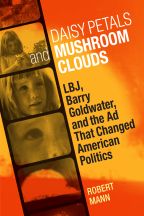
Robert Mann, Daisy Petals and Mushroom Clouds: LBJ, Barry Goldwater, and the Ad That Changed American Politics (Baton Rouge: Louisiana State University Press, 2011).

from the publisher:

"The grainy black-and-white television ad shows a young girl in a flower-filled meadow, holding a daisy and plucking its petals, which she counts one by one. As the camera slowly zooms in on her eye, a man’s solemn countdown replaces hers. At zero the little girl’s eye is engulfed by an atomic mushroom cloud. As the inferno roils in the background, President Lyndon B. Johnson’s voice intones, “These are the stakes—to make a world in which all of God’s children can live, or to go into the dark. We must either love each other, or we must die.”
In this thought-provoking and highly readable book, Robert Mann provides a concise, engaging study of the “Daisy Girl” ad, widely acknowledged as the most important and memorable political ad in American history. Commissioned by Johnson’s campaign and aired only once during Johnson’s 1964 presidential contest against Barry Goldwater, it remains an iconic piece of electoral propaganda, intertwining cold war fears of nuclear annihilation with the increasingly savvy world of media and advertising. Mann presents a nuanced view of how Johnson’s campaign successfully cast Barry Goldwater as a radical too dangerous to control the nation’s nuclear arsenal, a depiction that sparked immediate controversy across the United States. 
Repeatedly analyzed in countless books and articles, the spot purportedly destroyed Goldwater’s presidential campaign. Although that degree of impact on the Goldwater campaign is debatable, what is certain is that the ad ushered in a new era of political advertising using emotional appeals as a routine aspect of campaign strategy."

Friday, February 24, 2012

Animal Narratives in the Media


Claire Molloy, Popular Media and Animals (New York: Palgrave Macmillan, 2011).

from the publisher:

"How do mainstream films, television, advertising, videogames and newspapers engage with key animal issues such as vivisection, hunting, animal performance, farming, meat eating and animal control?

Claire Molloy argues that animal narratives and imagery are economically significant for popular media industries which, in turn, play an important role in shaping the limits and norms of public discourses on animals and animal issues. Through analysis of various popular examples this book grapples with some of the industrial, social, cultural and ethical aspects of media discourses on animals. By examining how popular media forms constitute key sources of information, definitions and images, the author explores some of the myriad ways in which media discourses sustain a range of constructions of animals that are connected, appropriated or co-opted by other systems of production and so play a role in the normalisation of particular practices."

Nature's Image


Janice Neri, The Insect and the Image: Visualizing Nature in Early Modern Europe, 1500-1700 (Minneapolis: University of Minnesota Press, 2011).

from the publisher:

"The Insect and the Image explores the ways in which visual images defined the insect as a proper subject of study for Europeans of the early modern period. Revealing how sixteenth- and seventeenth-century artists and image makers shaped ideas of the natural world, Janice Neri enhances our knowledge of the convergence of art, science, and commerce today."

Ralph M. Faust

Sometimes local action makes a difference. Ralph M. Faust, principal of Oswego High School in Oswego, New York, was my uncle. Here's a dissertation chapter about him and his leadership in helping Jewish refugees in Oswego who had fled the Holocaust. The author is at pains to acknowledge Ralph Faust's work, while whittling away a little at what he calls the myth of Ralph Faust. I do think Ruddy may inadvertently suggest that Ralph Faust fostered the "myth" that Ruddy writes about; in fact, Ralph Faust was a very modest man who in interviews never tried to inflate his own role in these events.

http://www.oswego.edu/~ruddy/Buffalo%20Papers/Dissertation/Chapter%2004.pdf

Michael Berube on adjunct faculty

Michael Berube on adjunct faculty:

The New Faculty Majority (NFM) summit Reclaiming Academic Democracy: Facing the Consequences of Contingent Employment in Higher Education, held on Saturday, 28 January, at the Grand Hyatt in Washington, DC, was full of bitter ironies. The gathering was convened in conjunction with the annual meeting of the Association of American Colleges and Universities (AAC&U). But when Carol Geary Schneider, president of the AAC&U, asked in the opening plenary session who had availed themselves of the “crosswalk” she had established between the AAC&U and the NFM, it became distressingly clear that for most AAC&U members “in conjunction with” apparently meant little more than “in the same hotel as.” At one end of the long hallway, NFM members talked about the challenges of keeping body and soul intact while teaching 4-4 jobs to which they had been required to reapply every year for twenty years; at the other end, university administrators browsed a book exhibit whose keywords seemed to be finance, management, outcomes, and assessment. At one point in the NFM proceedings, a faculty member from Oakland Community College held up a handbook for deans she’d purchased at the other end of the hallway and noted that adjunct faculty merited only one mention, under the heading “budgets.” . . . (more)


from the MLA blog, Michael Berube, "Among the Majority," FROM THE PRESIDENT, MLA blog.

The Adjunct Project

Have a look at "The Adjunct Project," which is collecting U.S. data on the situation of adjunct faculty at colleges and universities. The core of the project at this point is an open GoogleDocs spreadsheet on which contingent faculty are asked to report pay and working conditions at their institutions.

"The Adjunct Project is a way for us to compile data on treatment of contingent faculty. Combining our knowledge and resources will help us all to better understand the reality of life as an adjunct professor. The goal of this website is to identify universities that set the standard for best practices with regard to adjuncts. The best schools should be recognized and honored for what they are doing. The project is also designed to promote transparency in higher education employment practices for the sake of teachers, students, and parents."