Wednesday, February 24, 2016

New York Public Library Poster Collection

The Miriam and Ira D. Wallach Division of Art, Prints and Photographs: Art & Architecture Collection, The New York Public Library. "Harper's July" New York Public Library Digital Collections. Accessed February 24, 2016. http://digitalcollections.nypl.org/items/510d47dc-487d-a3d9-e040-e00a18064a99

From the free, downloadable collection of turn of the century art posters at the New York Public Library. http://digitalcollections.nypl.org/collections/turn-of-the-century-posters?format=html&id=turn-of-the-century-posters&per_page=250&page=2#/?tab=navigation


Friday, February 12, 2016

The Canary in the Mine

Some friends have disliked Hillary Clinton's yellow coat at the debate with Bernie Sanders last night. I did not much like that coat either, but with all due respect I think this line of criticism wanders into and reveals the anti-feminist double bind. This is a middle aged woman. The rules of dress for senior politicians are based on the standard followed by men -- dark suit, white shirt, dark or red tie. Women's clothing either imitates men (reminding us that she's not a man, implicitly qualified on those grounds for senior office), or it doesn't (ditto). That's the double bind, and none of us is immune to it. I don't remember much mockery of the clothing choices of the men in the race -- suit for the debate, jeans for the farmyard, casual for the diner, or whatever. Or implicit mockery of them for their figures. It is fashionable to suppose that the society has moved past sexism (or racism), but we haven't. I'm not accusing any of my friends here of this -- it's all of us.

 http://www.cnn.com/2016/02/11/politics/democratic-debate-highlights/

Wednesday, February 10, 2016

Burning the Autumn Leaves, 1940.

Jack Delano. Burning the Autumn Leaves on Broadway in Norwich, Connecticut. October 1940. FSA-OWI Collection, Library of Congress, Prints and Photographs Division. http://www.loc.gov/pictures/item/fsa2000023717/PP/


Monday, February 8, 2016

Football Season, 1937.


John Vachon. Spectators at football game, Annapolis, Maryland. November 1937.  FSA-OWI Collection, Library of Congress, Prints and Photographs Division. http://www.loc.gov/pictures/item/fsa1997002916/PP/ 

John Vachon. Watching Columbia-Navy football game, Annapolis, Maryland. November 1937. FSA-OWI Collection, Library of Congress, Prints and Photographs Division. http://www.loc.gov/pictures/item/fsa1997002915/PP/

Franklin D. Roosevelt: Message to the Boy Scouts of America on their Twenty-fifth Anniversary.

Enlisting the Boy Scouts in the New Deal.

Franklin D. Roosevelt: Message to the Boy Scouts of America on their Twenty-fifth Anniversary.

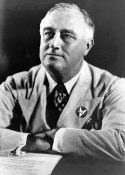
Franklin

Franklin D. Roosevelt


- Message to the Boy Scouts of America on their Twenty-fifth Anniversary.
February 8, 1935
President Head, Members of the Boy Scouts:
The year 1935 marks the Twenty-fifth Birthday celebration of the Boy Scouts of America. During these years the value of our organization in  building character and in training for citizenship has made itself a vital factor in the life of America. That is why not only the Boy Scoutsof today, but the millions of men and boys who have graduated through Scouting, will be joined by millions of other Americans in the proper marking and celebration of our anniversary.

As I review the record of these twenty-five years of Scouting in America, I am impressed with the extent of the volunteer service we have rendered. We as a Nation are proud of the fact that in addition to our splendid system of education and of other services made available through funds secured by taxation, there are in each community so many well-organized and efficiently administered agencies which supplement the work of Government and make available additional opportunities which strengthen the best objectives of the home, the church and the school.

Every Scout seeks to do a good turn daily; every troop seeks to accomplish some community benefit;and occasionally, as last year, Scouts everywhere unite to do a good turn nationally. A year ago, as your Honorary President, I started the national Scout effort to collect household furnishings and clothing and supplies for those in need; and the results were truly amazing. Hundreds of thousands of families were helped by the Boy Scouts.

The program for this year, embracing as it does over one million boys, lasts throughout the year. In May there will be a gathering of the Leaders of Scouting at the Twenty-fifth Annual Meeting of the National Council.

But the outstanding event will be America's first National Jamboree, to be held here in the City of Washington from August 21st to August 30th. I hope to attend it in person. Since I extended the invitation a year ago,definite plans have crystallized. With the cooperation of various officials here in Washington a fine camp site has been made available and will be all ready to receive thirty thousand boys when the meeting starts. I am glad to know that the selection of these boys is being made on the basis of merit and, furthermore, that in many cases these boys will come to Washington at the expense of the troop and not merely because the boy's economic situation in life is such as to make it possible for his parents to send him.

Thirty thousand Scouts brought together under such conditions will mean the most thoroughly representative group of American boys ever mobilized for a purpose of this character.

We hope, too, that other countries will send at least small delegations to meet with us on this occasion. Because Scouting is now in active operation in almost every civilized Nation of the world, this will give us a splendid opportunity to enlarge our basis of mutual respect, of understanding and of friendship among the people of the world, regardless of race or creed.

In a moment Dr. West is going to lead the Scouts in thousands of halls and other meeting places in every State in the Union in repeating the Scout Oath and Law. I hope that the people who are listening to my voice will give careful heed to this Scout Oath. It is the basis of good citizenship; it is the basis of good government; it is the basis of orderly progress for our country in the years to come.

Franklin D. Roosevelt: "Message to the Boy Scouts of America on their Twenty-fifth Anniversary.," February 8, 1935. Online by Gerhard Peters and John T. Woolley, The American Presidency Project. http://www.presidency.ucsb.edu/ws/?pid=14979.


Salvage Campaign, 1942.

Alfred T. Palmer. Annette del Sur public[iz]ing salvage campaign in yard of Douglas Aircraft Company, Long Beach, California. October 1942. FSA-OWI Collection, Library of Congress, Prints and Photographs Division.  http://www.loc.gov/pictures/item/fsa1992001591/PP/

Sunday, February 7, 2016

At the Wharves, Annapolis. 1937.


John Vachon. Men at the wharves, Annapolis, Maryland. November 1937. FSA-OWI Collection, Library of Congress, Prints and Photographs Division. http://www.loc.gov/pictures/item/fsa1997002872/PP/

 John Vachon. Untitled photo, possibly related to: Men at the wharves, Annapolis, Maryland. November 1937. FSA-OWI Collection, Library of Congress, Prints and Photographs Division.
http://www.loc.gov/pictures/item/fsa1997002873/PP/

Saturday, February 6, 2016

Breakfast with hawk.

A hawk was sitting on our back fence this morning, showing a keen interest in some squirrels who were darting about among the trees. I think the hawk left without breakfasting on any of the squirrels.


Friday, February 5, 2016

On to New Hampshire

John Collier. A view looking northeast from the fire tower manned by Barbara Mortensen, a fire and airplane lookout on Pine Mountain, Gorham vicinity, N.H. June 1943. Color transparency. FSA-OWI Collection, Library of Congress, Prints and Photographs Division.


Wednesday, February 3, 2016

Women Workers in the Roundhouse

Jack Delano. Women workers employed as wipers in the roundhouse having lunch in their rest room, C. & N.W. R.R., Clinton, Iowa. April 1943. Color transparency. FSA-OWI Collection, Library of Congress, Prints and Photographs Division. http://www.loc.gov/pictures/item/fsa1992001032/PP/


Tuesday, February 2, 2016

Men Working Together

"A poster comes to life. A couple of groundhogs get a liberal education from a Navy pilot as Aviation-radio Chief John Marshall Evans (left) escorts welder George Woolslayer and Sergeant French L. Vineyard (right) through his navy post. The three colleagues of the "Men Working Together" poster learned how the war can be won only by the united efforts of soldier, sailor and worker, during their introductions to one another's spheres of activity. Allegheny- Steel, Pittsburgh, Pennsylvania."  August 1942. Alfred T. Palmer, photographer. FSA-OWI Collection, Library of Congress Prints and Photographs Division.

Poster. "Men Working Together!" Office for Emergency Management. Division of Information, 1941. World War II Poster Collection. Digitized Poster Collections, Northwestern University Library.

The "Men Working Together" poster is discussed in Posters for Peace (figure 12, p. 32). When the Farm Security Administration (FSA) photography project moved to the Office of War Information (OWI) with America's engagement in World War II, along with poster artists from the Works Progress Administration (WPA), themes that had stimulated New Deal posters were adapted to serve the national security emergency.


Monday, February 1, 2016

Voting in the Primary - 1942

Arthur Rothstein, Dunklin County, Missouri. Voting in the primary election at the county courthouse. July 1942.  FSA-OWI Collection, Library of Congress. 

http://www.loc.gov/pictures/item/owi2001008873/PP/

Dear Iowa

Dear Iowa,

Use your best judgment. We're all in this together.

Wednesday, January 27, 2016

2016 Design Show Selected Entries -American Association of University Presses

2016 Design Show Selected Entries


Four Penn State University Press books selected for AAUP design awards.
-->
Penn State University Press
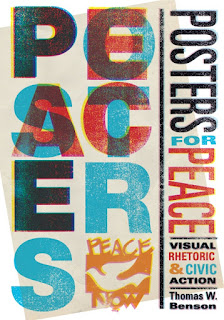
Posters for Peace: Visual Rhetoric & Civic Action by Thomas W. Benson
Designer: Brad Norr
Production Coordinator: Jennifer Norton
Art Director: Jennifer Norton –

Penn State University Press
Posters for Peace: Visual Rhetoric & Civic Action by Thomas W. Benson
Designer: Brad Norr
Production Coordinator: Jennifer Norton
Art Director: Jennifer Norton - See more at: http://www.aaupnet.org/events-a-conferences/book-jacket-and-journal-show/2016-show-information/2016-design-show-selected-entries#sthash.D2iATOrX.dpuf
Penn State University Press
Posters for Peace: Visual Rhetoric & Civic Action by Thomas W. Benson
Designer: Brad Norr
Production Coordinator: Jennifer Norton
Art Director: Jennifer Norton - See more at: http://www.aaupnet.org/events-a-conferences/book-jacket-and-journal-show/2016-show-information/2016-design-show-selected-entries#sthash.D2iATOrX.dpuf
Penn State University Press
Posters for Peace: Visual Rhetoric & Civic Action by Thomas W. Benson
Designer: Brad Norr
Production Coordinator: Jennifer Norton
Art Director: Jennifer Norton - See more at: http://www.aaupnet.org/events-a-conferences/book-jacket-and-journal-show/2016-show-information/2016-design-show-selected-entries#sthash.D2iATOrX.dpuf

STOP! Which Came First?

Stop Sign with Santorum bumper sticker. Near a Wegmans supermarket, State College, Pennsylvania, January 2016.

"Stop War" poster, silk screen, Berkeley, California, c. May 1970, from Thomas W. Benson Political Protest Collection, Special Collections, Penn State University Libraries and Thomas W. Benson, Posters for Peace: Visual Rhetoric and Civic Action (University Park: Penn State University Press, 2015).


When is the last time you saw a STOP sign decorated with an addition that constituted it as a political slogan? The "Stop War" poster shown above was part of the peace movement at the University of California, Berkeley, in May 1970, after the Cambodia invasion and the shootings at Kent State. Did the poster prompt others to add words to STOP signs, or was the poster artist inspired by a practice that was already ongoing? I can't remember, though it seems to me I saw STOP WAR on public STOP signs around the country at about that time, and perhaps before.

The STOP SANTORUM sign in the photograph above refers to and is a relic of the presidential primary campaign of 2012, and it was still there this week when I took the photograph -- January 2016.

It seems to me that the tone of these STOP WAR alterations was at the time somewhat transgressive, suggesting not only an appeal to peace but an act of resistance by defacing what is, after all, government property and a sign of government's regulative power. As the years have gone by, that cluster of rhetorical suggestions seems to me to have dimmed somewhat, with the worldwide spread of graffiti. Altering a STOP sign is still illegal, and so still formally an act of resistance or at least of exclamatory, even imperative, appeal, but the power has been diluted by use and context. STOP sign defacements are no longer the property of the Left, though probably most of such uses are anti-establishment in context and appeal. One has often seen, for example, Ron Paul, and now Rand Paul defacement of traffic signs. Are we all anti-establishment now?

See also http://nyti.ms/1Lrhss3 "Why Can't the GOP Stop Trump?" March 3, 2016.


Wednesday, January 20, 2016

Posters for Peace - CHOICE Outstanding Academic Title 2015

CHOICE has named Posters for Peace: Visual Rhetoric and Civic Action as an Outstanding Academic Title for 2015. Here is the review from CHOICE.

doi: 10.5860/CHOICE.192804
CHOICE November 2015 vol. 53 no. 03
Outstanding Title!
53-1124 DS559 2014-40914 CIP

Benson, Thomas W. Posters for peace: visual rhetoric and civic action.
Pennsylvania State, 2015. 214p bibl index afp ISBN 9780271065861 cloth, $69.95
[CC] Through an extended essay and 66 color plates of peace posters from the Penn State University Collection, Benson (rhetoric, Penn State) explores the visual rhetoric of political protest posters originating from the antiwar movement in Berkeley, CA, circa 1970. As he writes in his introduction, he examines “antecedents, contexts, and forms” to identify ways in which the posters communicated to audiences within their historical and rhetorical contexts. The historical context is particularly well explained in an accessible and concise review of the antiwar movement and the particular events of 1970 and their impact on Berkeley. Benson also explores the history of the political poster as a rhetorical medium, providing valuable insight into why this particular medium found such vibrant political expression at this time. The historical material Benson offers is as valuable as his rhetorical scholarship. The essay gives readers insights into the meanings that the artists and their audiences found in 1970. The plates alone are worth the price of the book, making the volume as a whole valuable for readers interested in art, pop culture, and Vietnam War–era politics as well as visual rhetoric. The Pennsylvania State University Press should be applauded for its care and investment in this valuable work. Summing Up: Highly recommended. Upper division undergraduates through faculty and professionals; students in two-year technical programs.
--J. E. Frost, University of Texas at Brownsville
Copyright 2015 American Library Association


Sunday, January 17, 2016

Sanders and Kennedy?

-->
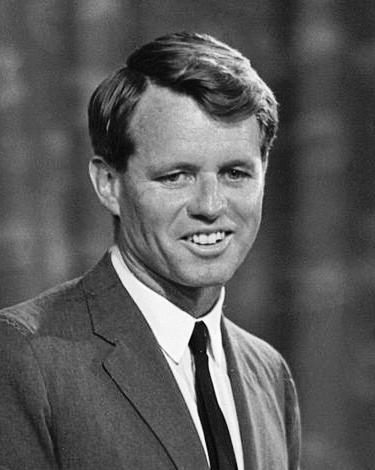
Robert F Kennedy crop.jpg


From the very outset, it has appeared that Bernie Sanders might win with the same sort of crossover appeal that Robert Kennedy seemed to have in 1968, before he was assassinated. Kennedy appealed to a broadening group of liberal and progressive voters (though some still resented his entering the race after Eugene McCarthy had demonstrated the vulnerability of Lyndon Johnson). Oddly, Kennedy also appealed to many disaffected George Wallace voters and might have built a coalition who saw him as a genuine speaker of the truth.

Bernie Sanders seems to be exercising much the same appeal, and might in the general election attract the support of some who are now considering Donald Trump or Ted Cruz.

That is not to say that if Hillary Clinton were the general election nominee she would lose, as did Hubert Humphrey in 1968 (to Richard Nixon). But similar forces are in some ways at work. On the other hand, a Sanders nomination might turn out something like that of George McGovern in 1972--resulting in a landslide for Richard Nixon.

"Robert F Kennedy crop" by derivative work:Robert F. Kennedy appearing before Platform Committee, August 19, 1964.jpg: Warren K. Leffler. This is a retouched picture, which means that it has been digitally altered from its original version. Modifications: Cropped and artifacts removed. Modifications made by Elcobbola. - Image: Robert F. Kennedy appearing before Platform Committee, August 19, 1964.jpg. Licensed under Public Domain via Commons - https://commons.wikimedia.org/wiki/File:Robert_F_Kennedy_crop.jpg#/media/File:Robert_F_Kennedy_crop.jpg

Thursday, January 14, 2016

Choice names Posters for Peace among Editors' Top Community College Resources

Choice has named Posters for Peace as among "Editors' Top 75 Community College Resources" for November 2015.

http://www.amazon.com/Posters-Peace-Visual-Rhetoric-Action/dp/0271065877/ref=sr_1_1?s=books&ie=UTF8&qid=1452790930&sr=1-1&keywords=benson+posters+for+peace
"Within the wider academic community, the number of two-year colleges is growing nationwide, and Choice is poised to help the libraries on these campuses, where much of the work revolves around three main challenges: how to help students learn; how to improve academic and program performance; and how to promote innovation."

Wednesday, January 6, 2016

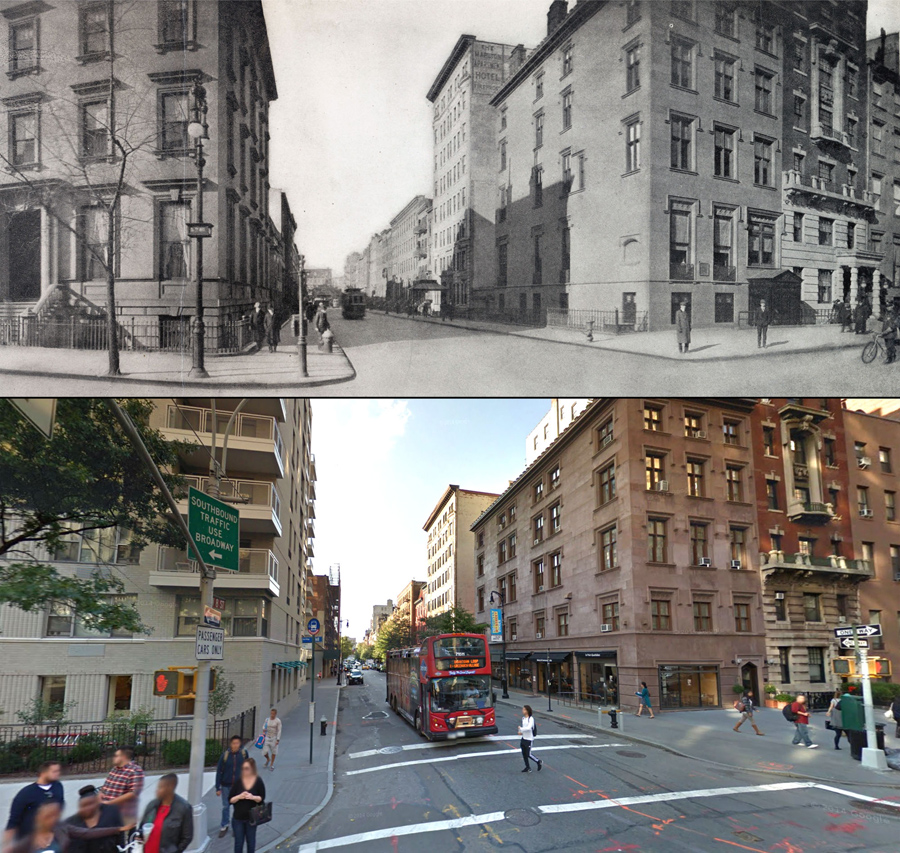
from Atlantic Photo: Fifth Avenue Then and Now

This is worth a look -- a fine set of images.

Alan Taylor, "Fifth Avenue Then and Now, a Century of Streetviews in NYC." Atlantic Photo. January 6, 2015.

"The New York Public Library has recently released even more digitized images from their vast collection, including more than 180,000 in the public domain. While browsing, one of the first collections I came across was a book published in 1911, titled Fifth Avenue, New York, From Start to Finish, with wide-angle streetview photographs made by photographer Burton Welles more than a century ago. I thought it would be fun to revisit those same locations using Google Maps Streetview images from today, to see what differences are visible. Some views look remarkably unchanged, while others are completely unrecognizable. The images are stacked on top of each other—unfortunately they never quite lined up enough to make use of my then-and-now fader widget. (Adding a note: I just discovered that the NYPL made their own wonderful then-and-now viewer for this same set of images.)"

When the Frost Is on the Pumpkin | The New York Public Library

Public Domain Collections: Free to Share & Reuse | The New York Public Library


The Miriam and Ira D. Wallach Division of Art, Prints and Photographs: Photography Collection, The New York Public Library. "When the Frost is on the Pumpkin, Berkshires, Mass." New York Public Library Digital Collections. Accessed January 6, 2016.
http://digitalcollections.nypl.org/items/510d47d9-a0e5-a3d9-e040-e00a18064a99