Tuesday, November 16, 2010

Media after Katrina


Diane Negra, ed., Old and New Media after Katrina (New York: Palgrave Macmillan, 2010).

from the publisher:

Five years after Hurricane Katrina, this thoughtful collection of essays reflects on the relationship between the disaster and a range of media forms. The assessments here reveal how mainstream and independent media have responded (sometimes innovatively, sometimes conservatively) to the political and social ruptures “Katrina” has come to represent. The contributors explore how Hurricane Katrina is positioned at the intersection of numerous early twenty-first century crisis narratives centralizing uncertainties about race, class, region, government and public safety. Looking closely at the organization of public memory of Katrina, this collection provides a timely and intellectually fruitful assessment of the complex ways in which media forms and national events are hopelessly entangled.

Digital Media in the Iran Presidential Uprising


Yahya R. Kamalipour, ed., Media, Power, and Politics in the Digital Age: The 2009 Presidential Election Uprising in Iran (Metuchen, NJ: Scarecrow, 2010).

Wednesday, November 10, 2010

Conflict of Interest in University Research

The American Association of University Professors journal Academe is out, with a new special issue on conflict of interest and corporate influence in university research. See, for instance:

Ben Santer answered his doorbell one evening to find a dead rat on his doorstep. He looked up and saw a man driving away, shouting obscenities out the car window. It would be one thing if this were an isolated incident. But Santer had been harassed before. A groundbreaking climate scientist at Lawrence Livermore National Laboratory, he was a lead author of the 1995 Intergovernmental Panel on Climate Change (IPCC) report, which for the first time attributed global warming to human activity. Santer’s research had earned him high esteem from scientists and contempt from those who did not accept his conclusions.

The funders of climate-change skepticism are engaged in a full-throttle effort to sow seeds of doubt among the public and policy makers, much as tobacco companies did decades ago. Without science on their side, these groups seek to manufacture controversy by attacking scientists conducting important research. . . .


Saturday, November 6, 2010

Economic Recovery Debate

The economic debate.

James K. Galbraith:
"The original sin of Obama's presidency was to assign economic policy to a closed circle of bank-friendly economists and Bush carryovers. Larry Summers. Timothy Geithner. Ben Bernanke. These men had no personal commitment to the goal of an early recovery, no stake in the Democratic Party, no interest in the larger success of Barack Obama. Their primary goal, instead, was and remains to protect their own past decisions and their own professional futures."

James K. Galbraith, "Obama's Problem Simply Defined: It Was the Banks," Huffington Post, 5 November 2010.

Paul Krugman:

"Mr. Obama’s problem wasn’t lack of focus; it was lack of audacity. At the start of his administration he settled for an economic plan that was far too weak. He compounded this original sin both by pretending that everything was on track and by adopting the rhetoric of his enemies."

Paul Krugman, "The Focus Hocus-Pocus," New York Times, 4 November 2010.

They could both be right. And if they are, and if the new majority in the House of Representatives manages to end spending that could stimulate the economy, while at the same time increasing the debt by extending tax cuts for the richest Americans, where does that leave us, economically and politically? If the economists are right that more, not less, stimulus was and is needed, why has it been so hard for the argument to win over the American electorate? Is it simply "if there's less for the other guy, there will be more for me" thinking?

A National Digital Library?

Robert Darnton, "Can We Create a National Digital Library?" New York Review of Books, 28 October 2010.

Can we create a National Digital Library? . . . We can equip the smallest junior college in Alabama and the remotest high school in North Dakota with the greatest library the world has ever known. We can open that library to the rest of the world, exercising a kind of “soft power” that will increase respect for the United States worldwide. By creating a National Digital Library, we can make our fellow citizens active members of an international Republic of Letters, and we can strengthen the bonds of citizenship at home. We can find the money and the skill, but can we find the will?


See also http://www.nybooks.com/articles/archives/2010/nov/25/toward-digital-public-library-america-exchange/

Wednesday, November 3, 2010

Whose GOP?


Daniel Williams, God's Own Party: The Making of the Christian Right (New York: Oxford University Press, 2010).


from the publisher:

When the Christian Right burst onto the scene in the late 1970s, many political observers were shocked. But, God's Own Party demonstrates, they shouldn't have been. The Christian Right goes back much farther than most journalists, political scientists, and historians realize. Relying on extensive archival and primary source research, Daniel K. Williams presents the first comprehensive history of the Christian Right, uncovering how evangelicals came to see the Republican Party as the vehicle through which they could reclaim America as a Christian nation.

The conventional wisdom has been that the Christian Right arose in response to Roe v. Wade and the liberal government policies of the 1970s. Williams shows that the movement's roots run much deeper, dating to the 1920s, when fundamentalists launched a campaign to restore the influence of conservative Protestantism on American society. He describes how evangelicals linked this program to a political agenda-resulting in initiatives against evolution and Catholic political power, as well as the national crusade against communism. Williams chronicles Billy Graham's alliance with the Eisenhower White House, Richard Nixon's manipulation of the evangelical vote, and the political activities of Jerry Falwell, Pat Robertson, and others, culminating in the presidency of George W. Bush. Though the Christian Right has frequently been declared dead, Williams shows, it has come back stronger every time. Today, no Republican presidential candidate can hope to win the party's nomination without its support.

A fascinating and much-needed account of a key force in American politics, God's Own Party is the only full-scale analysis of the electoral shifts, cultural changes, and political activists at the movement's core-showing how the Christian Right redefined politics as we know it.


The Public Work of Rhetoric


John M. Ackerman and David J. Coogan, eds., The Public Work of Rhetoric: Citizen-Scholars and Civic Engagement (Columbia, SC: University of South Carolina Press, 2010).

from the publisher:

The Public Work of Rhetoric presents the art of rhetorical techne as a contemporary praxis for civic engagement and social change, which is necessarily inclusive of people inside and outside the academy. In this provocative call to action, editors John M. Ackerman and David J. Coogan, along with seventeen other accomplished contributors, offer case studies and criticism on the rhetorical practices of citizen-scholars pursuing democratic ideals in diverse civic communities--with partnerships across a range of media, institutions, exigencies, and discourses.

Challenging conventional research methodologies and the traditional insularity of higher education, these essays argue that civic engagement as a rhetorical act requires critical attention to our notoriously veiled identity in public life, to our uneasy affiliation with democracy as a public virtue, and to the transcendent powers of discourse and ideology. This can be accomplished, the contributors argue, by building on the compatible traditions of materialist rhetoric and community literacy, two vestiges of rhetoric's dual citizenship in the fields of communication and English. This approach expresses a collective desire in rhetoric for more politically responsive scholarship, more visible impact in public life, and more access to the critical spaces between universities and their communities.

The compelling case studies in The Public Work of Rhetoric are located in inner-urban and postindustrial communities where poverty is the overriding concern, in afterschool and extracurricular alternatives that offer new routes to literate achievement, in new media and digital representations of ethnic cultures designed to promote chosen identities, in neighborhoods and scientific laboratories where race is the dominant value, and in the policy borderlands between universities and the communities they serve. Through these studies and accounts, the contributors champion the notion that the public work of rhetoric is the tough labor of gaining access and trust, learning the codes and histories of communities, locating the situations in which rhetorical expertise is most effective, and in many cases jointly defining the terms for gauging social change.

Rhetorics and Technologies


Stuart Selber, ed., Rhetorics and Technologies: New Directions in Writing and Communication (Columbia, SC: University of South Carolina Press, 2010).

from the publisher:

Recognizing an increasingly technological context for rhetorical activity, the thirteen contributors to this volume illuminate the challenges and opportunities inherent in successfully navigating intersections between rhetoric and technology in existing and emergent literacy practices. Edited by Stuart A. Selber, Rhetorics and Technologies positions technology as an inevitable aspect of the rhetorical situation and as a potent force in writing and communication activities.

Taking a broad approach, this volume is not limited to discussion of particular technological systems (such as new media or wikis) or rhetorical contexts (such as invention or ethics). The essays instead offer a comprehensive treatment of the rhetoric-technology nexus. The book's first section considers the ways in which the social and material realities of using technology to support writing and communication activities have altered the borders and boundaries of rhetorical studies. The second section explores the discourse practices employed by users, designers, and scholars of technology when communicating in technological contexts. In the final section, projects and endeavors that illuminate the ways in which discourse activities can evolve to reflect emerging sociopolitical realties, technologies, and educational issues are examined.

The resulting text bridges past and future by offering new understandings of traditional canons of rhetoric--invention, arrangement, style, memory, and delivery--as they present themselves in technological contexts without discarding the rich history of the field before the advent of these technological innovations. Rhetorics and Technologies includes a foreword by Carolyn R. Miller and essays by John M. Carroll, Marilyn M. Cooper, Paul Heilker, Johndan Johnson-Eilola, Debra Journet, M. Jimmie Killingsworth, Jason King, James E. Porter, Stuart A. Selber, Geoffrey Sirc, Susan Wells, and Anne Frances Wysocki.


.

Tuesday, November 2, 2010

Design for Hard Times

from the New York Times:

DURING the 2008 presidential campaign, Barack Obama’s choice of Gotham — an elegant 21st-century font — for his campaign signage was praised by graphic designers for its modernity and implicit message of change. Critics derided John McCain’s font, Optima, which was developed in the 1950s, and recalled the printing on a remedy for gastric distress. . . .


Kate Murphy, "The Candidate Is Not My Type," New York Times, 29 October 2010.

Monday, November 1, 2010

You Can Say That Again


Nori Neumark, Ross Gibson, and Theo Van Leeuwen, eds., Voice: Vocal Aesthetics in Digital Arts and Media (Cambridge: MIT Press, 2010).

from the publisher:

Voice has returned to both theoretical and artistic agendas. In the digital era, techniques and technologies of voice have provoked insistent questioning of the distinction between the human voice and the voice of the machine, between genuine and synthetic affect, between the uniqueness of an individual voice and the social and cultural forces that shape it. This volume offers interdisciplinary perspectives on these topics from history, philosophy, cultural theory, film, dance, poetry, media arts, and computer games. Many chapters demonstrate Lewis Mumford's idea of the "cultural preparation" that precedes technological innovation—that socially important new technologies are foreshadowed in philosophy, the arts, and everyday pastimes.

Chapters cover such technologies as voice mail, podcasting, and digital approximations of the human voice. A number of authors explore the performance, performativity, and authenticity (or 'authenticity effect') of voice in dance, poetry, film, and media arts; while others examine more immaterial concerns—the voice's often-invoked magical powers, the ghostliness of disembodied voices, and posthuman vocalization. The chapters evoke an often paradoxical reassertion of the human in the use of voice in mainstream media including recorded music, films, and computer games.

Saturday, October 30, 2010

Barack Obama and the Politics of Faith

Medhurst.jpeg

The Penn State Department of Communication Arts and Sciences colloquium and the Center for Democratic Deliberation lecture series on Religion, Politics, and Democratic Deliberation will host a lecture by Professor Martin J. Medhurst on Friday, October 29, 3:35 - 5:00 p.m., in 165 Willard Building on the University Park Campus. Professor Medhurst's lecture is titled "Barack Obama and the Politics of Faith."


Professor Medhurst is Distinguished Professor of Rhetoric and Communication and Professor of Political Science at Baylor University.

Friday, October 29, 2010

Inside the Senate’s battle over climate change: newyorker.com

Ryan Lizza, "As the World Burns," The New Yorker, 11 October 2010.

For three months, a period of record-high temperatures in Washington, what was now called the Kerry-Lieberman bill was debated and discussed as if it were a viable piece of legislation, but no Republican stepped forward to support it. During one speech in early June, Obama said that he knew “the votes may not be there right now, but I intend to find them in the coming months.” He never found them, and he didn’t appear to be looking very hard.


Read more http://www.newyorker.com/reporting/2010/10/11/101011fa_fact_lizza?currentPage=10#ixzz13lFs3H9C


Inside the Senate’s battle over climate change: newyorker.com

Sunday, October 24, 2010

Times on Health Care and the Campaign

New York Times editorial today:

Republicans and special interests are spreading so many distortions and lies about health care reform that it is little wonder if voters are anxious and confused. . . .


"Health Care and the Campaign," New York Times, 24 October 2010.

Sunday, October 17, 2010

Glenn Beck, the Tea Party, and the Republicans: newyorker.com

Beck’s version of American history relies on lessons from his own acknowledged inspiration, the late right-wing writer W. Cleon Skousen, and also restates charges made by the Birch Society’s founder, Robert Welch. The political universe is, of course, very different today from what it was during the Cold War. Yet the Birchers’ politics and their view of American history—which focussed more on totalitarian threats at home than on those posed by the Soviet Union and Communist China—has proved remarkably persistent. The pressing historical question is how extremist ideas held at bay for decades inside the Republican Party have exploded anew—and why, this time, Party leaders have done virtually nothing to challenge those ideas, and a great deal to abet them. . . .


Read more http://www.newyorker.com/reporting/2010/10/18/101018fa_fact_wilentz#ixzz12eSnkj00


Glenn Beck, the Tea Party, and the Republicans: newyorker.com

The Elections: How Bad for Democrats? by Michael Tomasky | The New York Review of Books

. . . In American politics, Republicans routinely speak in broad themes and tend to blur the details, while Democrats typically ignore broad themes and focus on details. Republicans, for example, speak constantly of “liberty” and “freedom” and couch practically all their initiatives—tax cuts, deregulation, and so forth—within these large categories. Democrats, on the other hand, talk more about specific programs and policies and steer clear of big themes. There is a reason for this: Republican themes, like “liberty,” are popular, while Republican policies often are not; and Democratic themes (“community,” “compassion,” “justice”) are less popular, while many specific Democratic programs—Social Security, Medicare, even (in many polls) putting a price on carbon emissions—have majority support. This is why, when all else fails, Democrats try to scare people about the threat to Social Security if the GOP takes over, as indeed they are doing right now. . . .


The Elections: How Bad for Democrats? by Michael Tomasky | The New York Review of Books

Sunday, October 10, 2010

My Friend the Twit

Frank Rich in the Times:

Nowhere, perhaps, is the gap between the romance and the reality of the Internet more evident than in our politics. . . .


Frank Rich, "Facebook Politicians Are Not Your Friends," New York Times, 10 October 2010.

Friday, October 8, 2010

Can a Foreign Country Buy a U.S. Congress?

Think Progress and other news sources are reporting that the U. S. Chamber of Congress, which is funding tens of millions of dollars worth of attack ads against Democrats in the congressional election in the United States, is, apparently, illegally soliciting and spending money from foreign corporations and governments to buy a Republican majority.

The largest attack campaign against Democrats this fall is being waged by the U.S. Chamber of Commerce, a trade association organized as a 501(c)(6) that can raise and spend unlimited funds without ever disclosing any of its donors. The Chamber has promised to spend an unprecedented $75 million to defeat candidates like Jack Conway, Sen. Barbara Boxer (D-CA), Jerry Brown, Rep. Joe Sestak (D-PA), and Rep. Tom Perriello (D-VA). As of Sept. 15th, the Chamber had aired more than 8,000 ads on behalf of GOP Senate candidates alone, according to a study from the Wesleyan Media Project. The Chamber’s spending has dwarfed every other issue group and most political party candidate committee spending. A ThinkProgress investigation has found that the Chamber funds its political attack campaign out of its general account, which solicits foreign funding. And while the Chamber will likely assert it has internal controls, foreign money is fungible, permitting the Chamber to run its unprecedented attack campaign. According to legal experts consulted by ThinkProgress, the Chamber is likely skirting longstanding campaign finance law that bans the involvement of foreign corporations in American elections. . . .


.

Tuesday, October 5, 2010

British Political Speech

Students of rhetoric will welcome the arrival of British Political Speech, an online resource for texts and related materials.

From the site's description of its mission:

This website is an outcome of the research project ‘How the Leader Speaks’ led by Dr. Alan Finlayson and Dr. Judi Atkins and funded by The Leverhulme Trust. The website is also supported by The Research Institute for Arts and Humanities, The Department of Political and Cultural Studies and The Centre for the Study of Culture and Politics, all at Swansea University.

The main aims of the project are:

  • to provide an accessible resource for all those interested in the history, theory and practice of political speech and rhetoric in the United Kingdom
  • to encourage, support and promote research into British political rhetoric, and to contribute to the better understanding, appreciation and practice of political argument
  • to undertake research into British political rhetoric and argumentation, and demonstrate the importance of such research for the wider study of British Politics.

Thanks to Alan Finlayson, Judi Atkins, and their supporters for this contribution to rhetorical culture.

Monday, October 4, 2010

Barack Obama's Speeches


Mary Frances Berry and Josh Gottheimer, Power in Words: The Stories Behind Barack Obama's Speeches, from the State House to the White House (Boston: Beacon Press, 2010).

From the publisher:
In Power in Words, distinguished historian and civil rights activist Mary Frances Berry and former presidential speechwriter Josh Gottheimer introduce Obama's most memorable speeches, from his October 2002 speech against the war in Iraq and his November 2008 election-night victory speech to "A More Perfect Union," his March 2008 response to the Reverend Wright controversy, and lesser-known but revealing speeches, such as one given in Nairobi, Kenya, in August 2006.

For each speech, Berry and Gottheimer add a rich introduction that includes political analysis, provides insight and historical context, and features commentary straight from the speechwriters themselves—including Jon Favreau, Obama's chief speechwriter, and several other Obama campaign writers. Compelling and enduring, Power in Words delivers the behind-the-scenes account of Obama's rhetorical legacy and is a collection to relish for years to come.

Thursday, September 30, 2010

Monday, September 27, 2010

Sunday, September 26, 2010

Saturday, September 25, 2010

Health Insurance Costs and the Campaign

From a New York Times editorial today:

With health insurers jacking up their premiums by double-digit amounts for people who buy their own policies, Republicans have been predictably eager to blame health care reform. Consumers, and voters, beware. . . .

For-Profit Schools Donate to Lawmakers Opposing New Financial Aid Rules -- from ProPublica

For-Profit Schools Donate to Lawmakers Opposing New Financial Aid Rules

by Sharona Coutts ProPublica, Sep. 17, 10:20 a.m.

Between 2005 and the beginning of this year, Rep. Donald M. Payne, D-N.J., received $6,000 in campaign contributions from sources related to for-profit colleges. This year, he received more than $20,000 from the schools and their lobby groups, according to campaign finance records. What changed?

For one, the colleges have upped their lobbying efforts considerably in the face of proposed regulations that the industry says could shutter many of its schools.

For another, Payne co-signed three letters to Education Secretary Arne Duncan, in which as many as 18 members of Congress pleaded with the secretary to put the brakes on that proposed regulation.

Collectively, members who signed the letters received nearly $94,000 from the for-profit college sector between the beginning of 2010 and late July, according to the most recent available campaign finance data reviewed by ProPublica. Most of the donations flowed after March 22 -- the date the first letter was written to Duncan.

(Take a look at the campaign contributions here.)

Other co-signers who received campaign cash from the industry include Reps. Alcee Hastings, D-Fla., and Debbie Wasserman Schultz, D-Fla.; and Jason Altmire, D-Pa. Payne and Altmire sit on the House committee that oversees education, as do several other members who signed the letters and received donations.

Payne did not reply to our requests for comment, but longtime campaign finance watchdog Fred Wertheimer, president of the group Democracy 21, which seeks to "eliminate the undue influence of big money in American politics," said the money given to Payne created a troubling impression.

"Whenever a member of Congress gets a large amount of contributions relatively close to the period where they take a specific action for an interest group, it raises appearance problems that undermine public confidence in the action that was taken, and also undermines the argument for the position on the merits," Wertheimer said.

A spokesman for Wasserman Schultz, who signed two of the letters and received nearly $7,400 from the for-profit industry this year, said the congresswoman signed the letters because the proposed Department of Education regulations are "overly broad and were written without Congressional hearings."

None of the other congressional offices we contacted responded to calls or e-mails.

The stakes are high for the for-profit schools because the proposed regulation tightens the conditions under which educational programs can participate in federal student aid programs. Many proprietary schools draw the majority of their revenue -- billions of dollars each year -- from those taxpayer-backed sources.

Called the "gainful employment" rule (PDF), the regulation would create a two-part test that Duncan has said is intended to stop some career schools from "saddling students with debt they cannot afford in exchange for degrees and certificates they cannot use."

The first part would measure how many former students are paying down the principal of their loans, while the second establishes ratios between the debt students take on to finance their education and their earnings after leaving the school, according to the Department of Education.

The test applies to individual programs of study rather than an entire school. Each program must satisfy at least one part of the test for its students to remain eligible for financial aid.

For example, if a school's nursing program failed to meet the lowest thresholds for principal repayment and debt ratios, future students could not pay for that program using federal financial aid. But if the same school's computer sciences program was in compliance, students in that field of study could continue accessing federal aid.

Schools could be required to warn students about high debt loads if a particular program falls into a danger zone, the Education Department says.

The regulation would apply to all schools -- including for-profit, public and private, nonprofit institutions. Based on current numbers, the department estimates that "5 percent of all programs would no longer be eligible to offer their students federal student aid and 55 percent of all programs would be required to warn their students about high debt-to-earnings ratios."

Mark Kantrowitz, a financial aid expert who publishes Fastweb.com and FinAid.org, predicted the rule will have a greater impact on for-profit schools than other institutions. "The difference is that every type of program at for-profits is impacted, whereas at traditional colleges, it's just the vocational programs," he said.

The department's move comes after government investigations found fraud (PDF) in the recruiting practices of several major for-profit colleges, and amid worsening data on loan default rates, especially for students at for-profit schools.

Harris Miller, president of the Career College Association, which represents for-profit colleges and trade schools, said the gainful employment rule poses a "fundamental threat to a lot of very high-quality programs that could be forced to close."

The industry's effort to build congressional pressure against the new rules has been carefully planned. ProPublica obtained a "whip list" that appears to divvy up responsibilities to lobby individual Democratic members among various schools and industry groups.

The whip list is in an Excel spreadsheet (.xls) written by Chris Collins, according to the document's "properties" data. The Career College Association lists a Chris Collins as its "Grass Roots Coordinator," but Miller said he would not comment on "specific internal documents."

The for-profit industry has not been shy about using its financial weight to lobby for what it wants. The founder of one for-profit chain, Arthur Keiser, has become a major national donor, according to campaign finance records. Keiser is also the current chairman of the Career College Association.

Campaign finance records show that Keiser, his wife, Belinda, and mother, Evelyn, contributed a collective $31,600 to members of Congress who signed the letters since the beginning of this year, when the fight over the regulations had begun to heat up.

Key figures in the industry have also paid numerous personal visits to the Education Department, according to public documents. They include visits by John McKernan, chairman of Education Management Corp., a company that owns several major for-profit schools. McKernan is the former governor of Maine and the husband of Republican Sen. Olympia Snowe.

Records also show visits to the department by officials from DeVry Inc. and Kaplan Inc., two of the biggest players in the industry, and their lobbyists.

Schools have also elicited tens of thousands of comments about the proposed regulation from their students, resulting in what the Department of Education said is by far the largest ever response to a public comment period.

In one instance, the president of the University of Phoenix, William Pepicello, sent out what appeared to be a blast e-mail to students that the Department of Education called misleading.

The e-mail claimed the gainful employment regulation would "block hundreds of thousands of Americans from getting the college education they need and deserve to get ahead in their jobs or find even better jobs."

An Education Department official told ProPublica that the e-mail inaccurately implied that the rule would prevent students from getting loans, when in fact it would affect only particular degree programs at specific schools.

"Students do not lose loan eligibility," said James Kvaal, deputy undersecretary of education. "They can and many will choose from the tens of thousands of programs that remain eligible," he said.

The University of Phoenix would not say to whom the e-mail was sent. The school's most recent financial filings say it has 476,500 students.

Education Department officials would not comment on the industry's lobbying campaign. The agency expects the rule to be finalized by November, and schools that fail the gainful employment test could be cut from the federal aid programs beginning in 2012.

Tuesday, September 21, 2010

Koching up a Tea Party

When public opinion is for sale:

"The anti-government fervor infusing the 2010 elections represents a political triumph for the Kochs. By giving money to “educate,” fund, and organize Tea Party protesters, they have helped turn their private agenda into a mass movement. Bruce Bartlett, a conservative economist and a historian, who once worked at the National Center for Policy Analysis, a Dallas-based think tank that the Kochs fund, said, “The problem with the whole libertarian movement is that it’s been all chiefs and no Indians. There haven’t been any actual people, like voters, who give a crap about it. So the problem for the Kochs has been trying to create a movement.” With the emergence of the Tea Party, he said, “everyone suddenly sees that for the first time there are Indians out there—people who can provide real ideological power.” The Kochs, he said, are “trying to shape and control and channel the populist uprising into their own policies. . . .”"


Read more http://www.newyorker.com/reporting/2010/08/30/100830fa_fact_mayer?currentPage=2#ixzz10ATIkmm1


Jane Meyer, "Covert Operations: The Billionaire Koch Brothers Who are Waging a War against Obama," The New Yorker, 30 August 2010.

Elections for Sale

"Crossroads Grassroots Policy Strategies would certainly seem to the casual observer to be a political organization: Karl Rove, a political adviser to President George W. Bush, helped raise money for it; the group is run by a cadre of experienced political hands; it has spent millions of dollars on television commercials attacking Democrats in key Senate races across the country. . . ."

Michael Luo and Stephanie Strom, "Donors Names Kept Secret As They Influence Midterms," New York Times, 21 September 2010.

Monday, September 20, 2010

Public Address Conference 2010

this note from Gordon Mitchell about the Public Address Conference later this month was published on h-rhetor today:

From: "Mitchell, Gordon Roger" gordonm@pitt.edu>
Date: Mon, 20 Sep 2010 11:29:23 -0400

Want to attend the 12th Biennial Public Address Conference upcoming September 30 - October 2, 2010, but can't make it to Pittsburgh? Let us bring some of the featured content to you live!

You are just a few clicks away from setting up your virtual ticket to what promises to be stellar criticism and commentary on the conference theme of "Human Rights Rhetoric: Controversies, Conundrums and Community Actions."

We have arranged for high-quality audio and video recordings of the following panels to be streamed live via the University of Pittsburgh's MediaSite platform, which also enables remote viewers to contribute written questions that we will be compiling and considering for inclusion during the audience Q&A session for each panel:

Friday, October 1, 2010, 12:40 - 1:45 p.m. EDT
http://xrl.us/amnestydebate
Public debate on the motion: "This House Believes Amnesty is a Necessary Tool to Address Gross Human Rights Violations in Deeply Divided Societies."
Marie-Odile Hobeika, University of Pittsburgh and Amber Kelsie, University of Pittsburgh; vs. touring British national debate champions Mary Nugent, University of Cambridge, and Lewis Iwu, BPP School of Law, London.

Friday, October 1, 2010, 4:00 - 6:00 p.m. EDT
http://xrl.us/boortonn
Mari Boor Tonn, University of Richmond, "'From the Eye to the Soul': Industrial Labor's Mary Harris 'Mother' Jones and the Rhetorics of Display."
Respondents will include Lawrence Prelli, University of New Hampshire and Cara Finnegan, University of Southern Illinois at Urbana Champaign.

Saturday, October 2, 2010, 4:00 - 6:00 p.m. EDT
http://xrl.us/hartnett
Stephen John Hartnett, University of Colorado at Denver, ³Speaking with the Damned: or, Prison Education, Social Justice, and Communication as a Human Right." Respondents will include Gerard Hauser, University of Colorado at Boulder and Marcus Rediker, University of Pittsburgh

Finally, Kirt Wilson, Pennsylvania State University, will deliver a keynote address during the conference's opening session: "More than Civil Rights: The Fight for Black Freedom as a Human Rights Struggle." Respondents will include Robert Terrill, Indiana University and Raymie McKerrow, Ohio University. We wish we could bring this panel to you live, but university firewall restrictions require us to tape the event and make it available for web streaming late on September 30 or early the next day on October 1: http://xrl.us/wilsonkeynote

Want more conference information? Visit our conference website at:
http://www.pitt.edu/~comm/

Technical questions? Contact the conference AV coordinator Gordon Mitchell
at gordonm at pitt dot edu.

* * *

Gordon R. Mitchell
Associate Professor of Communication
Director of Graduate Studies
Director, William Pitt Debating Union
University of Pittsburgh
CL 1117, 4200 Fifth Ave.
Pittsburgh, PA 15260
Phone: (412) 624-8531
Fax: (412) 624-1878
http://www.pitt.edu/~gordonm/

Tuesday, September 14, 2010

Shepherd with His Horse and Dog

Russell Lee, "Shepherd with his horse and dog on Gravelly Range, Madison County, Montana," August 1942." LC-USW36-847 B - Farm Security Administration - Office of War Information Collection -- Library of Congress Prints and Photographs Division Washington, D.C. 20540 USA http://hdl.loc.gov/loc.pnp/pp.print

Monday, September 13, 2010

Invasion of the Mind Snatchers


Eric Burns, Invasion of the Mind Snatchers: Television's Conquest of America in the Fifties (Philadelphia: Temple University Press, 2010).

from the press:

When the first television was demonstrated in 1927, a headline in The New York Times read, "Like a Photo Come to Life." It was a momentous occasion. But the power of television wasn't fully harnessed until the 1950s, when the medium was, as Eric Burns writes, "At its most preoccupying, its most life-altering."

In Invasion of the Mind Snatchers, Emmy-award winning broadcaster Eric Burns chronicles the influence of television on the baby boomer generation. Spellbound by Howdy Doody and The Ed Sullivan Show, those children often acted out their favorite programs, purchased the merchandise promoted by performers, and were fascinated by the personalities they saw on screen, often emulating their behavior. It was the first generation raised by TV, and Burns looks at both the promise of broadcasting as espoused by the inventors and how that promise was both redefined and lost by the corporations who helped spread this revolutionary technology.

Sunday, September 12, 2010

Hendrik Hertzberg on "The Mosque"

Hendrik Hertzberg, "Move the Mosque," The New Yorker online, 11 September 2010.

Feisal Abdul Rauf, back from his State Department-sponsored trip overseas in time for the 9/11 anniversary, said his piece this week on the Op-Ed page of the Times. If you haven’t yet read his Op-Ed, please hasten to do so. What he writes is so generous, so unself-pitying, so utterly reasonable, and, in Andrew Sullivan’s words, “so transparently constructive, so evidently in the interests not only of domestic peace but of strategic victory against Jihadist terror” that one is “at a loss to understand why so many have reacted so ferociously to this project.” (I’m pleased to note that the imam is again calling the project Cordoba House—a much better name than Park51, which sounds like a Korean teenager’s internet handle). . . .

Hendrik Hertzberg recommends moving the mosque -- to Ground Zero, where it would be a beacon of freedom and reconciliation. Hertzberg points out that there has been a mosque at the Pentagon, since October 2002.

Dog Bites Back

Frank Rich, writing in the New York Times, calls (as so many have since January 2009) for President Obama to fight back, harder and in public rhetoric, against the conservative opposition and big business. This longing for presidential rhetoric seems to be a recurrent feature of our national life.

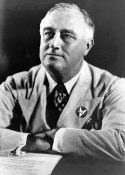
Rich even recommends FDR's 1936 Madison Square Garden speech excoriating his opposition -- a speech that my students always find a shocker. Here is a key passage from Franklin Roosevelt's speech, near the end of his first term:

For nearly four years you have had an Administration which instead of twirling its thumbs has rolled up its sleeves. We will keep our sleeves rolled up.

We had to struggle with the old enemies of peace—business and financial monopoly, speculation, reckless banking, class antagonism, sectionalism, war profiteering.

They had begun to consider the Government of the United States as a mere appendage to their own affairs. We know now that Government by organized money is just as dangerous as Government by organized mob.

Never before in all our history have these forces been so united against one candidate as they stand today. They are unanimous in their hate for me—and I welcome their hatred.

I should like to have it said of my first Administration that in it the forces of selfishness and of lust for power met their match. I should like to have it said of my second Administration that in it these forces met their master.


Frank Rich, "Time for This Big Dog to Bite Back," New York Times, 12 September 2010.

Does big business try to run (or to stop) the government? Where to start? Have a look at Eric Lipton, "A G.O.P. Leader Tightly Bound to Lobbyists," New York Times, 11 September 2010. "As Democrats try to cast John A. Boehner of Ohio, the House minority leader, as the face of the Republican Party, his ties to lobbyists are under attack. . . ."

Friday, September 10, 2010

How Not to Give a Six-Minute Speech

Dairy Cat, 1939


Arthur Rothstein, "Milker gives pet cat some milk direct from cow, Brandtjen Dairy Farm, Dakota County, Minnesota." Farm Security Administration - Office of War Information Photograph Collection (Library of Congress. September 1939.

Tuesday, September 7, 2010

Academic Tenure for Whom?

A new report from the American Association of University Professors:

The AAUP's latest report discusses a growing consensus: Institutions that employ teaching-intensive faculty should hire them and evaluate their teaching through the rigorous system of peer review known as the tenure system. As E. Gordon Gee, the United States's highest-paid university president puts it, campus employers must preserve "multiple ways to salvation" inside the tenure system—even at research-intensive institutions.

As the report notes, tenure was designed as a “big tent” to unite faculty of diverse interests and workplace priorities. It was not designed as a merit badge for research-intensive faculty or as a fence to exclude those with teaching-intensive commitments. . . .

The complete report, "Tenure and Teaching-Intensive Appointments" is at the AAUP site.

Monday, September 6, 2010

Free Labor Will Win

Labor Day poster. Labor Day poster distributed to war plants and labor organizations. The original is twenty-eight and one-half inches by forty inches and is printed in full color. It was designed by the Office of War Information (OWI) from a photograph especially arranged by Anton Bruehl, well-known photographer. From the FSA-OWI collection at the Library of Congress. (1942)

1938 again?

Paul Krugman, "1938 in 2010," New York Times, 6 September 2010.

Now, we weren’t supposed to find ourselves replaying the late 1930s. President Obama’s economists promised not to repeat the mistakes of 1937, when F.D.R. pulled back fiscal stimulus too soon. But by making his program too small and too short-lived, Mr. Obama did just that: the stimulus raised growth while it lasted, but it made only a small dent in unemployment — and now it’s fading out. . . .


Paul Krugman has been warning about this possibility for two years, and he says it is now showing signs of happening.

Saturday, September 4, 2010

Friday, September 3, 2010

Level the Playing Field?

Robert Reich in the New York Times today -- "How to End the Great Recession":

THE Great Depression and its aftermath demonstrate that there is only one way back to full recovery: through more widely shared prosperity. In the 1930s, the American economy was completely restructured. New Deal measures — Social Security, a 40-hour work week with time-and-a-half overtime, unemployment insurance, the right to form unions and bargain collectively, the minimum wage — leveled the playing field.

Reich argues that we cannot recover from the long structural recession until the middle class is able to buy the goods in produces.

Thursday, September 2, 2010

The Two-Body Problem

The AAUP has released a new report on recommended practices for academics seeking jobs for themselves and spouses/partners.

Do you have a “two-body” problem? Are you and your partner or spouse searching for academic positions in the same area, or even at the same institution? Or are you an administrator or department chair seeking guidance on sound policies and procedures for appointing an academic couple? Would you like to know what kinds of dual-career accommodation programs might be available to assist you, or what procedures an institution should follow to best accommodate your partner? If so, the AAUP’s newly released “Recommendations on Partner Accommodation and Dual Career Appointments” is a must read.

The new recommendations were formulated by the AAUP’s Committee on Women in the Academic Profession in view of the increasing likelihood that faculty, especially women faculty, will have domestic partners or spouses who are also academics. The recommendations provide critical guidance on developing sound, equitable policies. In addition, they provide a comprehensive review of the types of partner accommodation programs already available to dual-career academic couples at many colleges and universities.

The recommendations recognize the diversity of academic institutions and their needs, rather than endorse a particular partner accommodation program or policy as appropriate for all institutions. Research universities, for example, may have a particular interest in accommodating partners to remedy the consistent underrepresentation of women among their tenure-track and tenured faculty. Smaller institutions or those with collective bargaining agreements, because they may have more difficulty accommodating dual career couples, may be less inclined to do so. Whatever their needs, colleges and universities can benefit from well-developed policies that, according to the recommendations, “meet the strictest tests for transparency and good governance practices.”

Included among the recommendations:

  • Accommodation policies should be developed by appropriate faculty bodies.
  • The policies should take into account local conditions and institutional particularities, departmental hiring priorities, and programmatic and budgetary needs.
  • Any faculty appointments made as a result of their implementation should be driven by considerations of merit, and, whenever possible, appointments should be made to tenure-track positions.
  • Dual career appointments should not be the occasion for increasing the number of contingent faculty members at an institution.

Balancing the needs of departments and institutions with the needs of faculty members is of paramount importance to successful partner accommodation appointments.

We hope these recommendations will prove a useful tool to faculty and administrators seeking to harmonize sensitivity to the needs of academic couples with due attention to good governance and the protections of tenure long recommended by the AAUP.

Ann E. Green, Chair
Committee on Women in the Academic Profession

Ann Higginbotham, Chair

Tuesday, August 31, 2010

Public Forgetting


Bradford Vivian, Public Forgetting: The Rhetoric and Politics of Beginning Again (University Park: Penn State University Press, 2010).

from the press:

“In his sustained meditation on forgetting, Bradford Vivian makes a singular and extremely valuable contribution to the field of memory studies. He substantially advances the theoretical discussion of memory and forgetting with his extended critiques (rhetorical analyses, really) of both ancient and recent formulations of collective public memory and forgetting. The conclusion is almost poetic in its lightness of touch. It pulls all the strands of the book into a single compelling case for forgetting as part of memory.” —James E. Young, University of Massachusetts Amherst, author of The Texture of Memory and At Memory's Edge.

Forgetting is usually juxtaposed with memory as its opposite in a negative way: it is seen as the loss of the ability to remember, or, ironically, as the inevitable process of distortion or dissolution that accompanies attempts to commemorate the past. The civic emphasis on the crucial importance of preserving lessons from the past to prevent us from repeating mistakes that led to violence and injustice, invoked most poignantly in the call of “Never again” from Holocaust survivors, tends to promote a view of forgetting as verging on sin or irresponsibility. In this book, Bradford Vivian hopes to put a much more positive spin on forgetting by elucidating its constitutive role in the formation and transformation of public memory. Using examples ranging from classical rhetoric to contemporary crises like 9/11, Public Forgetting demonstrates, contrary to conventional wisdom, how communities may adopt idioms of forgetting in order to create new and beneficial standards of public judgment concerning the lessons and responsibilities of their shared past.

Facebook page for Public Forgetting


Saturday, August 21, 2010

Dick Cavett on the Mosque

Dick Cavett, "Real Americans Please Stand Up" New York Times, 22 August 2010.

I remain amazed and really, sincerely, want to understand this. What can it be that is faulty in so many people’s thought processes, their ethics, their education, their experience of life, their understanding of their country, their what-have-you that blinds them to the fact that you can’t simultaneously maintain that you have nothing against members of any religion but are willing to penalize members of this one? Can you help me with this?

see also, Frank Rich, "How Fox Betrayed Petraeus," New York Times, 22 August 2010.

picnic time

Jack Delano, "Having a picnic lunch at the "World's Fair" in Tunbridge, Vermont," September 1941. Farm Security Administration - Office of War Information Photograph Collection (Library of Congress) . LC-USF33- 021181-M3.

Friday, August 20, 2010

Dorothea Lange


Jan Goggans, California on the Breadlines: Dorothea Lange, Paul Taylor, and the Making of a New Deal Narrative (Berkeley: University of California Press, 2010).

from the press:

California on the Breadlines is the compelling account of how Dorothea Lange, the Great Depression’s most famous photographer, and Paul Taylor, her labor economist husband, forged a relationship that was private—they both divorced spouses to be together—collaborative, and richly productive. Lange and Taylor poured their considerable energies into the decade-long project of documenting the plight of California’s dispossessed, which in 1939 culminated in the publication of their landmark book, American Exodus: A Record of Human Erosion. Jan Goggans blends biography, literature, and history to retrace the paths that brought Lange and Taylor together. She shows how American Exodus set forth a new way of understanding those in crisis during the economic disaster in California and ultimately informed the way we think about the Great Depression itself.

Linda Gordon, Dorothea Lange: A Life Beyond Limits (New York: W. W. Norton, 2009).

from the press:

Winner of the 2010 Bancroft Prize and the 2009 Los Angeles Times Book Prize in Biography: Dorothea Lange’s photographs define how we remember the Depression generation; now an evocative biography defines her creative struggles and enduring legacy.

We all know Dorothea Lange’s iconic photos—the “Migrant Mother” holding her child, the gaunt men forlornly waiting in breadlines—but few know the arc of her extraordinary life. In this sweeping account, renowned historian Linda Gordon charts Lange’s journey from polio-ridden child to wife and mother, to San Francisco portrait photographer, to chronicler of the Great Depression and World War II. Gordon uses Lange’s life to anchor a moving social history of twentieth-century America, re-creating the bohemian world of San Francisco, the Dust Bowl, and the Japanese American internment camps. She explores Lange’s growing radicalization as she embraced the democratic power of the camera, and she examines Lange’s entire body of work, reproducing more than one hundred images, many of them previously unseen and some of them formerly suppressed. Lange reminds us that beauty can be found in unlikely places, and that to respond to injustice, we must first simply learn how to see it.

.

Wednesday, August 18, 2010

Wired Says Web Is Dead. Already?

Wired magazine

Two decades after its birth, the World Wide Web is in decline, as simpler, sleeker services — think apps — are less about the searching and more about the getting. Chris Anderson explains how this new paradigm reflects the inevitable course of capitalism. And Michael Wolff explains why the new breed of media titan is forsaking the Web for more promising (and profitable) pastures.


From the September issue, 17 August 2010. The rest of the issue is here.

Tuesday, August 17, 2010

Eavesdropping


John L. Locke, Eavesdropping: An Intimate History (New York: Oxford University Press, 2010).


from the publisher:

Who among us hasn't eavesdropped on a stranger's conversation in a theater or restaurant? Indeed, scientists have found that even animals eavesdrop on the calls and cries of others. In Eavesdropping , John L. Locke provides the first serious look at this virtually universal phenomenon. Locke's entertaining and disturbing account explores everything from sixteenth-century voyeurism to Hitchcock's "Rear Window"; from chimpanzee behavior to Parisian cafe society; from private eyes to Facebook and Twitter. He uncovers the biological drive behind the behavior and highlights its consequences across history and cultures. Eavesdropping can be a good thing--an attempt to understand what goes on in the lives of others so as to know better how to live one's own. Even birds who listen in on the calls of distant animals tend to survive longer. But Locke also concedes that eavesdropping has a bad name. It can encompass cheating to get unfair advantage, espionage to uncover secrets, and secretly monitoring emails to maintain power over employees. In the age of CCTV, phone tapping, and computer hacking, this is eye-opening reading.

Thursday, August 12, 2010

Friendship Fictions


Michael A. Kaplan, Friendship Fictions: The Rhetoric of Citizenship in the Liberal Imaginary (Tuscaloosa: University of Alabama Press, 2010).

from the publisher:

A criticism often leveled at liberal democratic culture is its emphasis on the individual over community and private life over civic participation. However, liberal democratic culture has a more complicated relationship to notions of citizenship. As Michael Kaplan shows, citizenship comprises a major theme of popular entertainment, especially Hollywood film, and often takes the form of friendship narratives; and this is no accident. Examining the representations of citizenship-as-friendship in four Hollywood films (The Big Chill, Thelma & Louise, Lost in Translation, and Smoke), Kaplan argues that critics have misunderstood some of liberal democracy’s most significant features: its resilience, its capacity for self-revision, and the cultural resonance of its model of citizenship.

For Kaplan, friendship—with its dynamic pacts, fluid alliances, and contingent communities—is one arena in which preconceptions about individual participation in civic life are contested and complicated. Friendship serves as a metaphor for citizenship and mirrors the individual’s participation in civic life. Friendship Fictions unravels key implications of this metaphor and demonstrates how it can transform liberal culture into a more just and democratic way of life.

Byron and the Rhetoric of Italian Nationalism


Arnold A. Schmidt, Byron and the Rhetoric of Italian Nationalism (New York: Palgrave Macmillan, 2010).

from the publisher:

Making extensive use of untranslated texts, Byron and the Rhetoric of Italian Nationalism analyzes the incorporation of Byron’s life and works into Italian political discourse during the risorgimento, unification, and the two world wars. Italian authors appreciated his celebration of liberty and nationalism so much that between 1818 and 1948, they referred to Byron more than to any other non-Italian poet. Arnold Anthony Schmidt explores the intellectual milieu of Byron’s Italian years, his participation in Grand Tour and salon culture, his influence on Italian Classicists and Romantics, and his importance in constructing Italy’s national identity.

How to Make a Citizen


Anna McCarthy, The Citizen Machine: Governing by Television in 1950s America (New York: The New Press, 2010).

from the press:

The Citizen Machine is the untold political history of television’s formative era. Historian Anna McCarthy goes behind the scenes of early television programming, revealing that producers, sponsors, and scriptwriters had far more in mind than simply entertaining (and selling products). Long before the age of PBS, leaders from business, philanthropy, and social reform movements as well as public intellectuals were all obsessively concerned with TV’s potential to mold the right kind of citizen.

After World War II, inspired by the perceived threats of Soviet communism, class war, and racial violence, members of what was then known as “the Establishment” were drawn together by a shared conviction that television broadcasting could be a useful tool for governing. The men of Du Pont, the AFL-CIO, the Advertising Council, the Ford Foundation, the Fund for the Republic, and other organizations interested in shaping (according to American philosopher Mortimer Adler) “the ideas that should be in every citizen’s mind,” turned to TV as a tool for reaching those people they thought of as the masses.

Based on years of path-breaking archival work, The Citizen Machine sheds new light on the place of television in the postwar American political landscape. At a time when TV broadcasting is in a state of crisis, and when a new political movement for media reform has ascended the political stage, here is a vital new history of the ideas and assumptions that have profoundly shaped not only television, but our political culture itself.


Anna McCarthy is an associate professor in the department of Cinema Studies at New York University. She is the co-editor of the noted journal Social Text, as well as the author of Ambient Television.

Now we know better, of course. It's the Internet that's going to save democracy.

Monday, August 2, 2010

Rhetoric, Politics, and Trust in Breast Cancer Research

Lisa Keranen, Scientific Characters: Rhetoric, Politics, and Trust in Breast Cancer Research (Tuscaloosa: University of Alabama Press, 2010).

from the press:

Scientific Characters chronicles the contests over character, knowledge, trust, and truth in a politically charged scientific controversy that erupted after a 1994 Chicago Tribune headline: “Fraud in Breast Cancer Research: Doctor Lied on Data for Decade.” In the aftermath of this dramatic news, Dr. Bernard Fisher, the eminent oncologist and celebrated pioneer of breast cancer research, came under intense scrutiny following allegations that one of his investigators falsified data in landmark breast cancer research. Although he was eventually cleared of all wrongdoing, the controversy called into question the treatment decisions of tens of thousands of women, because Fisher’s research had demonstrated that lumpectomy and radiation were as effective as breast removal for early stage cancers—a finding that was hailed as revolutionary in women’s health care.

Moving back and forth between news coverage, medical journals, letters to the editor, and oncology pamphlets, Lisa Keränen draws insights from rhetoric, literary studies, sociology, and science studies to analyze the roles of character in shaping the outcomes of the “Datagate” controversy. Throughout the scandal, debates about the character of Fisher and other key players endured, showing how scientific knowledge is shaped by perceptions of the personal temperament, trustworthiness, integrity, and transparency of those who produce it. As administrators, politicians, scientists, patients, journalists, and citizens attempted to make sense of what had happened, and to assess the integrity of the research, they raised questions, assigned blame, attributed responsibility, and reshaped the norms of scientific practice. Scientific Characters thusaddresses what happens when scientists, patients, and advocates are called to defend themselves in public concerning complex technical matters with direct implications for human life. In assessing the rhetoric that animated Datagate, Scientific Characters sheds light on the challenges faced by scientists and citizens as science becomes more bureaucratized, dispersed, and accountable to varied publics.

Tuesday, July 27, 2010

BP and Academic Freedom

Cary Nelson, president of the American Association of University Professors, on "BP and Academic Freedom" Inside Higher Ed, 22 July 2010:

"On Friday, July 16, Ben Raines, a reporter for Mobile, Alabama’s Press-Register, published a story detailing extensive efforts by BP to employ scientists engaged in (or likely to engage in) research about the massive oil spill in the Gulf of Mexico. Inside Higher Ed has since conducted independent interviews for its own coverage. The contracts offered by the giant company, according to both sources, restrict the scientists from publishing research results, sharing them with other scientists, or even talking about them for as long as three years, a serious restraint in the midst of an ongoing crisis. . . ."

Friday, June 25, 2010

When a President Fires a General


"WASHINGTON (June 23) -- The deed is done. . . ."
Andrea Stone, "President Obama Gets High Marks for Handling McChrystal Mess," AOL News, 23 June 2010.

Senator, Here's My Book Order for Your Review

The AAUP has commented on a new law in Pennsylvania that would regulate faculty choice of course textbooks:

Academic Freedom in Pennsylvania

The Pennsylvania legislature has taken the first dangerous step in restricting academic freedom in textbook selection. The State Senate has unanimously passed a law (.pdf) requiring faculty members to choose "the least expensive, educationally sound textbooks." This vague and possibly unenforceable standard undermines the right of faculty members to select the best textbook, even if it is more expensive than the alternatives. "Educationally sound" also potentially sets a rather low standard for textbook selection. As a legal requirement, it will have a chilling effect on faculty members' ability to exercise their academic freedom in planning courses of the highest quality. Certainly the legislature has no business deciding what is "educationally sound" in a college classroom. Only faculty members have the capacity to choose the books that best meet their pedagogical aims. If there is a tradeoff to be made between quality and price, only faculty members have the professional competence to make that choice. We urge the legislature to eliminate that provision from the College Textbook Affordability, Accountability and Accessibility Act.

The Pennsylvania legislation is also worrying because it is part of a national trend to regulate textbook selection. Certainly rising textbook prices are a serious matter. Increased availability of electronic versions of textbooks that certainly should prove less expensive is likely an inevitable feature of a changing marketplace. But the main ways to reduce the expense of a college education are to increase state appropriations to public colleges and universities and to eliminate unnecessary administrative positions.

Cary Nelson
AAUP President


see also the story in the Chronicle of Higher Education.